

3.1.3: Disaccharides
- Page ID
- 178455

\( \newcommand{\vecs}[1]{\overset { \scriptstyle \rightharpoonup} {\mathbf{#1}} } \)
\( \newcommand{\vecd}[1]{\overset{-\!-\!\rightharpoonup}{\vphantom{a}\smash {#1}}} \)
\( \newcommand{\dsum}{\displaystyle\sum\limits} \)
\( \newcommand{\dint}{\displaystyle\int\limits} \)
\( \newcommand{\dlim}{\displaystyle\lim\limits} \)
\( \newcommand{\id}{\mathrm{id}}\) \( \newcommand{\Span}{\mathrm{span}}\)
( \newcommand{\kernel}{\mathrm{null}\,}\) \( \newcommand{\range}{\mathrm{range}\,}\)
\( \newcommand{\RealPart}{\mathrm{Re}}\) \( \newcommand{\ImaginaryPart}{\mathrm{Im}}\)
\( \newcommand{\Argument}{\mathrm{Arg}}\) \( \newcommand{\norm}[1]{\| #1 \|}\)
\( \newcommand{\inner}[2]{\langle #1, #2 \rangle}\)
\( \newcommand{\Span}{\mathrm{span}}\)
\( \newcommand{\id}{\mathrm{id}}\)
\( \newcommand{\Span}{\mathrm{span}}\)
\( \newcommand{\kernel}{\mathrm{null}\,}\)
\( \newcommand{\range}{\mathrm{range}\,}\)
\( \newcommand{\RealPart}{\mathrm{Re}}\)
\( \newcommand{\ImaginaryPart}{\mathrm{Im}}\)
\( \newcommand{\Argument}{\mathrm{Arg}}\)
\( \newcommand{\norm}[1]{\| #1 \|}\)
\( \newcommand{\inner}[2]{\langle #1, #2 \rangle}\)
\( \newcommand{\Span}{\mathrm{span}}\) \( \newcommand{\AA}{\unicode[.8,0]{x212B}}\)
\( \newcommand{\vectorA}[1]{\vec{#1}} % arrow\)
\( \newcommand{\vectorAt}[1]{\vec{\text{#1}}} % arrow\)
\( \newcommand{\vectorB}[1]{\overset { \scriptstyle \rightharpoonup} {\mathbf{#1}} } \)
\( \newcommand{\vectorC}[1]{\textbf{#1}} \)
\( \newcommand{\vectorD}[1]{\overrightarrow{#1}} \)
\( \newcommand{\vectorDt}[1]{\overrightarrow{\text{#1}}} \)
\( \newcommand{\vectE}[1]{\overset{-\!-\!\rightharpoonup}{\vphantom{a}\smash{\mathbf {#1}}}} \)
\( \newcommand{\vecs}[1]{\overset { \scriptstyle \rightharpoonup} {\mathbf{#1}} } \)
\(\newcommand{\longvect}{\overrightarrow}\)
\( \newcommand{\vecd}[1]{\overset{-\!-\!\rightharpoonup}{\vphantom{a}\smash {#1}}} \)
\(\newcommand{\ket}[1]{\left| #1 \right>}\)
\(\newcommand{\bra}[1]{\left< #1 \right|}\)
\(\newcommand{\braket}[2]{\left< #1 \vphantom{#2} \right| \left. #2 \vphantom{#1} \right>}\)
\(\newcommand{\braopket}[3]{\left< #1 \vphantom{#2}\vphantom{#3} \right| #2 \vphantom{#1}\vphantom{#3} \left| #3 \vphantom{#1}\vphantom{#2} \right>}\)
\(\newcommand{\qmvec}[1]{\mathbf{\vec{#1}}}\)
\(\newcommand{\op}[1]{\hat{\mathbf{#1}}}\)
\(\newcommand{\expect}[1]{\langle #1 \rangle}\)
\(\newcommand{\dfn}[1]{\emph{\textbf{#1}}}\)
- Read linkage notation: Interpret α or β at the donor anomeric carbon and positions in 1→4, 1→6, and 1→2 linkages.
- Predict reducing behavior: Determine whether a disaccharide is reducing or nonreducing and explain Benedict and Fehling outcomes.
- Understand glycosidic bond chemistry: Describe formation of acetals from anomeric hemiacetals, acid sensitivity, and enzymatic hydrolysis by specific glycosidases; assumes prior knowledge of ring-closing hemiacetals from Monosaccharides.
- Recognize common examples: Assign compositions and linkages for maltose, lactose, cellobiose, sucrose, and trehalose.
These goals support structural analysis, naming, and property prediction for disaccharides.
Introduction
Scope: This page builds on the Monosaccharides page and focuses on how two monosaccharides join to form disaccharides. The emphasis is on linkage notation, anomeric configuration, and reducing versus nonreducing behavior.
What you should already know: Numbering of carbons in common monosaccharides, identification of anomeric carbons, and conversion among Fischer, Haworth, and chair forms.
Carbohydrate or glycan biochemistry is very complex and challenging owing to the stereochemical complexity of simple sugars, the large number of positions on the sugars used to form linkages between other sugars to create polymers, the large number of chemical modifications to base sugars, and the lack of a genetic template to instruct glycan polymer formation. No wonder our understanding of complex glycans has developed after that of the chemically simpler polymers like nucleic acids and proteins.
In addition, the terminology used to describe them varies as well. We use these general descriptions of them:
Sugar: usually refers to low molecular weight carbohydrates like glucose, lactose, and sucrose, but it can also refer broadly to any carbohydrate.
Carbohydrate: a general term that applies to simple sugars to complex sugar polymers like glycogen, starch, and cellulose. The name derives from the formula for simple sugars like glucose (C6H12O6), which can be written as C6(H2O)6 - a carbo (C) - hydrate (H2O).
Glycan: a general term for molecules containing simple sugars and sugar derivatives linked in a polymer, either standalone molecules or attached to other molecules like proteins.
Formation of Disaccharides
This section focuses on acetal formation that creates glycosidic bonds between two sugars. Ring-closing hemiacetal formation in single sugars is treated on the Monosaccharides page.
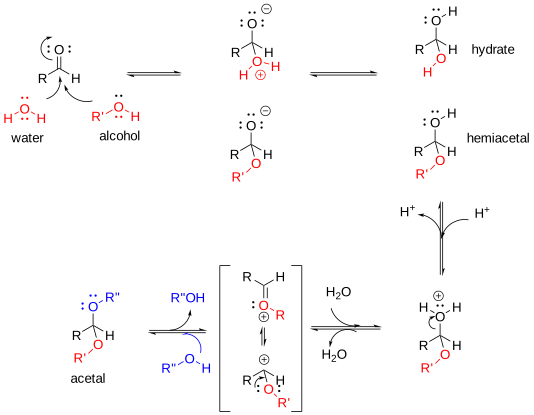
Assign α or β only to a residue whose anomeric carbon participates in the glycosidic bond. If one anomeric carbon participates, give a single α or β for that residue. If both anomeric carbons participate, give α/β for both residues.
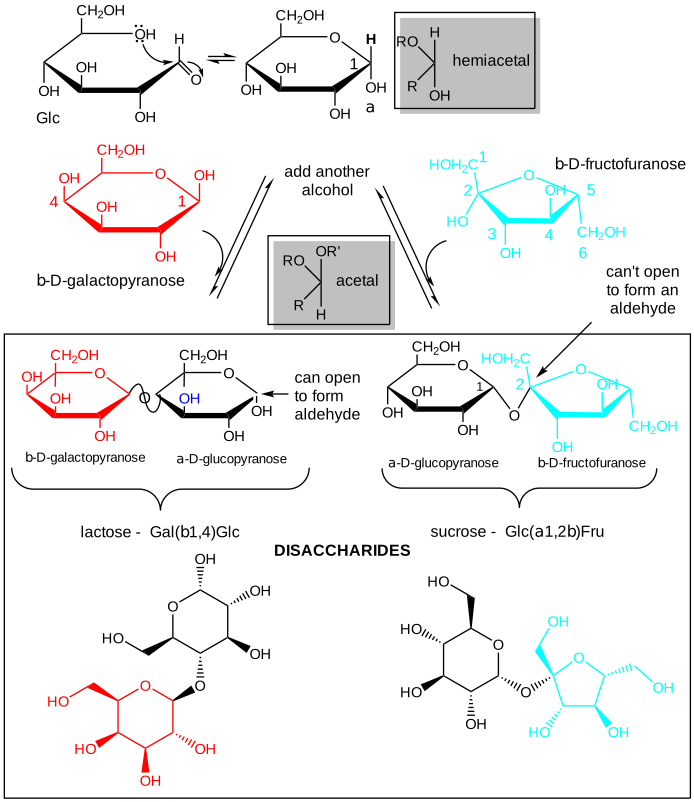
If the other alcohol is a second monosaccharide, a disaccharide results. The acetal link bonding the two monosaccharides is called a glycosidic bond. Because any hydroxyl can serve as the acceptor, linkages are diverse, including 1→2, 1→3, 1→4, and 1→6. Here are examples of disaccharides:
- maltose: Glc(α1→4)Glc, a disaccharide hydrolysis product of glycogen or starch
- cellobiose: Glc(β1→4)Glc, a disaccharide hydrolysis product of cellulose
- lactose: Gal(β1→4)Glc, also known as milk sugar
- sucrose: Glc(α1→2β)Fru. Because fructose participates through its anomeric carbon, sucrose does not equilibrate to an open-chain keto form and is nonreducing.
Figure \(\PageIndex{18}\) illustrates the differences between lactose and sucrose. Note that the β-D-fructofuranose ring is flipped (left to right as in turning one of your hands over) compared to Figure \(\PageIndex{16}\).
Acetal links between sugars in glycans can be hydrolyzed by water under acid catalysis, and by specific glycosidases.
The disaccharides above that retain a free anomeric carbon (for example maltose and lactose) are reducing sugars. In lactose, galactose is attached to glucose through the OH on C4, so the anomeric carbon of glucose (C1) can revert to the open-chain aldehyde. Benedict and Fehling reagents oxidize that aldehyde, reducing Cu2+ to Cu2O. Sugars that possess a potentially open-chain aldehyde or an α-hydroxy ketone that tautomerizes to an aldehyde under basic conditions (such as fructose) give positive tests.
Any mono-, di-, or polysaccharide with at least one hemiacetal remains reducing. If all anomeric carbons are locked as acetals, as in sucrose where both anomeric carbons form the 1→2 link, the sugar is nonreducing.
Alpha-gal syndrome (AGS) arises after tick exposure to the disaccharide galactose-α-1,3-galactose (alpha-gal), which elicits IgE antibodies. Subsequent exposures, including ingestion of red meat or cow’s milk, can trigger allergic reactions up to anaphylaxis.
The structure of Gal(α1,3)Gal is shown in Figure \(\PageIndex{19}\).
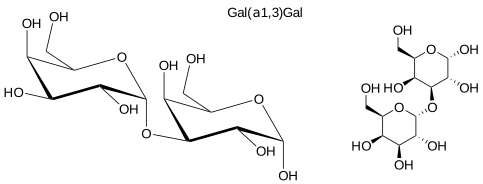
Figure \(\PageIndex{19}\): The disaccharide Gal(α1,3)Gal
Figure \(\PageIndex{20}\) shows an interactive iCn3D model of α-D-galactosyl-(1,3)-α-D-galactose (PubChem 9840966).

Figure \(\PageIndex{21}\) shows an interactive iCn3D model of the human anti-alpha-galactosyl antibody complex (7UEN). The Fab light chain is magenta and the heavy chain is blue. Side chains H27 and S91 contact the disaccharide.
.png)
Summary
Disaccharides form when the anomeric carbon of one sugar reacts to give an acetal (the glycosidic bond) with a hydroxyl on the same or a second sugar. Configuration at the anomeric carbon (α or β) and the carbons joined (for example 1→4, 1→2, 1→6) define structure and properties. If at least one anomeric carbon remains a hemiacetal, the disaccharide is reducing and can mutarotate. If both anomeric carbons are locked as acetals, the disaccharide is nonreducing.
Key topics:
-
Glycosidic bond chemistry: Formation of acetals from anomeric hemiacetals, acid-catalyzed hydrolysis, and specificity of glycosidases.
-
Nomenclature and notation: Reading α or β at the donor anomeric carbon and mapping positions in 1→4, 1→6, and 1→2 linkages.
-
Reducing vs nonreducing disaccharides: Structural criteria and outcomes with Benedict or Fehling reagents.
-
Representative structures: Maltose [Glc(α1→4)Glc], lactose [Gal(β1→4)Glc], cellobiose [Glc(β1→4)Glc], sucrose [Glc(α1→2β)Fru], and trehalose [Glc(α1→1α)Glc].
-
Biological relevance: Dietary sources, digestion and intolerance, and immune recognition exemplified by the α-Gal epitope.
Overall, this chapter lays a foundation for understanding the intricate world of carbohydrate biochemistry by examining the molecular structures, stereochemical variations, and modifications that contribute to the functional complexity of glycans in biological systems.