

3.3: Transcription of RNA
- Page ID
- 135663
\( \newcommand{\vecs}[1]{\overset { \scriptstyle \rightharpoonup} {\mathbf{#1}} } \)
\( \newcommand{\vecd}[1]{\overset{-\!-\!\rightharpoonup}{\vphantom{a}\smash {#1}}} \)
\( \newcommand{\dsum}{\displaystyle\sum\limits} \)
\( \newcommand{\dint}{\displaystyle\int\limits} \)
\( \newcommand{\dlim}{\displaystyle\lim\limits} \)
\( \newcommand{\id}{\mathrm{id}}\) \( \newcommand{\Span}{\mathrm{span}}\)
( \newcommand{\kernel}{\mathrm{null}\,}\) \( \newcommand{\range}{\mathrm{range}\,}\)
\( \newcommand{\RealPart}{\mathrm{Re}}\) \( \newcommand{\ImaginaryPart}{\mathrm{Im}}\)
\( \newcommand{\Argument}{\mathrm{Arg}}\) \( \newcommand{\norm}[1]{\| #1 \|}\)
\( \newcommand{\inner}[2]{\langle #1, #2 \rangle}\)
\( \newcommand{\Span}{\mathrm{span}}\)
\( \newcommand{\id}{\mathrm{id}}\)
\( \newcommand{\Span}{\mathrm{span}}\)
\( \newcommand{\kernel}{\mathrm{null}\,}\)
\( \newcommand{\range}{\mathrm{range}\,}\)
\( \newcommand{\RealPart}{\mathrm{Re}}\)
\( \newcommand{\ImaginaryPart}{\mathrm{Im}}\)
\( \newcommand{\Argument}{\mathrm{Arg}}\)
\( \newcommand{\norm}[1]{\| #1 \|}\)
\( \newcommand{\inner}[2]{\langle #1, #2 \rangle}\)
\( \newcommand{\Span}{\mathrm{span}}\) \( \newcommand{\AA}{\unicode[.8,0]{x212B}}\)
\( \newcommand{\vectorA}[1]{\vec{#1}} % arrow\)
\( \newcommand{\vectorAt}[1]{\vec{\text{#1}}} % arrow\)
\( \newcommand{\vectorB}[1]{\overset { \scriptstyle \rightharpoonup} {\mathbf{#1}} } \)
\( \newcommand{\vectorC}[1]{\textbf{#1}} \)
\( \newcommand{\vectorD}[1]{\overrightarrow{#1}} \)
\( \newcommand{\vectorDt}[1]{\overrightarrow{\text{#1}}} \)
\( \newcommand{\vectE}[1]{\overset{-\!-\!\rightharpoonup}{\vphantom{a}\smash{\mathbf {#1}}}} \)
\( \newcommand{\vecs}[1]{\overset { \scriptstyle \rightharpoonup} {\mathbf{#1}} } \)
\(\newcommand{\longvect}{\overrightarrow}\)
\( \newcommand{\vecd}[1]{\overset{-\!-\!\rightharpoonup}{\vphantom{a}\smash {#1}}} \)
\(\newcommand{\ket}[1]{\left| #1 \right>}\)
\(\newcommand{\bra}[1]{\left< #1 \right|}\)
\(\newcommand{\braket}[2]{\left< #1 \vphantom{#2} \right| \left. #2 \vphantom{#1} \right>}\)
\(\newcommand{\braopket}[3]{\left< #1 \vphantom{#2}\vphantom{#3} \right| #2 \vphantom{#1}\vphantom{#3} \left| #3 \vphantom{#1}\vphantom{#2} \right>}\)
\(\newcommand{\qmvec}[1]{\mathbf{\vec{#1}}}\)
\(\newcommand{\op}[1]{\hat{\mathbf{#1}}}\)
\(\newcommand{\expect}[1]{\langle #1 \rangle}\)
\(\newcommand{\dfn}[1]{\emph{\textbf{#1}}}\)
The process of transcribing DNA into RNA is a complex system involving numerous enzyme complexes all working together in a highly coordinated fashion. In the 1990s, a research group led by Roger Kornberg at Stanford University successfully developed an in vitro transcription system from baker’s yeast that faithfully replicated the in vivo process found in cells. The group then used this system to isolate several dozen proteins required for transcription, including the Mediator protein complex required for efficient transcription in eukaryotes. Thanks to this groundbreaking research, we now know that the protein components of transcription are remarkably conserved across the spectrum of eukaryotes, from yeast to human cells. Based on this work, Roger Kornberg won the Nobel Prize in Chemistry in 2006.
Read Roger Kornberg’s recollections of his research that culminated in this Nobel Prize.
Introduction
The goal of transcription is to make an RNA copy of a gene's DNA sequence. Transcription is the first step in gene expression, in which information from a gene is used to produce a functional product, such as RNA or a protein. This flow of genetic information is also known the central dogma of molecular biology (Figure \(\PageIndex{1}\)), which states that a gene becomes transcribed and then can be translated into a protein.
For a protein-coding gene, the RNA copy, made through transcription, carries the information needed to build the protein. Transcription is relatively straightforward. RNA nucleotides, complementary to the DNA template, are linked together to form an RNA copy known as an RNA transcript. The translation of this transcript into a polypeptide sequence is more complex and will require the reading of RNA nucleotides in a specific manner. This process will be covered in Chapter 3.4: Translation.

RNA is a nucleic acid that converts the genetic code found in DNA into the proteins that perform cellular functions.At the end of this section, you will be able to:
- List and explain types of RNA found in cells
- Describe the modifications needed to create mRNA, rRNA, and tRNA
- Explain the structure of a protein-coding gene and its regulatory sequences (i.e., the transcription unit)
- List the types of RNA polymerases involved in transcription
- List and explain the stages of transcription
- Explain the steps involved in mRNA processing
- Explain the spliceosome and its role in spicing
- Explain alternative splicing and its importance
Types of RNA
RNA, like DNA, is a nucleic acid made up of nucleotides. However, there some important differences between RNA and DNA. RNA nucleotides have a pentose sugar, named ribose, that has a hydroxyl group (OH), rather than a hydrogen, at the 2' carbon. The bases of RNA are adenine, guanine, cytosine, and uracil. Finally, RNA is a single polynucleotide chain. For more information about nucleic acids, refer to Chapter 2.7 Nucleic Acids.
There are several types of RNA found in cells. These RNA types can be broken down into two categories: coding and non-coding. There is only one type of RNA that is classified as coding. This RNA is known as messenger RNA or mRNA and it is produced following the transcription of protein-coding genes in the nucleus.
There are numerous types of non-coding RNA molecules, including:
- ribosomal RNA or rRNA
- transfer RNA of tRNA
- microRNA or miRNA
- small nuclear RNA or snRNA
Non-coding RNA molecules, like coding RNA, are transcribed. However, they are not translated into proteins. More about protein translation can be found in Chapter 3.4: Translation.
mRNA
Messenger RNA, or mRNA, is produced upon transcription of protein-coding genes. This transcription takes place in the nucleoplasm, the fluid of the nucleus. Following transcription, this RNA transcript, which is often called pre-mRNA, is exported out into the cytoplasm to be modified into mRNA.
Pre-mRNA processing into mRNA involves three events (Figure \(\PageIndex{2}\)):
- addition of a modified guanine nucleotide, known as the 5'-methylated cap, to the 5' end of the pre-mRNA
- addition of a long stretch of adenine nucleotides, known as the poly-A tail, to the 3' end of the pre-mRNA
- splicing to remove all introns from the pre-mRNA

rRNA
Ribosomal RNA, or rRNA, makes up the majority of RNA found in cells. rRNA is produced upon transcription of a class of genes called ribosomal genes. This transcription takes place in the nucleolus of the nucleus. Following transcription, the rRNA is folded into a series of stems and loops, resulting in a characteristic secondary structure (Figure \(\PageIndex{3}\)). This mature rRNA will become part of the ribosome, the "machine" for translation of proteins. rRNA molecules are named based on their size. rRNA size is quantified using a technique called sedimentation. In sedimentation, molecules are added to columns of sugar and then centrifuged. The rate of sedimentation through the column is denoted with a capital "S". Larger rRNA molecules will have a faster sedimentation rate and a larger "S" value in comparison to smaller rRNA molecules. The types of rRNA molecules made are dependent upon species. For example, humans have the following rRNA molecules: 5S, 5.8S, 18S, and 28S. In contrast, E.coli cells produce 5S, 16S, and 23S rRNA molecules. More about rRNA can be found in Chapter 3.4: Translation.

(B) The 4 types of rRNA molecules found in human cells are 18S and a complex made of 28S, 5.8S, and 5S. (adapted from Petrov et al, CC BY-SA 4.0)
tRNA
Transfer RNA, or tRNA, is transcribed in the nucleoplasm of the nucleus. tRNA is a short, single-stranded RNA molecule approximately 80 nucleotides in length that is then folded into a characteristic secondary structure of stems and loops not unlike rRNA. This secondary structure is then folded further to create a unique tertiary structure (Figure \(\PageIndex{4}\)). More about tRNA can be found in Chapter 3.4: Translation.

Genes are Transcribed
Not every stretch of DNA in our genome is transcribed into RNA. A significant portion of our genome is considered to be "junk" DNA, sequences to which a function has not yet been assigned. Those stretches of DNA that are transcribed are known as genes. A gene is defined as a sequence of DNA that is transcribed into functional RNA. Protein-coding genes are transcribed into coding RNA (i.e. mRNA). Non-protein coding genes are transcribed into a specific type of non-coding RNA.
The eukaryotic gene is part of a "transcription unit", which is comprised of the stretch of DNA that is transcribed, in addition to several regulatory sequences that will control transcription (Figure \(\PageIndex{5}\)).
For a protein-coding gene, the gene itself is made of three regions:
- the coding sequence (CDS), which is the majority of the transcribed DNA. The coding sequence is often called an Open Reading Frame (ORF). The CDS/ORF is made of exons, which are DNA sequences that will be translated into amino acids, and introns, which are intervening stretches of DNA that are not translated
- the 5' untranslated region (5'UTR), a regulatory DNA sequence before (upstream from) the coding sequence
- the 3' untranslated region (3'UTR), a regulatory DNA sequence after (downstream from) the coding sequence
Both prokaryotic and eukaryotic protein-coding genes will have UTRs flanking the coding sequence. However, these UTRs are significantly shorter in prokaryotes.
Associated with the gene are regulatory sequences known as the promotor and the enhancer. The promoter is a DNA sequence located immediately upstream of the gene that "promotes" transcription. The majority of prokaryotic and eukaryotic genes will have some type of promoter. In both prokaryotes and eukaryotes, the promoter region of most genes typically contains a sequence of DNA known as a core promoter. The DNA sequence of this core promoter is very similar in many prokaryotic and eukaryotic genes (i.e., is conserved). The most well-known eukaryotic core promoter has the sequence "TATAAA" and is known as the TATA box. In prokaryotic cells, this core promoter sequence is "TATAAT" and is called the Pribnow box, after its discoverer. In eukaryotes, additional sequences can be found next to the core promoter. These sequences are called proximal promoter elements (PPEs) and collectively they are known as the proximal promoter. The sequences making up the proximal promoter will vary from gene to gene. If present, they function as regulators of transcription.
In addition to a promoter region, eukaryotic genes are also associated with a stretch of DNA known as the enhancer. As its name implies, the enhancer "enhances" the efficiency of transcription. The enhancer is usually found at a significant distance upstream of the promoter and gene, although some enhancers can be found downstream of the gene. The enhancer is a sequence that is unique to eukaryotic cells and is not found in prokaryotes.

Transcription by the RNA polymerase
The enzyme complex responsible for transcription is the RNA polymerase. In prokaryotes, there is a single RNA polymerase that transcribes all genes. In eukaryotes, there are three RNA polymerases: RNA polymerase I, RNA polymerase II, and RNA polymerase III. Each of these are responsible for the transcription of specific RNA molecules in the eukaryotic cell. Table \(\PageIndex{1}\) summarizes these polymerases.
| RNA Polymerase | Transcription Location | RNAs transcribed |
|---|---|---|
| RNA polymerase I | nucleolus | 5.8S, 18S, and 28S rRNA |
| RNA polymerase II | nucleoplasm | mRNA |
| RNA polymerase III | nucleoplasm | 5S rRNA, tRNA |
Both prokaryotic and eukaryotic RNA polymerases are made of several subunits, with each subunit performing a specific task in transcription. For example, specific subunits in the polymerase act to recognize the promoter sequence, open the DNA helix (i.e., act like a helicase), or hold the two DNA strands apart (i.e. act like SSBs). Additional subunits bind to the DNA template and synthesize the RNA transcript by linking RNA nucleotides together.
Transcription: from DNA to RNA
In both prokaryotes and eukaryotes, transcription occurs in three stages: initiation, elongation, and termination.
Initiation
Transcription begins with the binding of a large complex of proteins, called the Transcription Initiation Complex, to the promoter of the transcription unit (Figure \(\PageIndex{6}\)). Contained with this complex is the RNA polymerase. The RNA polymerase recognizes the sequence of the core promoter and binds to the DNA at that region. This binding places the RNA polymerase in close proximity to the first nucleotide to be transcribed, otherwise known as the transcription start site (TSS). In eukaryotes, the TSS is found in the 5' UTR. Polymerase binding in eukaryotes is made more efficient by the proximal promoter elements found next to the core promoter. In eukaryotes, the binding of the RNA polymerase to the promoter region is further enhanced by the presence of DNA-binding proteins called transcription factors. Transcription factors called general transcription factors will help position the RNA polymerase at the core promoter, while more specialized transcription factors, called specific transcription factors, will bind to the proximal promoter and help regulate RNA polymerase activity. Additional transcription factors, known as activators, bind the gene's enhancer, significantly enhancing the initiation of transcription by the RNA polymerase. In order to do this, a "DNA bending protein" bends the DNA so that the enhancer sequence with its activators is brought into proximity of the promoter. Additional proteins, forming a mediator complex, facilitates the interaction between the activators at the enhancer and the transcription factors at the promoter so that the initiation of transcription occurs efficiently and rapidly. Together with the RNA polymerase, the transcription factors, activators, and the mediator complex make up a significant portion of the Transcription Initiation Complex. Once this complex is finished forming, the RNA polymerase acts to partially unwind the DNA helix at the TSS creating a "transcription bubble". Transcription then enters the elongation stage.

Elongation
Elongation in both prokaryotes and eukaryotes occurs when the RNA polymerase reads the DNA sequence and links the incoming RNA nucleotides together to produce the RNA transcript (Figure \(\PageIndex{7}\)). The RNA polymerase reads the DNA strand with the 3' to 5' orientation so that it can synthesize the RNA transcript in the 5' to 3' direction. This DNA strand is referred to as the template strand. The strand in the 5' to 3' direction is not read by the RNA polymerase and is called the non-template strand. During elongation, the RNA polymerase acts as a helicase to unwind the DNA helix, increasing the size of the transcription bubble. It holds the two DNA strands away from each other, acting as single-stranded binding proteins (SSBs). The RNA polymerase also does not require primers to bind to the DNA template strand. As such, a primase is not required for transcription. The RNA transcript that is made during elongation is complementary to the template strand, with the nucleotide uracil (U) used in place of thymine (T). This means if the template sequence is TAAGTG, the RNA transcript sequence would be UUCAC.

Termination
Once the gene is transcribed, the RNA polymerase needs to dissociate from the template strand and release the newly made RNA transcript. This is happens at a termination sequence located at the 3' end of the gene. The termination sequence can vary depending on the gene and on whether that gene is prokaryotic or eukaryotic. In eukaryotes, the termination sequence is found within the 3'UTR. The sequence is usually comprised of repeated nucleotide sequences that result in the RNA polymerase stalling, detaching from the template, and freeing the RNA transcript.
Animation: Transcription
mRNA Processing in Eukaryotes
Newly transcribed RNA molecules made from eukaryotic protein-coding genes undergo specific processing steps in order to turn them into mature mRNA molecules. As listed in the section on mRNA above, these modifications are: the addition of a "cap" to the 5' end of the RNA, the addition of a "poly-A tail" to the 3' end of the RNA, and the removal of introns within the coding sequence of the gene. These three modifications must be completed before the resulting mRNA can be transferred from the nucleus to the cytoplasm so that it can translated into a protein. These modifications also increase the stability of the mRNA once in the cytoplasm. As a result, eukaryotic mRNAs last for several hours, whereas the typical prokaryotic mRNA, which lack most of these modifications, lasts no more than five seconds before being degraded.
Addition of the "Cap"
As the RNA transcript is being transcribed, a modified guanine nucleotide called 7-methylguanosine, is added as a “cap” to the 5' end of the growing RNA transcript through an unusual 5'-to-5' triphosphate linkage. This nucleotide is referred to as the 5' methylated cap owing to the presence of a methyl group attached to the guanine base of the nucleotide (Figure \(\PageIndex{8}\)). The 5' methylated cap plays a role in the export of the mRNA from the nucleus and protects the 5' end of the mRNA from degradation by RNAses, RNA-degrading enzymes. As will be discussed in Chapter 3.4: Translation, the cap also helps to regulate the start of translation.

Addition of the "Tail"
Following the termination of transcription, a long chain of adenine nucleotides, called the poly-A tail, is added to the 3' end of the RNA transcript through a process called polyadenylation. A sequence in the 3'UTR region, known as the polyadenylation signal (AAUAAA) determines the location of this poly-A tail. During polyadenylation, the majority of the 3'UTR is cleaved off and a specialized RNA polymerase, called polyA polymerase, catalyzes the addition of about 250 adenine nucleotides. Like the cap, the poly-A tail plays a role in nuclear export, protects the RNA transcript from RNAse activity (at the 3' end) and plays a role in regulating translation. Interestingly, the addition of a poly-A tail to prokaryotic transcripts enhances mRNA degradation.
Splicing
The coding sequence of a eukaryotic protein-coding gene will contain regions that will be translated into the amino acids of a polypeptide chain. These regions are called exons because they are expressed. In addition, there are regions that will not be translated as amino acids. These intervening sequences are called introns. Introns must be removed or "spliced out" of the RNA transcript and the exons ligated or joined together during processing. The process of removing introns and reconnecting exons is called splicing. Splicing take place in the nucleus by a complex of RNA and proteins, called a spliceosome. The spliceosome is made up of five snRP subunits, with each snRP comprised of a stretch of snRNA (small, nuclear RNA) and supportive proteins (Figure \(\PageIndex{9}\)).
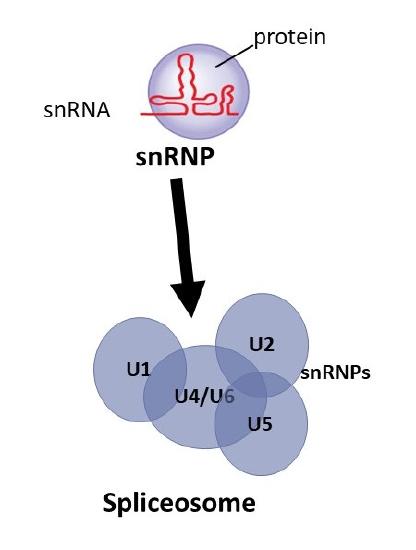
The individual snRPs (U1, U2, U4, U5, and U6) assemble in a specific order on the coding sequence of the RNA transcript. They assemble at sequences flanking the intron called splice sites. The sequence at the start of an intron is called the donor site and usually has the nucleotides "GU" somewhere within the sequence. The sequence at the end of the intron is called the acceptor site and contains the nucleotides "AG" within its sequence. These two sequences are recognized by specific parts of the spliceosome. Once the spliceosome forms, it cuts out the intron and ligates the flanking exons (Figure \(\PageIndex{10}\)). Following splicing, translation of the coding sequence produces the polypeptide that will become the functional protein.

The splicing activity of the spliceosome is actually performed by the snRNA of the spliceosome and not the proteins. An RNA with enzymatic activity is classified as a ribozyme. Therefore, the spliceosome is a ribozyme.
Animation: Splicing
While all introns must be spliced from eukaryotic mRNA, exons also can be spliced. The removal of exons by the spliceosome creates novel mRNA transcripts and new "versions" of polypeptides. In this way, multiple polypeptide isoforms can be made from one coding sequence, depending on the exons spliced out. The process of exon removal to create different polypeptide isoforms is known as alternative splicing (Figure \(\PageIndex{11}\)). Alternative splicing increases genetic diversity as more than one polypeptide can be made from a single mRNA.

Splicing must be carefully performed by the spliceosome. If the splicing process errs by even a single nucleotide, the nucleotide sequence of the rejoined exons would be shifted, and the resulting protein would be nonfunctional following translation.
Transcription is the first step in gene expression in which the DNA coding sequence is copied to make an RNA molecule. However, distinctions do exist. Protein-coding genes in both prokaryotes and eukaryotes are transcribed into mRNA molecules. These mRNA molecules will form the starting point for the last step in gene expression: translation. Transcription is performed by an RNA polymerase, which links nucleotides to form an RNA transcript.
The major concepts to remember are:
- Prokaryotes and eukaryotes share many similarities when undergoing transcription
- Only the DNA strand with the 3' to 5' orientation serves as a template for transcription
- Transcription has three stages: initiation, elongation, and termination
- Transcription of DNA into RNA is performed by an RNA polymerase
- Protein-coding genes are transcribed into mRNA molecules
- In eukaryotes, mRNA is made through the addition of a 5' cap, and a 3' poly-A tail to the RNA transcript. All introns are cut out of the mRNA coding sequence through splicing.
- In eukaryotes, most protein-coding genes require the formation of a transcription initiation complex to increase the efficiency of transcription
Glossary
5' methylated cap: a modified guanine (G) nucleotide found at the 5' end of the mRNA strand; prevents mRNA degredation
3' poly-A tail: a long chain of adenine (A) nucleotides attached to the 3' end of the mRNA strand
Activators: DNA binding proteins that bind to the enhancer regions of a DNA strand
Alternative splicing: the process that allows a single gene to code for multiple proteins by varying the combination of exons included in the final mRNA
Coding sequence: the section of the DNA/RNA sequence that is translated into a polypeptide strand; composed of exons and introns; has the same sequence as the transcribed RNA (with thymine replaced with uracil)
Enhancer: a sequence of DNA that binds activators and enhances the process of transcription
Exon: a section of the coding sequence that is translated into amino acids
Intron: a section of the coding sequence that is not translated
Mediator protein: a large complex of proteins that mediates the interaction between activator proteins and transcription factors during transcription initiation
Messenger RNA (mRNA): a sequence of RNA produced through the process of transcription; specifies the sequence of amino acids following translation; comprised of a coding sequence and flanked by a 5' methylated cap and a 3' poly-A tail
Pre-mRNA: unmodified RNA produced through transcription; must be modified through the addition of a 5' cap, a 3' poly-A tail, and splicing; also called an RNA transcript
Polyadenylation: the addition of a long chain of adenine nucleotides (called the poly-A tail) to the 3' end of mRNA; enhances stability of the mRNA and translation
Promoter sequence: a sequence of DNA where the RNA polymerase binds; determines the site of transcription initiation
Ribosomal RNA (rRNA): a type of RNA that is a structural component of ribosomes; aids in protein synthesis
RNA polymerase: an enzyme that reads the DNA template strand and synthesizes an complementary RNA strand using RNA nucleotides
RNA processing: the modifications made to pre-mRNA, including capping, splicing, and polyadenylation, to produce mature mRNA
RNA transcription: the process by which a DNA sequence is copied into a complementary RNA strand
Spliceosome: a large complex of snRPs that splices out introns (and exons) from the coding sequence of mRNA
Small nuclear RNA (snRNA): a small sequence of RNA found as part of a small nuclear ribonucleoprotein (snRNP)
Small nuclear ribonucleoprotein (snRNP): a combination of an snRNA molecule and a protein; also known as a ribonucleoprotein (RNP)
Splicing: the process of removing introns (and exons) from the pre-mRNA transcript; also called RNA splicing
TATA Box: a specific DNA sequence found in the promoter region that helps position RNA polymerase for transcription initiation
Template strand: the DNA strand copied into a complementary RNA strand through the process of transcription; has the 3' to 5' orientation; also called the anti-sense strand
Termination Sequence: a specific DNA sequence that signals the end of transcription
Transcription factors: DNA binding proteins that bind specific sequences of DNA and assist in the initiation and regulation of transcription
Transfer RNA (tRNA): an RNA molecule that helps decode mRNA sequences into proteins by carrying specific amino acids to the ribosome
Untranslated region (UTR): a stretch of RNA that is not translated; contains important regulatory sequences for transcription and translation; found in front of the coding sequence (5' UTR) and behind the coding sequence (3' UTR); found in both DNA and RNA