

12.1: Biochemical Reactions and Energy Changes
- Page ID
- 14998


\( \newcommand{\vecs}[1]{\overset { \scriptstyle \rightharpoonup} {\mathbf{#1}} } \)
\( \newcommand{\vecd}[1]{\overset{-\!-\!\rightharpoonup}{\vphantom{a}\smash {#1}}} \)
\( \newcommand{\dsum}{\displaystyle\sum\limits} \)
\( \newcommand{\dint}{\displaystyle\int\limits} \)
\( \newcommand{\dlim}{\displaystyle\lim\limits} \)
\( \newcommand{\id}{\mathrm{id}}\) \( \newcommand{\Span}{\mathrm{span}}\)
( \newcommand{\kernel}{\mathrm{null}\,}\) \( \newcommand{\range}{\mathrm{range}\,}\)
\( \newcommand{\RealPart}{\mathrm{Re}}\) \( \newcommand{\ImaginaryPart}{\mathrm{Im}}\)
\( \newcommand{\Argument}{\mathrm{Arg}}\) \( \newcommand{\norm}[1]{\| #1 \|}\)
\( \newcommand{\inner}[2]{\langle #1, #2 \rangle}\)
\( \newcommand{\Span}{\mathrm{span}}\)
\( \newcommand{\id}{\mathrm{id}}\)
\( \newcommand{\Span}{\mathrm{span}}\)
\( \newcommand{\kernel}{\mathrm{null}\,}\)
\( \newcommand{\range}{\mathrm{range}\,}\)
\( \newcommand{\RealPart}{\mathrm{Re}}\)
\( \newcommand{\ImaginaryPart}{\mathrm{Im}}\)
\( \newcommand{\Argument}{\mathrm{Arg}}\)
\( \newcommand{\norm}[1]{\| #1 \|}\)
\( \newcommand{\inner}[2]{\langle #1, #2 \rangle}\)
\( \newcommand{\Span}{\mathrm{span}}\) \( \newcommand{\AA}{\unicode[.8,0]{x212B}}\)
\( \newcommand{\vectorA}[1]{\vec{#1}} % arrow\)
\( \newcommand{\vectorAt}[1]{\vec{\text{#1}}} % arrow\)
\( \newcommand{\vectorB}[1]{\overset { \scriptstyle \rightharpoonup} {\mathbf{#1}} } \)
\( \newcommand{\vectorC}[1]{\textbf{#1}} \)
\( \newcommand{\vectorD}[1]{\overrightarrow{#1}} \)
\( \newcommand{\vectorDt}[1]{\overrightarrow{\text{#1}}} \)
\( \newcommand{\vectE}[1]{\overset{-\!-\!\rightharpoonup}{\vphantom{a}\smash{\mathbf {#1}}}} \)
\( \newcommand{\vecs}[1]{\overset { \scriptstyle \rightharpoonup} {\mathbf{#1}} } \)
\(\newcommand{\longvect}{\overrightarrow}\)
\( \newcommand{\vecd}[1]{\overset{-\!-\!\rightharpoonup}{\vphantom{a}\smash {#1}}} \)
\(\newcommand{\avec}{\mathbf a}\) \(\newcommand{\bvec}{\mathbf b}\) \(\newcommand{\cvec}{\mathbf c}\) \(\newcommand{\dvec}{\mathbf d}\) \(\newcommand{\dtil}{\widetilde{\mathbf d}}\) \(\newcommand{\evec}{\mathbf e}\) \(\newcommand{\fvec}{\mathbf f}\) \(\newcommand{\nvec}{\mathbf n}\) \(\newcommand{\pvec}{\mathbf p}\) \(\newcommand{\qvec}{\mathbf q}\) \(\newcommand{\svec}{\mathbf s}\) \(\newcommand{\tvec}{\mathbf t}\) \(\newcommand{\uvec}{\mathbf u}\) \(\newcommand{\vvec}{\mathbf v}\) \(\newcommand{\wvec}{\mathbf w}\) \(\newcommand{\xvec}{\mathbf x}\) \(\newcommand{\yvec}{\mathbf y}\) \(\newcommand{\zvec}{\mathbf z}\) \(\newcommand{\rvec}{\mathbf r}\) \(\newcommand{\mvec}{\mathbf m}\) \(\newcommand{\zerovec}{\mathbf 0}\) \(\newcommand{\onevec}{\mathbf 1}\) \(\newcommand{\real}{\mathbb R}\) \(\newcommand{\twovec}[2]{\left[\begin{array}{r}#1 \\ #2 \end{array}\right]}\) \(\newcommand{\ctwovec}[2]{\left[\begin{array}{c}#1 \\ #2 \end{array}\right]}\) \(\newcommand{\threevec}[3]{\left[\begin{array}{r}#1 \\ #2 \\ #3 \end{array}\right]}\) \(\newcommand{\cthreevec}[3]{\left[\begin{array}{c}#1 \\ #2 \\ #3 \end{array}\right]}\) \(\newcommand{\fourvec}[4]{\left[\begin{array}{r}#1 \\ #2 \\ #3 \\ #4 \end{array}\right]}\) \(\newcommand{\cfourvec}[4]{\left[\begin{array}{c}#1 \\ #2 \\ #3 \\ #4 \end{array}\right]}\) \(\newcommand{\fivevec}[5]{\left[\begin{array}{r}#1 \\ #2 \\ #3 \\ #4 \\ #5 \\ \end{array}\right]}\) \(\newcommand{\cfivevec}[5]{\left[\begin{array}{c}#1 \\ #2 \\ #3 \\ #4 \\ #5 \\ \end{array}\right]}\) \(\newcommand{\mattwo}[4]{\left[\begin{array}{rr}#1 \amp #2 \\ #3 \amp #4 \\ \end{array}\right]}\) \(\newcommand{\laspan}[1]{\text{Span}\{#1\}}\) \(\newcommand{\bcal}{\cal B}\) \(\newcommand{\ccal}{\cal C}\) \(\newcommand{\scal}{\cal S}\) \(\newcommand{\wcal}{\cal W}\) \(\newcommand{\ecal}{\cal E}\) \(\newcommand{\coords}[2]{\left\{#1\right\}_{#2}}\) \(\newcommand{\gray}[1]{\color{gray}{#1}}\) \(\newcommand{\lgray}[1]{\color{lightgray}{#1}}\) \(\newcommand{\rank}{\operatorname{rank}}\) \(\newcommand{\row}{\text{Row}}\) \(\newcommand{\col}{\text{Col}}\) \(\renewcommand{\row}{\text{Row}}\) \(\newcommand{\nul}{\text{Nul}}\) \(\newcommand{\var}{\text{Var}}\) \(\newcommand{\corr}{\text{corr}}\) \(\newcommand{\len}[1]{\left|#1\right|}\) \(\newcommand{\bbar}{\overline{\bvec}}\) \(\newcommand{\bhat}{\widehat{\bvec}}\) \(\newcommand{\bperp}{\bvec^\perp}\) \(\newcommand{\xhat}{\widehat{\xvec}}\) \(\newcommand{\vhat}{\widehat{\vvec}}\) \(\newcommand{\uhat}{\widehat{\uvec}}\) \(\newcommand{\what}{\widehat{\wvec}}\) \(\newcommand{\Sighat}{\widehat{\Sigma}}\) \(\newcommand{\lt}{<}\) \(\newcommand{\gt}{>}\) \(\newcommand{\amp}{&}\) \(\definecolor{fillinmathshade}{gray}{0.9}\)-
Explain Key Reaction Mechanisms:
- Describe the three primary ways to break a C–X bond (leading to carbocations, carbanions, or free radicals) and explain why these intermediates are high in energy.
-
Interpret Free Energy Diagrams:
- Compare free energy profiles for uncatalyzed versus enzyme-catalyzed reactions.
- Explain how enzymes lower the activation energy without changing the free energies of reactants or products.
-
Analyze Transition States and Intermediates:
- Discuss the relationship between the structure of transition states and the intermediates formed during bond breaking.
- Relate changes in Gibbs free energy (ΔG) to reaction kinetics and thermodynamics.
-
Assess Structural Influences on Reactivity:
- Evaluate how resonance and inductive effects stabilize reactants, intermediates, and products.
- Compare the thermodynamic driving forces for reactions based on the relative stability of similar molecules.
-
Determine Oxidation States and Oxidation Levels:
- Apply the rules for calculating oxidation numbers to assess the oxidation of carbon atoms in organic molecules.
- Use changes in oxidation state to identify and predict oxidation reactions in metabolic pathways.
-
Describe Nucleophilic Addition Reactions:
- Outline the mechanisms by which water, alcohols, and amines add to carbonyl groups, leading to diols, hemiacetals, acetals, and Schiff bases.
- Understand how acid and base catalysts influence these reactions.
-
Examine Reactivity of Carboxylic Acid Derivatives:
- Compare the relative reactivity of carboxylic acid derivatives (amides, esters, anhydrides, acid chlorides) based on resonance stabilization and leaving group stability.
- Predict how bond strengths and product stability affect nucleophilic substitution reactions.
-
Understand C–C Bond Formation Mechanisms:
- Describe how aldol and Claisen condensations use enolate intermediates to form new C–C bonds.
- Explain the roles of electrophiles (e.g., carbonyl carbons) and nucleophiles (e.g., carbanions) in these reactions.
-
Explore C–C Bond Cleavage Reactions:
- Detail the mechanisms of retroaldol reactions and decarboxylation (especially in beta-keto acids), emphasizing the importance of electron sinks.
-
Integrate Reaction Mechanisms with Metabolic Contexts:
- Connect these basic organic and thermodynamic principles to their roles in bioenergetics and metabolic pathways.
- Prepare to apply these concepts in the more comprehensive studies of reaction mechanisms in Unit 2: Bioenergetics and Metabolism.
These goals are designed to build a strong foundation in both the mechanistic details and the thermodynamic principles that underlie enzyme function and metabolic reactions.
Introduction
We have already discussed How Enzymes Work and Enzymatic Reaction Mechanisms in great detail in Chapter 6. Here, we will focus on a lighter, less granular review of some key reaction mechanisms and the changes in Gibbs' free energy associated with them, both in an uncatalyzed and enzyme-catalyzed reaction. Consider it a simple review of basic organic reactions and thermodynamics in preparation for the comprehensive focus on reaction mechanisms in Unit 2: Bioenergetics and Metabolism.
Breaking C-X bonds
Organic reactions involve making and breaking bonds to carbon. There are three ways to break a bond to a C-X bond, producing either a carbocation, carbanion, or free radical intermediate, all unstable and reactive, as illustrated in Figure \(\PageIndex{1}\). Both the carbocation and free radical are electron-deficient, and the carbanion, although not electron-deficient, has a negative charge on C, an atom with a relatively low electronegativity.
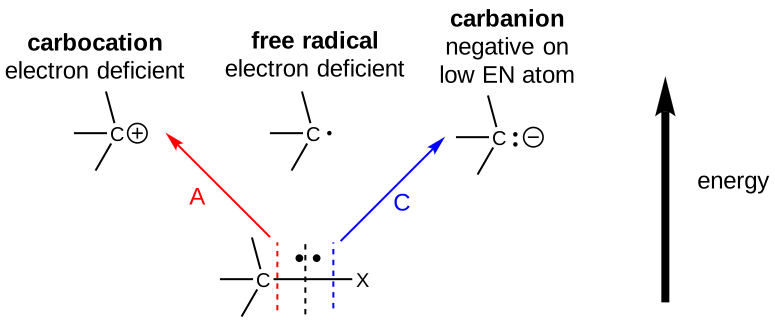
Figure \(\PageIndex{1}\): Ways to break a C-X bond
These unstable intermediates are higher in energy than the reactants. Hence, the transition state, which is even higher in energy than the intermediates, must have a structure that resembles the intermediates more than the reactants, as shown in Figure \(\PageIndex{2}\). The charged carbanion and carbocation intermediates have a developing charge in the transition state.
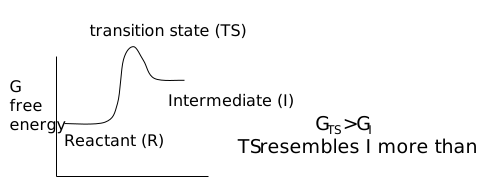
Figure \(\PageIndex{2}\): Gibbs' free energy of reactants, transition state, and intermediate in breaking a bond.
The thermodynamics of the reactions is determined by the change in free energy between the intermediates and the reactants. In contrast, the kinetics of the reaction is determined by the difference in free energy between the transition states and the reactants, as shown in Figure \(\PageIndex{3}\). A catalyst lowers the energy of the transition state without affecting the energies of the reactants or intermediates (assuming that these are free and not bound to the catalyst.
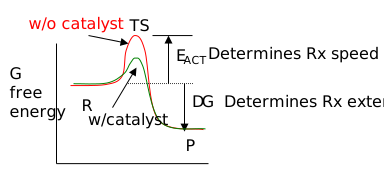
Figure \(\PageIndex{3}\): Activation energy and ΔG for a simple uncatalyzed and catalyzed reaction
The free energy diagram shown in Figure 3 is very simplistic. We need a diagram that better fits an enzyme-catalyzed reaction using the simple reaction equation below.
E + S ↔ ES → EP ↔ E + P
A free energy diagram for the binding of E and S followed by the conversion of bound S to bound and then the free product is shown in Figure \(\PageIndex{4}\).
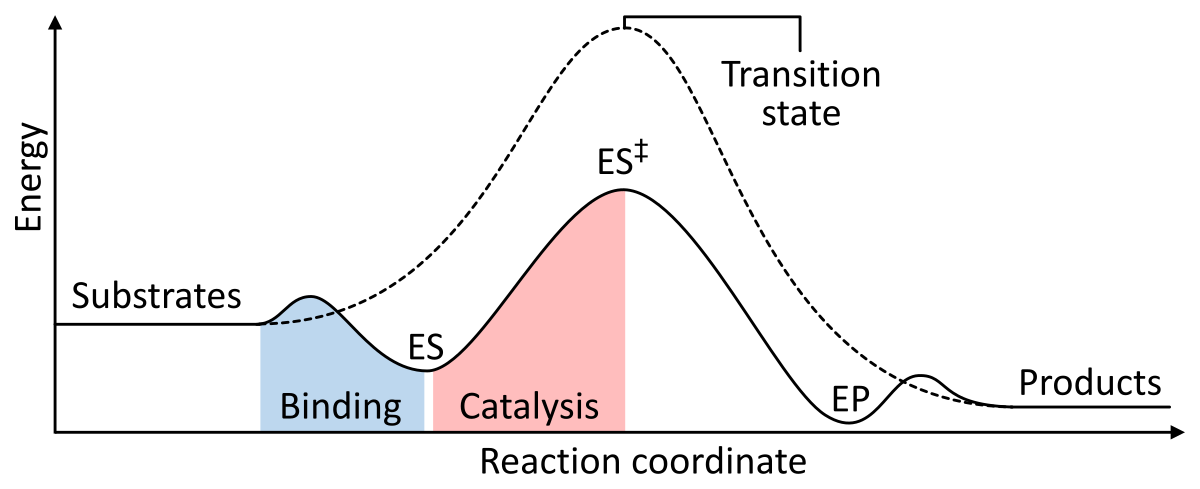
Figure \(\PageIndex{4}\): Simple free energy curve for the enzyme-catalyzed substrate conversion to product. https://commons.wikimedia.org/wiki/F...y_levels_2.svg
Even this diagram is overly simplified since it suggests that the bound substrate in the ES complex is converted to the bound product in one step with no intermediates.
The free energy diagram should include intermediates along the reaction pathway. An example of this is shown in Figure \(\PageIndex{5}\) for the reversible conversion of a 3-carbon sugar, dihydroxyacetone phosphate (DHAP), to another 3-carbon sugar, glyceraldehyde-3-phosphate, in a reaction catalyzed by the enzyme triose phosphate isomerase (we will study the enzyme in the next chapter).
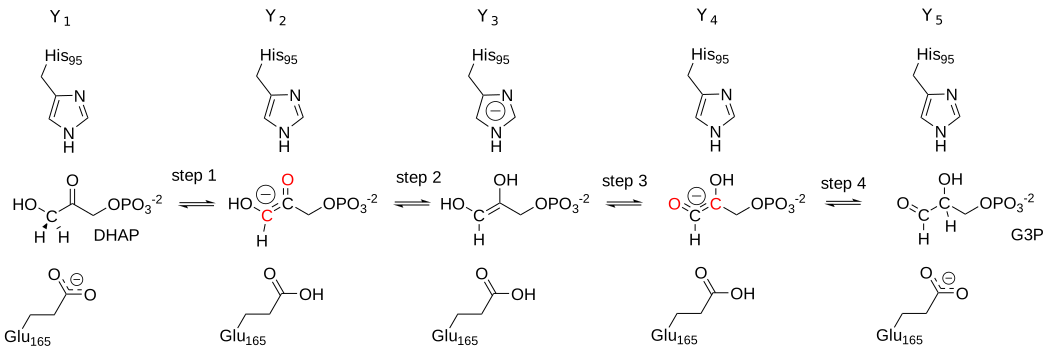
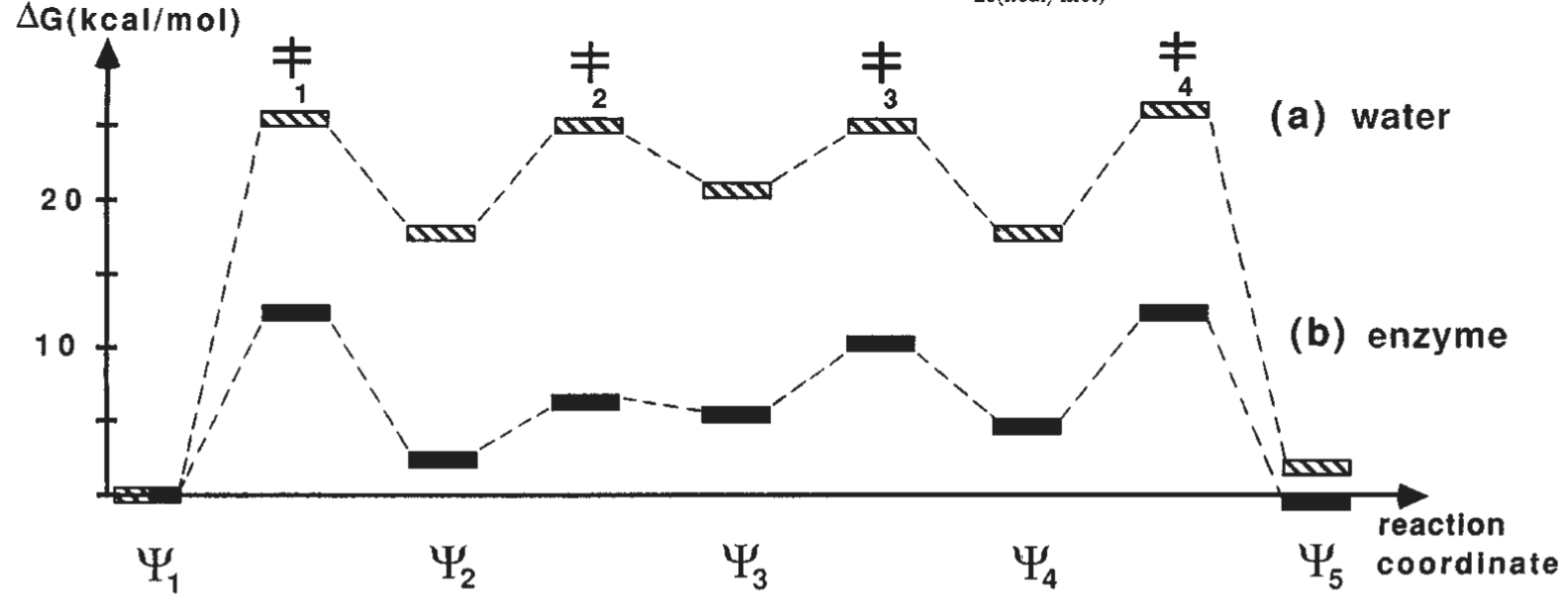
Figure \(\PageIndex{5}\): Complete free energy profile for all the elementary steps of the triosephosphate isomerase-catalyzed reaction. Aqvist J, Fothergill M. Computer simulation of the triosephosphate isomerase-catalyzed reaction. J Biol Chem. 1996 Apr 26;271(17):10010-6. doi: 10.1074/jbc.271.17.10010. PMID: 8626554. Creative Commons Attribution (CC BY 4.0)
Note that the enzyme lowers the activation energy of each step in the overall reaction. Enzymes can also catalyze reactions by altering the reaction pathway, although in this case, all the intermediates in the conversion are the same in both the uncatalyzed and catalyzed pathways.
A comparison of the thermodynamic reactivity of molecules of similar structures can be made by determining the relative stability of the reactants and products from structural considerations. Consider two reactants, R1 and R2, which produce products P1 and P2, respectively. Any structural features that preferentially stabilize R2 compared to R1 or P2 compared to P1 but don't stabilize R2 and P2 to the same extent will lead to a greater driving force for R2 → P2 compared to R1. This is shown graphically in Figure \(\PageIndex{6}\):
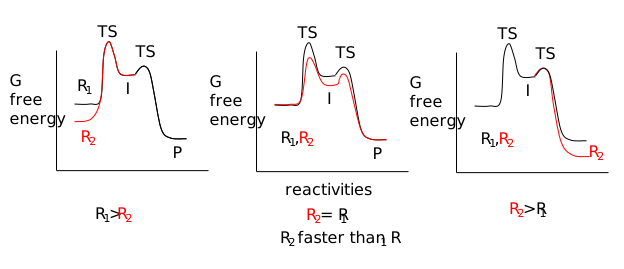
Figure \(\PageIndex{6}\): Free energy reaction diagrams for two similar molecules
Mechanisms that stabilize a reactant, intermediate, or product include resonance and inductive effects (electron release or withdrawal).
An example of how the comparative acidity of two similar molecules can be determined by comparing their structures is shown below for acetic acid and ethanol in Figure \(\PageIndex{7}\).
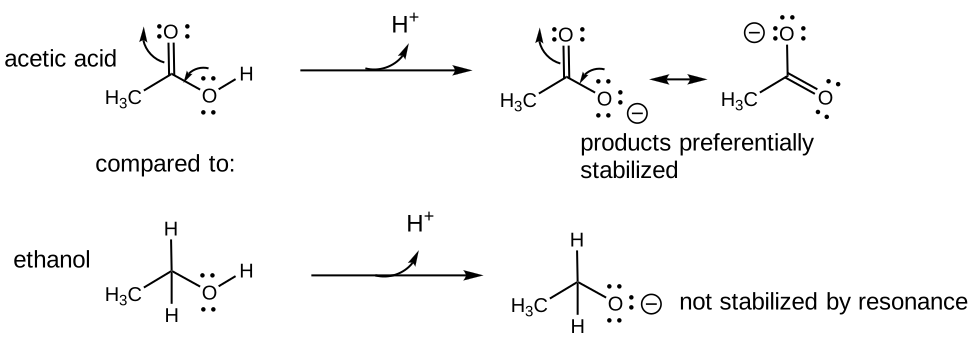
Figure \(\PageIndex{7}\): Comparative acidity of two similar molecules
The stronger acid, acetic acid, has the more stable (and hence less basic) charged product (the conjugate base)
An example of how an intermediate can be stabilized through resonance is shown in Figure \(\PageIndex{8}\) for the keto-enol tautomerization reaction, which is favored in the direction of the keto form, a weaker acid than the enol.
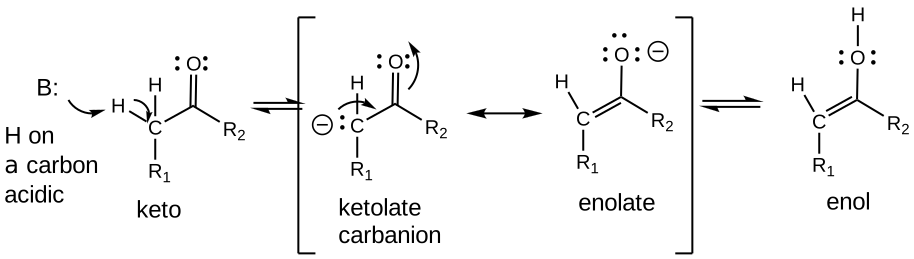
Figure \(\PageIndex{8}\): Comparative stability of keto and enol intermediates
An example of how the inductive effect (electron release and withdrawal) stabilizes/destabilizes carbocations and cations is shown in Figure \(\PageIndex{8}\).
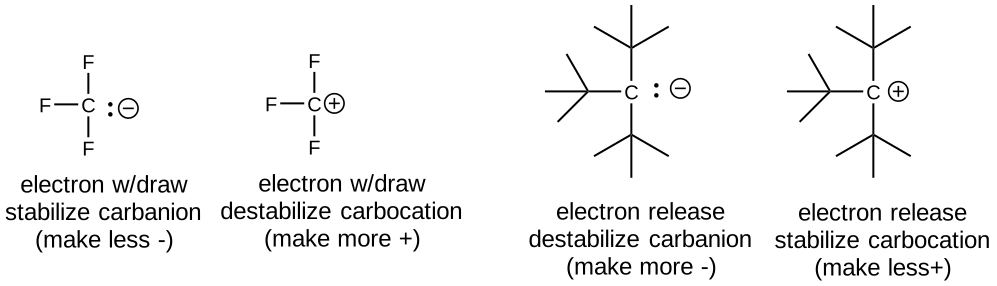
Figure \(\PageIndex{8}\): Factors contributing to stabilization of carbocations and carbanions
Also, remember that electron-withdrawing by the F's in the negatively charged conjugate base of trifluoracetic acid helps explain its lower pKa than acetic acid.
Lastly, consider how stabilizing a tertiary carbocation below helps explain the preferential formation of the tertiary alcohol over the secondary alcohol, as shown in Figure \(\PageIndex{9}\).
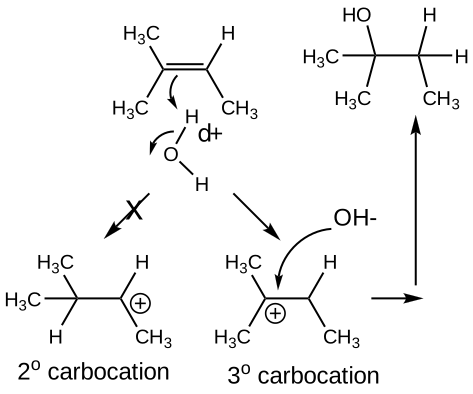
Figure \(\PageIndex{9}\): Preferential formation of tertiary alcohol
Oxidation of Organic Molecules
Organic molecules are usually oxidized in two-electron steps. Two methods can be used to determine if a C atom in an organic molecule has been oxidized.
- C is oxidized if the number of bonds from C to oxygen increases or the number of bonds to H decreases. More generally, if the number of bonds from C to a more electronegative atom increases or the number of bonds from C to a less electronegative atom decreases, the carbon is oxidized.
- A more robust method involves determining the oxidation number of the carbon atoms in the reactant and product. If the oxidation number becomes more positive, the C is oxidized.
The general rules for determining the oxidation numbers of the atoms in a molecule are:
- O is generally 2-
- H is usually 1+
- in molecules consisting of one type of atom (like O2) - i.e., a polyatomic element, the atoms have an oxidation number of 0.
- the sum of the oxidation numbers of the atoms in a molecule equals the net charge on the molecule or ion.
In general, the oxidation number can be calculated as follows:
- assign all nonbonded electrons of an atom to that atom
- assign all bonded electrons to the more electronegative atom of the two atoms bonded
- assign one electron of a bond to each atom if the two are identical.
- sum up the assigned electrons from 1-3. Subtract this number from the total number of electrons in the atom's outer shell (the group number). The result is the oxidation number.
An illustration of the sequential two-step oxidation of ethane to acetic acid and assigned oxidation numbers is shown in Figure \(\PageIndex{10}\). Focus on the C with red bonds. One electron is assigned to the C for the non-bolded red bond and 2 for the bolded red bond. Remember that C has a higher electronegativity than H, so we assign both electrons in a C-H bond to C to determine C's oxidation number. Each carbon in a C-C bond is assigned one electron from the bond since they have the same electronegativities.

Figure \(\PageIndex{10}\): Change in oxidation number on the stepwise conversion of ethane to acetic acid
Note that the red carbon connected to the NH2 in ethylamine has the same oxidation state as the red carbon in ethanol. Hence, converting ethane to ethylamine is an oxidation reaction and requires an oxidizing agent.
Reactions of Carbonyls: Aldehydes and Ketones
When water reacts with an aldehyde in a nucleophilic addition reaction, a 1,1-diol or a geminal diol results. This reaction can be catalyzed by a base, which acts as the nucleophile (it's a stronger nucleophile than water) and adds to the carbonyl C. OH- is regenerated when the alkoxide produced abstracts a proton from water, regenerating OH-.
When an alcohol adds to an aldehyde or ketone, a hemiacetal or hemiketal, respectively, is formed. In the presence of an acid catalyst, the acid protonates the carbonyl oxygen, making the carbonyl more electrophilic. After the alcohol adds and forms the hemiacetal or hemiketal, the acid can protonate the OH group, leading to its expulsion as water in an acid-catalyzed elimination. The carbocation or resonant-form oxonium ion can react with another ROH to form an acetal or ketal. These steps are summarized in Figure \(\PageIndex{11}\).
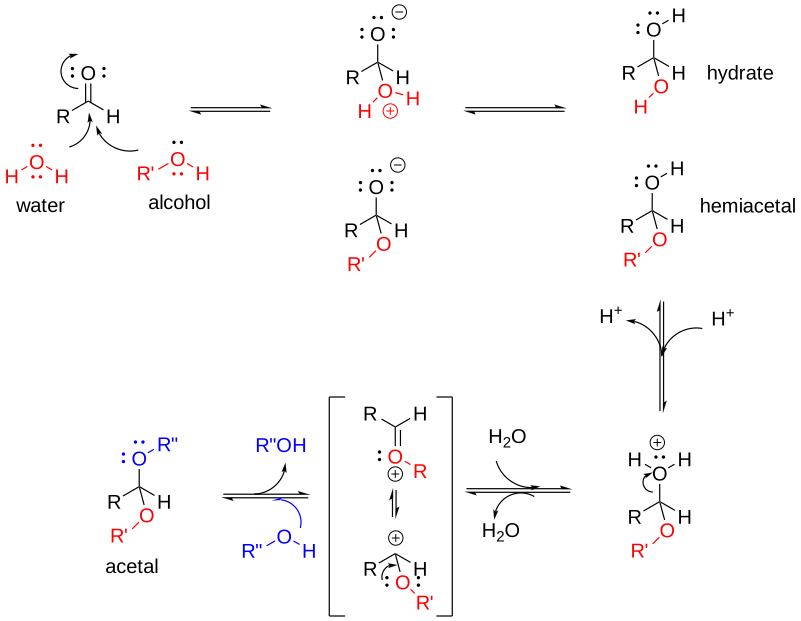
Figure \(\PageIndex{11}\): Nucleophilic addition to an aldehyde
If the nucleophile is an amine, an addition can occur, followed by an elimination to form an imine or Schiff base, as shown in Figure \(\PageIndex{12}\).
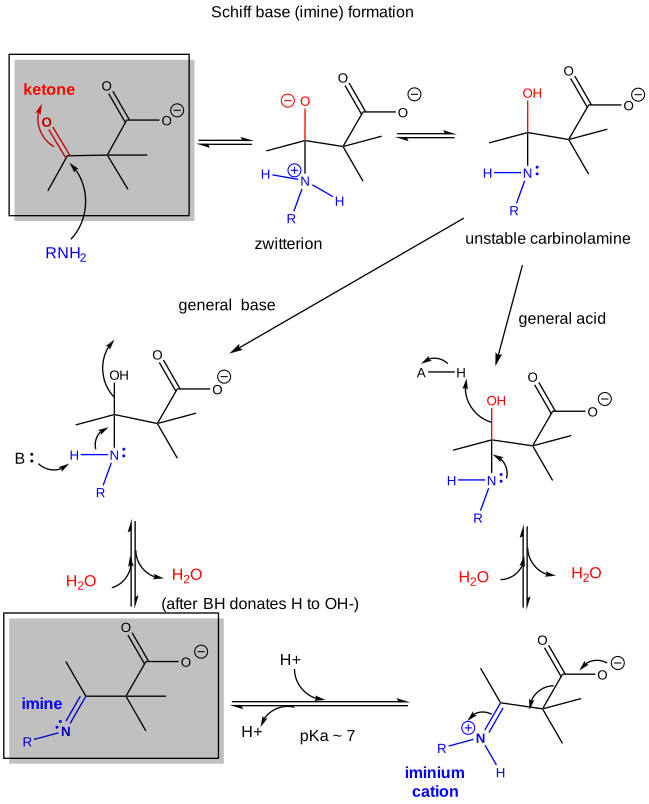
Figure \(\PageIndex{12}\): Schiff base formation
An acetal or ketal is a geminal ether (as water addition to aldehydes or ketones produces geminal diols). As with other ethers, these geminal ethers are stable to base and are often used as protecting groups to keep aldehydes and ketones from undesired reactions in basic solution. Acetal formation is favored by excess anhydrous alcohol in acetic conditions, while high water concentrations and an acid catalyst accelerate acetal breakdown.
Why are ethers and, hence, acetals/ketals resistant to bases? They resist nucleophilic attack, such as by base, since the expelled group (alkoxide) is unstable. (Epoxides, in contrast, will react with OH- nucleophiles since the epoxide ring is strained and of high energy.). Ethers can react with acids, which protonate the ether O to form an oxonium ion. Nucleophilic attack (such as by Br-) on an adjacent C can occur (SN2), with electrons flowing to the protonated oxonium ion (a great electron sink) as it departs.
Reactions of Carboxylic Acid Derivatives
Carboxylic acid derivatives undergo nucleophilic substitution reactions. They have good leaving groups compared to aldehydes and ketones (which undergo addition reactions). With the substitution reaction, the carbonyl's double bond stability is retained. Two things control the reactivity of these derivatives: the stability of the reactants compared to the products. Figure \(\PageIndex{13}\) shows the relative reactivity of carboxylic acid derivatives.
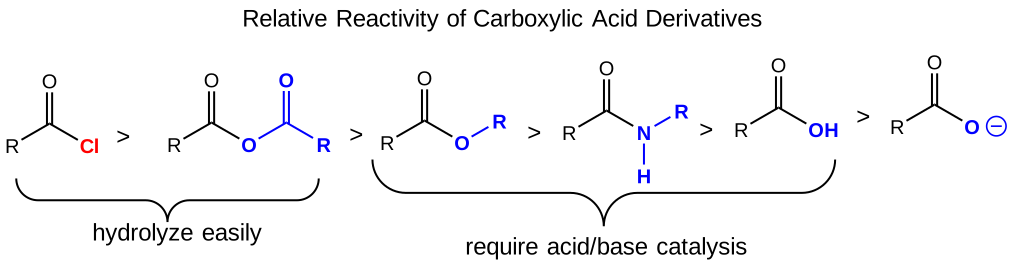
Figure \(\PageIndex{13}\): Relative reactivity of carboxylic acid derivatives
A reactant is less reactive if stabilized by resonance. Hence, the relative reactivity is amide < ester < anhydride < acid chloride.
The nonbonded electron pair on N of the amide, a less electronegative atom than O, can delocalize and form a resonant structure with a double bond between the N and carbonyl C more readily than the O in the ester. An electron pair on the bridging O in the anhydride could delocalize and split between the two carbonyls C (called competing resonances). This process is less stable than with the other carboxylic acid derivatives. The reactant least stabilized by resonance is the acid chloride, since a nonbonded pair of electrons on the larger chlorine molecule can't delocalize as readily, given the C-Cl bond distance.
Notice this order of decreased stability based on resonance stabilization is also the order of increased electrophilicity of the carbonyl C (which is most electrophilic in the absence of electron delocalization from the adjacent N, O, or Cl.
The stability of the products is also important. If the deprotonated leaving group is considered as one of the products (which differentiates the different reactions), then the order of decreased stability of products is Cl- > RCOO- > RO- > RHN-. This is shown in Figure \(\PageIndex{14}\). (Note: the pKa of ROH = 16 and R2NH = 40)
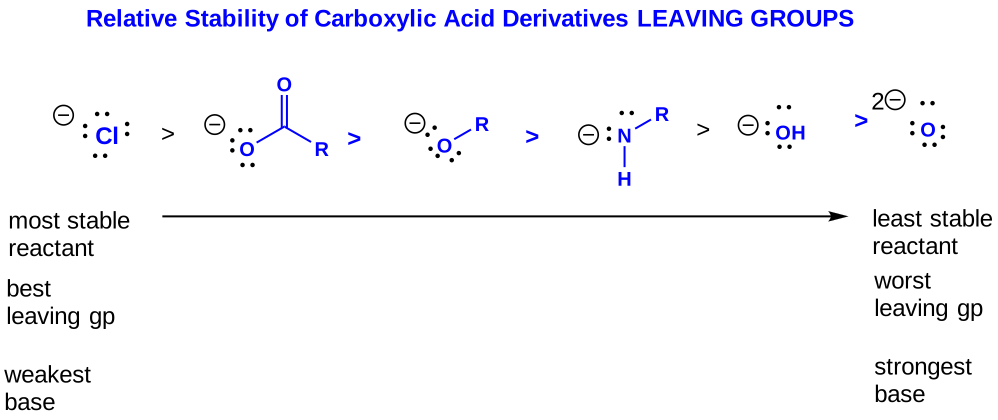
Figure \(\PageIndex{14}\): Relative stability of carboxylic acid derivative leaving groups
What determines the stability of products compared to reactants is the strength of bonds made and broken during the reaction.
In nucleophilic addition to aldehydes and ketones, the strength of the bond to the nucleophile must be greater than the strength of the pi bond broken in the carbonyl. A C-Cl bond strength is 81 kcal/mol (340 kJ/mol) compared to a pi C-O bond strength of 93 kcal/mol (389 kJ/mol). Hence, a Cl- is not likely to add to a carbonyl C. Consider the hydration of formaldehyde (carbonyl with 2 H's), acetaldehyde (with 1 H and 1 methyl group, and acetone (with 2 methyl groups). The ΔGo for hydration of these is -19, -1, and +15 kcal/mol (63 kJ/mol), respectively, showing that increased electron release toward the carbonyl C, which makes it less electrophilic and more stable, decreases the reactivity of the carbonyl.
In nucleophilic substitution, the leaving group (anion) must be more stable than the nucleophile.
Kinetics of Reactivity of Carbonyls
The relative kinetic reactivity of various carbonyls toward nucleophiles follows the order of electrophilicity of the C. (i.e, the extent of the positive charge on the carbonyl C.) The slow step in a nucleophilic attack is breaking the pi-carbonyl bond. If the reactant is stabilized by resonance in ways that reduce the electrophilicity of the carbonyl C, the reaction is slowed.
Nucleophilicity is a measure of the "affinity" of an atom or ion for an electrophilic C with a nucleophilic lone pair. This is similar to basicity, which is a measure of the "affinity" of an atom or ion for a proton. Halides are not good nucleophiles for reactions with acid derivatives since the halide (like Cl-) is a better leaving group than the actual leaving group.
Making C-C Bonds
Metabolism can be divided into catabolic (breaking down) and anabolic (synthetic) reactions. To obtain energy, sugars and fatty acids are converted to carbon dioxide. Hence, C-C bonds must be broken. In contrast, C-C bonds must be synthesized in photosynthesis. In all reactions, electrons from broken bonds flow to atoms where bonds will be made. Flow is from a source (a pair of electrons possibly with a negative charge) to a sink (a slightly or fully positive atom). Figure \(\PageIndex{15}\) shows a couple of ways to make a C-C bond using either the reaction of two carbon-centered radicals (free radical mechanisms are uncommon biologically) or a carbocation with a carbanion.
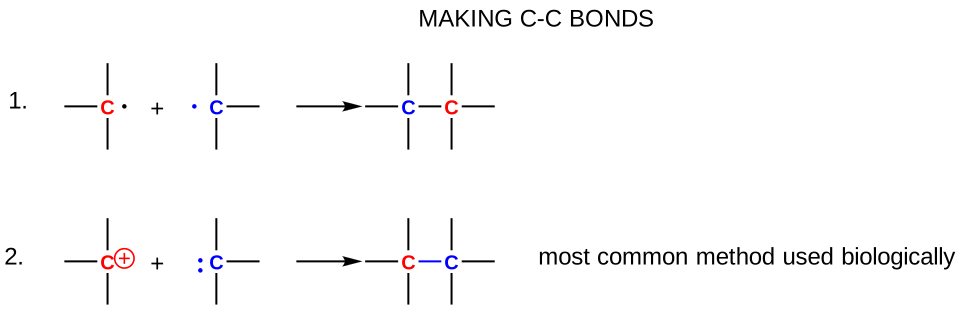
Figure \(\PageIndex{15}\): Making C-C bonds
A carbocation is unstable unless incorporated into a molecule in which it is stable, so instead of using them, the carbonyl C is used as the electrophilic carbon. (Instability of carbocations is reflected in their propensity to rearrange.) Taking into account the resonance form of the C=O carbonyl bond with a positive charge on C and a negative charge on O, the net charge on the carbonyl is about +0.5. A carbanion, often stabilized as an enolate resonant form, is used as the negatively charged carbon. These features are illustrated in Figure \(\PageIndex{16}\).
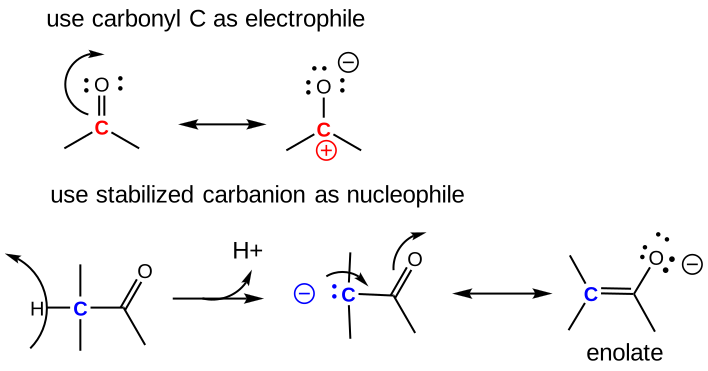
Figure \(\PageIndex{16}\): Carbonyl carbons as electrophiles and carbanions as nucleophiles
One method of making a C-C bond is an aldol condensation, in which a carbanion formed by the deprotonation of a C-H alpha to a carbonyl (which is stabilized by the enolate resonance form) acts as a nucleophile that adds to a carbonyl C in an aldehyde or ketone. The reaction is illustrated in Figure \(\PageIndex{17}\).
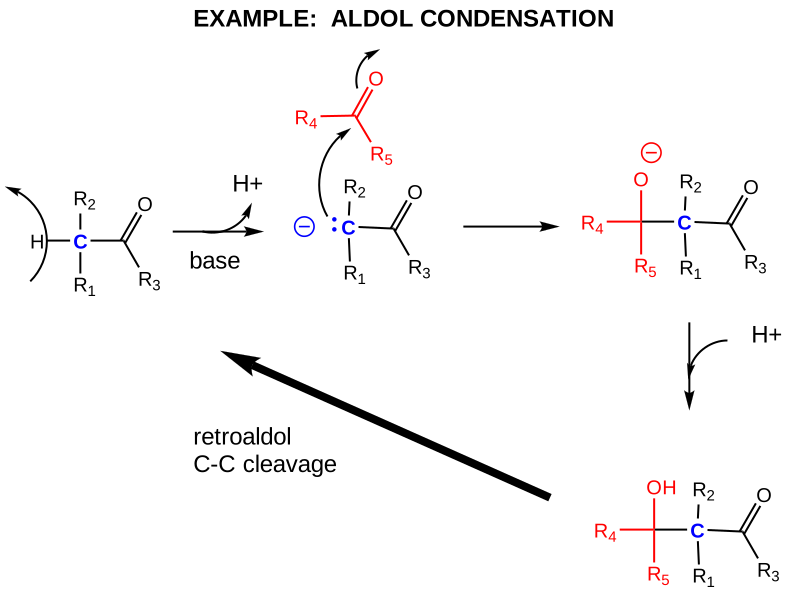
Figure \(\PageIndex{17}\): Aldol condensation
In another C-C bond synthesis reaction, a Claisen Condensation, a carbanion formed by the deprotonation of a C-H alpha to a carbonyl (which is stabilized by the enolate resonance form) acts as a nucleophile that substitutes at a carbonyl C in a carboxylic ester or thioester. This is illustrated in Figure \(\PageIndex{18}\).
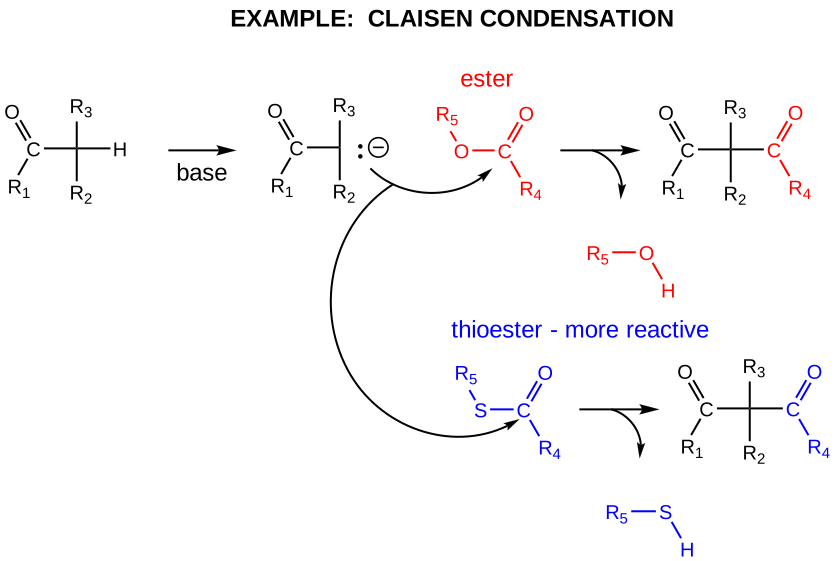
Figure \(\PageIndex{18}\): Claisen condensation
Breaking C-C Bonds
In addition to a retroaldol condensation, a common method to break a C-C bond is through a decarboxylation reaction at a beta-keto acid. Notice in Figure \(\PageIndex{19}\) that the analogous reaction at an alpha-keto acid is unlikely since the electrons from the C-C bond that is cleaved have no "sink" to which to flow.
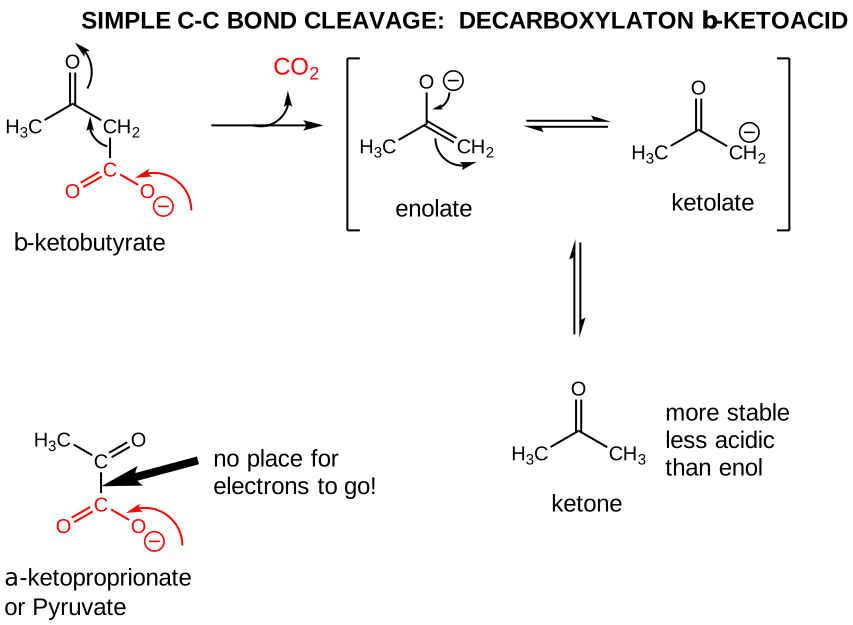
Figure \(\PageIndex{19}\) C-C bond cleavage by decarboxylation of beta-keto acids.
Alpha-keto acids can be decarboxylated using thiamine cofactors as discussed in Chapter 6.
Summary
This chapter provides a concise yet comprehensive review of key organic reaction mechanisms and thermodynamic principles as they pertain to biochemistry. It bridges the detailed understanding of enzyme mechanisms from previous chapters with broader concepts essential for metabolism and bioenergetics. Major topics include:
-
Mechanisms of Bond Breaking:
The chapter begins by outlining the three primary pathways for breaking a C–X bond—leading to the formation of carbocations, carbanions, or free radicals. These unstable intermediates, each high in energy, require transition states that resemble the intermediates more than the reactants. This discussion lays the groundwork for understanding reaction kinetics and the factors that determine activation energies. -
Free Energy Diagrams and Enzyme Catalysis:
A series of free energy diagrams illustrate the differences between uncatalyzed and enzyme-catalyzed reactions. Enzymes are shown to lower the activation energy by stabilizing transition states without altering the free energies of the reactants or products. The diagrams progress from simple representations to more detailed profiles that include intermediates along the reaction pathway, such as in the triose phosphate isomerase reaction. -
Structural Effects on Reactivity and Thermodynamics:
The text reviews how resonance and inductive effects influence the stability of reactants, intermediates, and products. Through comparative analyses (e.g., acetic acid vs. ethanol), it is shown how molecular structure dictates the driving force of a reaction, and how these principles apply to the relative reactivity of similar compounds. -
Oxidation of Organic Molecules:
The oxidation process is explained in terms of electron flow—specifically, how an increase in bonds to more electronegative atoms (or a decrease in bonds to hydrogen) indicates oxidation. The chapter also provides a method for calculating oxidation numbers to determine changes in the oxidation state of carbon atoms during metabolic transformations. -
Reactions Involving Carbonyls:
A detailed look at nucleophilic addition reactions to aldehydes and ketones is presented. The formation of geminal diols, hemiacetals, acetals, and Schiff bases are explained, along with the role of acid and base catalysis in these transformations. This section underscores the importance of reaction conditions in determining product stability. -
Reactivity of Carboxylic Acid Derivatives:
The reactivity order of carboxylic acid derivatives (from amides to acid chlorides) is analyzed in terms of resonance stabilization and leaving group ability. The chapter discusses how bond strengths and product stability influence the outcome of nucleophilic substitution reactions in these derivatives. -
C–C Bond Formation and Cleavage:
The synthesis of new carbon–carbon bonds is illustrated by mechanisms such as aldol and Claisen condensations, where enolate intermediates act as nucleophiles. Conversely, the chapter explains the mechanisms by which C–C bonds are broken, highlighting retroaldol condensations and decarboxylation reactions—particularly the decarboxylation of beta-keto acids, where electron flow has a favorable sink.
Overall, this chapter integrates basic organic reaction mechanisms with thermodynamic concepts to prepare students for advanced studies in bioenergetics and metabolism. It emphasizes how structural features and energetic considerations govern both the direction and rate of biochemical reactions, providing a foundation for understanding metabolic pathways and enzyme-catalyzed processes in living systems.