Biology LibreTexts

15.1: Insulin Signaling in the Liver

  • Page ID
    15013
  • \( \newcommand{\vecs}[1]{\overset { \scriptstyle \rightharpoonup} {\mathbf{#1}} } \)

    \( \newcommand{\vecd}[1]{\overset{-\!-\!\rightharpoonup}{\vphantom{a}\smash {#1}}} \)

    \( \newcommand{\dsum}{\displaystyle\sum\limits} \)

    \( \newcommand{\dint}{\displaystyle\int\limits} \)

    \( \newcommand{\dlim}{\displaystyle\lim\limits} \)

    \( \newcommand{\id}{\mathrm{id}}\) \( \newcommand{\Span}{\mathrm{span}}\)

    ( \newcommand{\kernel}{\mathrm{null}\,}\) \( \newcommand{\range}{\mathrm{range}\,}\)

    \( \newcommand{\RealPart}{\mathrm{Re}}\) \( \newcommand{\ImaginaryPart}{\mathrm{Im}}\)

    \( \newcommand{\Argument}{\mathrm{Arg}}\) \( \newcommand{\norm}[1]{\| #1 \|}\)

    \( \newcommand{\inner}[2]{\langle #1, #2 \rangle}\)

    \( \newcommand{\Span}{\mathrm{span}}\)

    \( \newcommand{\id}{\mathrm{id}}\)

    \( \newcommand{\Span}{\mathrm{span}}\)

    \( \newcommand{\kernel}{\mathrm{null}\,}\)

    \( \newcommand{\range}{\mathrm{range}\,}\)

    \( \newcommand{\RealPart}{\mathrm{Re}}\)

    \( \newcommand{\ImaginaryPart}{\mathrm{Im}}\)

    \( \newcommand{\Argument}{\mathrm{Arg}}\)

    \( \newcommand{\norm}[1]{\| #1 \|}\)

    \( \newcommand{\inner}[2]{\langle #1, #2 \rangle}\)

    \( \newcommand{\Span}{\mathrm{span}}\) \( \newcommand{\AA}{\unicode[.8,0]{x212B}}\)

    \( \newcommand{\vectorA}[1]{\vec{#1}}      % arrow\)

    \( \newcommand{\vectorAt}[1]{\vec{\text{#1}}}      % arrow\)

    \( \newcommand{\vectorB}[1]{\overset { \scriptstyle \rightharpoonup} {\mathbf{#1}} } \)

    \( \newcommand{\vectorC}[1]{\textbf{#1}} \)

    \( \newcommand{\vectorD}[1]{\overrightarrow{#1}} \)

    \( \newcommand{\vectorDt}[1]{\overrightarrow{\text{#1}}} \)

    \( \newcommand{\vectE}[1]{\overset{-\!-\!\rightharpoonup}{\vphantom{a}\smash{\mathbf {#1}}}} \)

    \( \newcommand{\vecs}[1]{\overset { \scriptstyle \rightharpoonup} {\mathbf{#1}} } \)

    \(\newcommand{\longvect}{\overrightarrow}\)

    \( \newcommand{\vecd}[1]{\overset{-\!-\!\rightharpoonup}{\vphantom{a}\smash {#1}}} \)

    \(\newcommand{\avec}{\mathbf a}\) \(\newcommand{\bvec}{\mathbf b}\) \(\newcommand{\cvec}{\mathbf c}\) \(\newcommand{\dvec}{\mathbf d}\) \(\newcommand{\dtil}{\widetilde{\mathbf d}}\) \(\newcommand{\evec}{\mathbf e}\) \(\newcommand{\fvec}{\mathbf f}\) \(\newcommand{\nvec}{\mathbf n}\) \(\newcommand{\pvec}{\mathbf p}\) \(\newcommand{\qvec}{\mathbf q}\) \(\newcommand{\svec}{\mathbf s}\) \(\newcommand{\tvec}{\mathbf t}\) \(\newcommand{\uvec}{\mathbf u}\) \(\newcommand{\vvec}{\mathbf v}\) \(\newcommand{\wvec}{\mathbf w}\) \(\newcommand{\xvec}{\mathbf x}\) \(\newcommand{\yvec}{\mathbf y}\) \(\newcommand{\zvec}{\mathbf z}\) \(\newcommand{\rvec}{\mathbf r}\) \(\newcommand{\mvec}{\mathbf m}\) \(\newcommand{\zerovec}{\mathbf 0}\) \(\newcommand{\onevec}{\mathbf 1}\) \(\newcommand{\real}{\mathbb R}\) \(\newcommand{\twovec}[2]{\left[\begin{array}{r}#1 \\ #2 \end{array}\right]}\) \(\newcommand{\ctwovec}[2]{\left[\begin{array}{c}#1 \\ #2 \end{array}\right]}\) \(\newcommand{\threevec}[3]{\left[\begin{array}{r}#1 \\ #2 \\ #3 \end{array}\right]}\) \(\newcommand{\cthreevec}[3]{\left[\begin{array}{c}#1 \\ #2 \\ #3 \end{array}\right]}\) \(\newcommand{\fourvec}[4]{\left[\begin{array}{r}#1 \\ #2 \\ #3 \\ #4 \end{array}\right]}\) \(\newcommand{\cfourvec}[4]{\left[\begin{array}{c}#1 \\ #2 \\ #3 \\ #4 \end{array}\right]}\) \(\newcommand{\fivevec}[5]{\left[\begin{array}{r}#1 \\ #2 \\ #3 \\ #4 \\ #5 \\ \end{array}\right]}\) \(\newcommand{\cfivevec}[5]{\left[\begin{array}{c}#1 \\ #2 \\ #3 \\ #4 \\ #5 \\ \end{array}\right]}\) \(\newcommand{\mattwo}[4]{\left[\begin{array}{rr}#1 \amp #2 \\ #3 \amp #4 \\ \end{array}\right]}\) \(\newcommand{\laspan}[1]{\text{Span}\{#1\}}\) \(\newcommand{\bcal}{\cal B}\) \(\newcommand{\ccal}{\cal C}\) \(\newcommand{\scal}{\cal S}\) \(\newcommand{\wcal}{\cal W}\) \(\newcommand{\ecal}{\cal E}\) \(\newcommand{\coords}[2]{\left\{#1\right\}_{#2}}\) \(\newcommand{\gray}[1]{\color{gray}{#1}}\) \(\newcommand{\lgray}[1]{\color{lightgray}{#1}}\) \(\newcommand{\rank}{\operatorname{rank}}\) \(\newcommand{\row}{\text{Row}}\) \(\newcommand{\col}{\text{Col}}\) \(\renewcommand{\row}{\text{Row}}\) \(\newcommand{\nul}{\text{Nul}}\) \(\newcommand{\var}{\text{Var}}\) \(\newcommand{\corr}{\text{corr}}\) \(\newcommand{\len}[1]{\left|#1\right|}\) \(\newcommand{\bbar}{\overline{\bvec}}\) \(\newcommand{\bhat}{\widehat{\bvec}}\) \(\newcommand{\bperp}{\bvec^\perp}\) \(\newcommand{\xhat}{\widehat{\xvec}}\) \(\newcommand{\vhat}{\widehat{\vvec}}\) \(\newcommand{\uhat}{\widehat{\uvec}}\) \(\newcommand{\what}{\widehat{\wvec}}\) \(\newcommand{\Sighat}{\widehat{\Sigma}}\) \(\newcommand{\lt}{<}\) \(\newcommand{\gt}{>}\) \(\newcommand{\amp}{&}\) \(\definecolor{fillinmathshade}{gray}{0.9}\)

    Search Fundamentals of Biochemistry

    Learning Goals (ChatGPT o3-mini)
    1. Understand Glycogen Structure and Function:

      • Describe the molecular structure of glycogen, including alpha 1→4 main chain linkages, alpha 1→6 branch points, and the role of glycogenin at the reducing ends.
      • Explain the physiological roles of glycogen storage in liver versus skeletal muscle and its significance in energy metabolism.
    2. Appreciate the Importance of Blood Glucose Homeostasis:

      • Discuss how liver glycogen reserves help maintain blood glucose levels critical for brain function and overall energy balance.
      • Explain the consequences of impaired glucose homeostasis on neuronal function and organismal survival.
    3. Describe Glycogen Metabolism Pathways:

      • Outline the process of glycogen breakdown (glycogenolysis) and its conversion to glucose 1-phosphate and subsequently to glucose 6-phosphate.
      • Connect glycogenolysis to broader metabolic pathways, such as glycolysis, anaerobic lactate production, and aerobic respiration.
    4. Differentiate Hormonal Regulation of Glucose:

      • Compare the roles of insulin and glucagon in the regulation of blood glucose levels.
      • Explain how insulin promotes glucose uptake and storage, while glucagon stimulates gluconeogenesis and glycogenolysis.
    5. Trace Insulin Biosynthesis and Maturation:

      • Describe the synthesis of insulin from preproinsulin to proinsulin and its conversion to mature insulin with the release of the C-peptide.
      • Recognize the clinical significance of C-peptide measurements in distinguishing endogenous insulin production from exogenous administration.
    6. Explain the Structure and Activation of the Insulin Receptor:

      • Describe the molecular architecture of the insulin receptor, emphasizing its receptor tyrosine kinase activity, dimerization, and autophosphorylation.
      • Illustrate how insulin binding induces conformational changes that enable downstream signaling.
    7. Outline the Insulin Signaling Cascade:

      • Map the key steps of the insulin signaling pathway, including the recruitment of IRS-1, activation of PI3-kinase, conversion of PIP2 to PIP3, and subsequent activation of PDK and Akt.
      • Explain how Akt activation leads to the phosphorylation of downstream targets (e.g., AS160 and GSK-3), resulting in GLUT4 translocation and activation of glycogen synthase.
    8. Connect Insulin Signaling to Glucose Uptake and Glycogen Synthesis:

      • Explain the mechanism by which insulin signaling increases the number of GLUT4 transporters at the plasma membrane, facilitating rapid glucose uptake.
      • Describe how insulin-induced inactivation of GSK-3 via Akt leads to activation of glycogen synthase, thereby promoting glycogen synthesis.
    9. Integrate the Role of Hexokinase in Glucose Metabolism:

      • Understand how hexokinase phosphorylates glucose to form glucose 6-phosphate, effectively trapping glucose within the cell for energy production or storage.
      • Discuss how this phosphorylation step is essential for both glycolysis and glycogen synthesis.
    10. Evaluate the Physiological and Clinical Relevance:

      • Discuss how the integrated processes of insulin signaling, glucose uptake, and glycogen synthesis contribute to maintaining energy homeostasis.
      • Evaluate the implications of dysregulation in these pathways in metabolic diseases such as diabetes.

    These learning goals aim to provide a comprehensive framework that connects molecular mechanisms with systemic physiological outcomes, equipping students with the knowledge to understand and analyze insulin-mediated regulation of glucose metabolism.

    Introduction

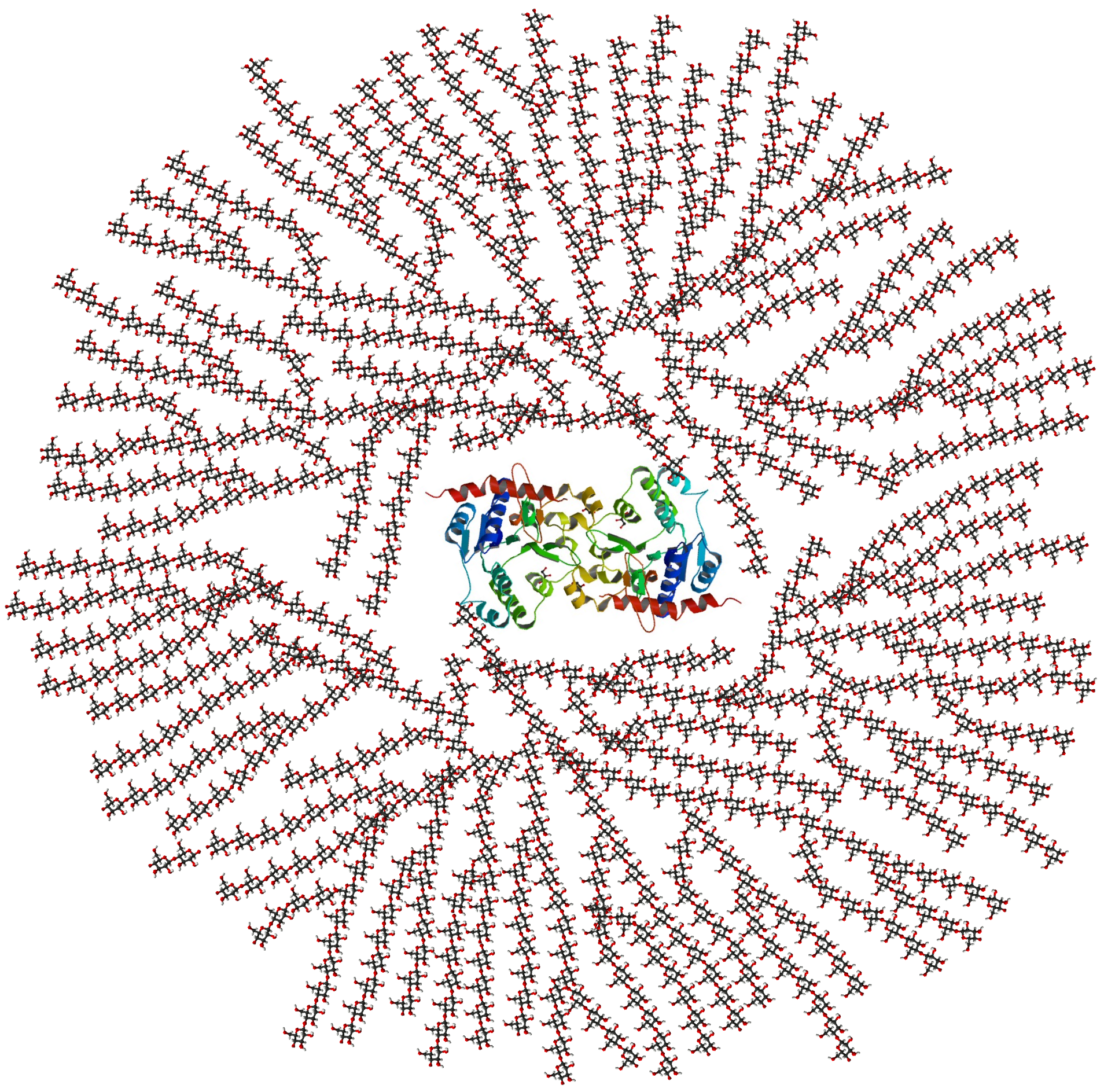
    In this section, we will discuss insulin signaling and glycogen synthesis. Insulin is released in the fed state and leads to glucose uptake, where it can be stored, if not needed, for glycogen synthesis. Recall that glycogen is a large polymer of glucose residues connected in the main chain by alpha 1 → 4 linkages and with branching side chains about every 12 – 15 residues at the alpha 1 → 6 positions. The reducing ends of the carbohydrate (two for each polymer) are connected to the glycogenin dimeric protein at the center of the macromolecule (Figure \(\PageIndex{1}\)). With the branching nature of the polymer, many non-reducing ends of the molecule are present, allowing easy access and fast release of glucose for energy utilization.

    Most of the body’s glycogen pools are stored in the liver, with 10% of the liver biomass in glycogen granules, and in the skeletal muscle, with glycogen comprising 2% of the muscle biomass. Each glycogen polymer may have upwards of 30,000 glucose residues, making it visible using standard microscopic techniques. The muscle cells use glycogen stored within muscle tissue as a source of energy to fuel muscle contraction. In the liver, the purpose of glycogen storage is different. Glycogen stored at this location maintains the homeostatic balance of blood glucose levels. The liver is the primary organ that can actively transport glucose into the bloodstream. Our only other major source of glucose within the blood is our diet.
    3D molecular structure illustration with colorful ribbons representing proteins in various shapes and orientations.
    Figure \(\PageIndex{1}\): The Glycogen Polymer. The glycogen-reducing ends of the glycogen polymer are connected with the dimeric glycogenin protein shown at the center of the diagram using the ribbon projection. The polymer is constructed predominantly of glucose monomers connected through alpha 1 --> 4 linkages. Alpha 1 --> 6 branches are apparent about every 12 - 15 residues. (Public Domain; Mikael Häggström via Wikipedia.

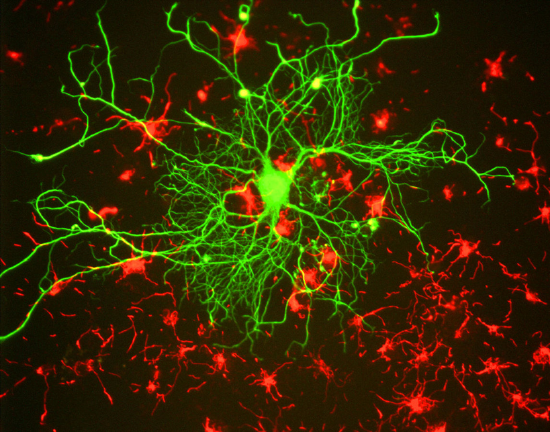
    Blood glucose homeostasis is critical for brain function (Figure \(\PageIndex{2}\)). The brain has a huge energy demand but nearly zero storage of key energy molecules required for ATP production. Furthermore, glucose and ketone bodies are the only energy sources that can pass the blood-brain barrier and be utilized by the brain for ATP production. Note that ketone bodies are only produced during starvation or disease states such as diabetes and are not a regular energy source for the brain. Thus, glucose is critical for brain function. The brain uses nearly 10% of the whole body’s energy for nerve impulse transmission. If the blood flow carrying critical oxygen and glucose to the brain is impeded, people will lose consciousness within approximately 20 seconds! Brain death/permanent damage occurs within 4 minutes of blood flow cessation. This exemplifies the importance of the liver in maintaining blood glucose levels, as well as the importance of oxygen maintenance.
    Neurons are depicted with green and red branching structures against a dark background, representing neural connections.
    Figure \(\PageIndex{2}\): Cortical neuron stained with antibody to neurofilament subunit NF-L in green. In red are neuronal stem cells stained with antibodies to alpha-internexin. Image created using antibodies from EnCor Biotechnology Inc. (CC BY-SA 3.0 Unported; GerryShaw via Wikipedia)

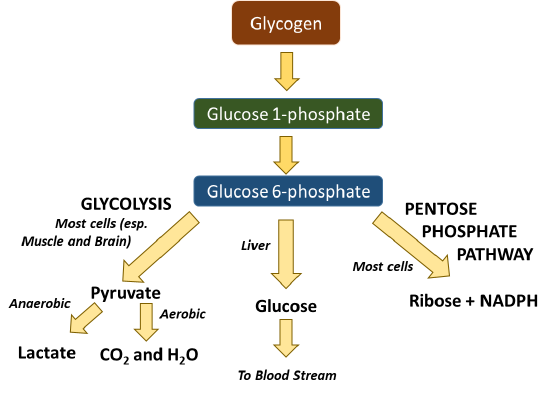
    Glycogen in the liver or muscle can be broken down into glucose 1-phosphate (Figure \(\PageIndex{3}\)). This can be converted to glucose 6-phosphate, which is readily used in many cellular processes. The glycolysis (or the breakdown of glucose into pyruvate) occurs in all cells and produces a small amount of ATP. Further processing of pyruvate can occur anaerobically (or in the absence of oxygen) to produce lactate, or the process can continue to occur in the aerobic pathway to complete oxidation to carbon dioxide and water in the Krebs cycle. Note that oxygen from breathing is used to create the water within this pathway. This fuels the process of oxidative phosphorylation within the mitochondria and produces large quantities of ATP (from 30-36 molecules/glucose). Within the liver, glucose can be freed from glycogen and released into the bloodstream to maintain homeostatic levels. Glucose 6-phosphate can also be utilized as a precursor for other major macromolecules such as ribose and deoxyribose, as well as the hexosamine compounds commonly found cushioning joints or attached to plasma membrane proteins.

    Flowchart illustrating glycogen breakdown into glucose-1-phosphate and glucose-6-phosphate with directional arrows.
    Figure \(\PageIndex{3}\): Pathways of Glycogen Utilization.

    In healthy individuals, hormone signaling is critical to maintaining blood glucose homeostasis. Within this system, the hormones glucagon and insulin work together to maintain normal plasma glucose levels ( Figure \(\PageIndex{4}\)). During hyperglycemia, pancreatic beta (β) cells release insulin, which stimulates glucose uptake by energy-consuming cells and glycogen formation in the liver. During hypoglycemia, pancreatic alpha (α) cells release glucagon, which stimulates gluconeogenesis and glycogenolysis in the liver and the release of glucose to the plasma.
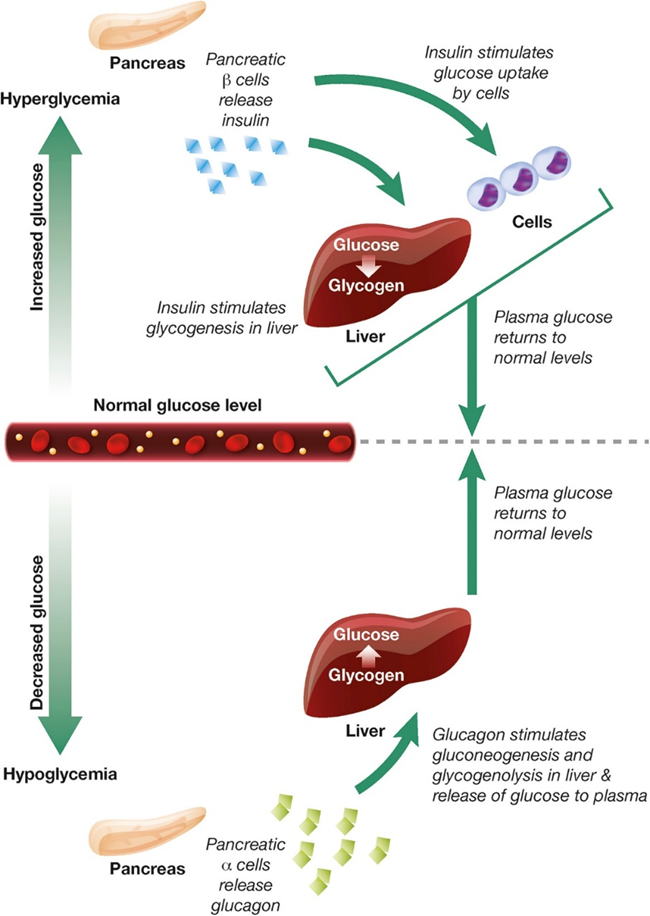
    Diagram illustrating the regulation of glucose levels by the pancreas and liver, showing insulin and glucagon functions.

    Figure \(\PageIndex{4}\): Hormone Signaling Involved in Blood Glucose Homeostasis. The hormones glucagon and insulin, released by the pancreas, are critical for regulating the liver's release or uptake of glucose from the bloodstream. In the upper diagram, beta cells within the pancreas secrete the insulin hormone when blood glucose levels rise. Insulin signaling causes the liver to increase glucose uptake from the bloodstream and promotes its storage as glycogen. Alternatively, alpha cells in the pancreas release the hormone glucagon when blood glucose levels are low, as shown in the lower diagram. Glucagon signaling in the liver leads to the breakdown of glycogen and the release of stored glucose into the bloodstream. Hædersdal, S., et al (2018) Mayo Clinic Proceedings 93(2):217-239

    The first area we will focus our attention on is the mechanism insulin utilizes to reduce blood glucose levels. Figure \(\PageIndex{5}\) shows the structure of the pancreas and its anatomical relationship with the liver and the stomach. The pancreas is the sensor organ that detects blood glucose levels. It is responsible for signaling the liver to remove or release glucose in response to changing levels. Notably, the pancreas also produces most of the digestive enzymes utilized by the body, including proteases, amylases, and lipases.
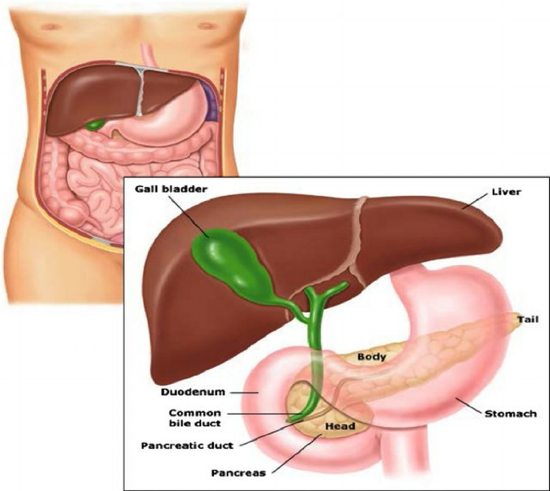
    Diagram of the human digestive system with a focus on the liver and bile ducts, labeled for anatomical reference.
    Figure \(\PageIndex{5}\): The Anatomy of the Liver and Pancreas. Akinlade, A., et al (2014) Int. Archives of Med 7(50):28

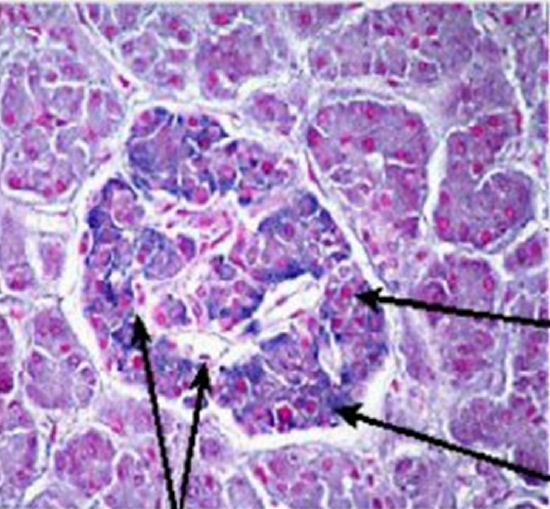
    Figure \(\PageIndex{6}\) shows a light microscope image of the pancreatic islet cells. They are responsible for the production of glucagon and insulin. The islets are distinguished from the surrounding tissue by a continuous connective tissue capsule and extensive vascularity.
    Microscopic view of tissue, featuring a central structure with highlighted sections in purple and pink hues.
    Figure \(\PageIndex{6}\): Pancreatic Islet Cells. In this diagram, the islet cells that secrete glucagon (known as alpha cells) are stained in red, while the beta cells that produce insulin are stained in blue. Akinlade, A., et al (2014) Int. Archives of Med 7(50):28

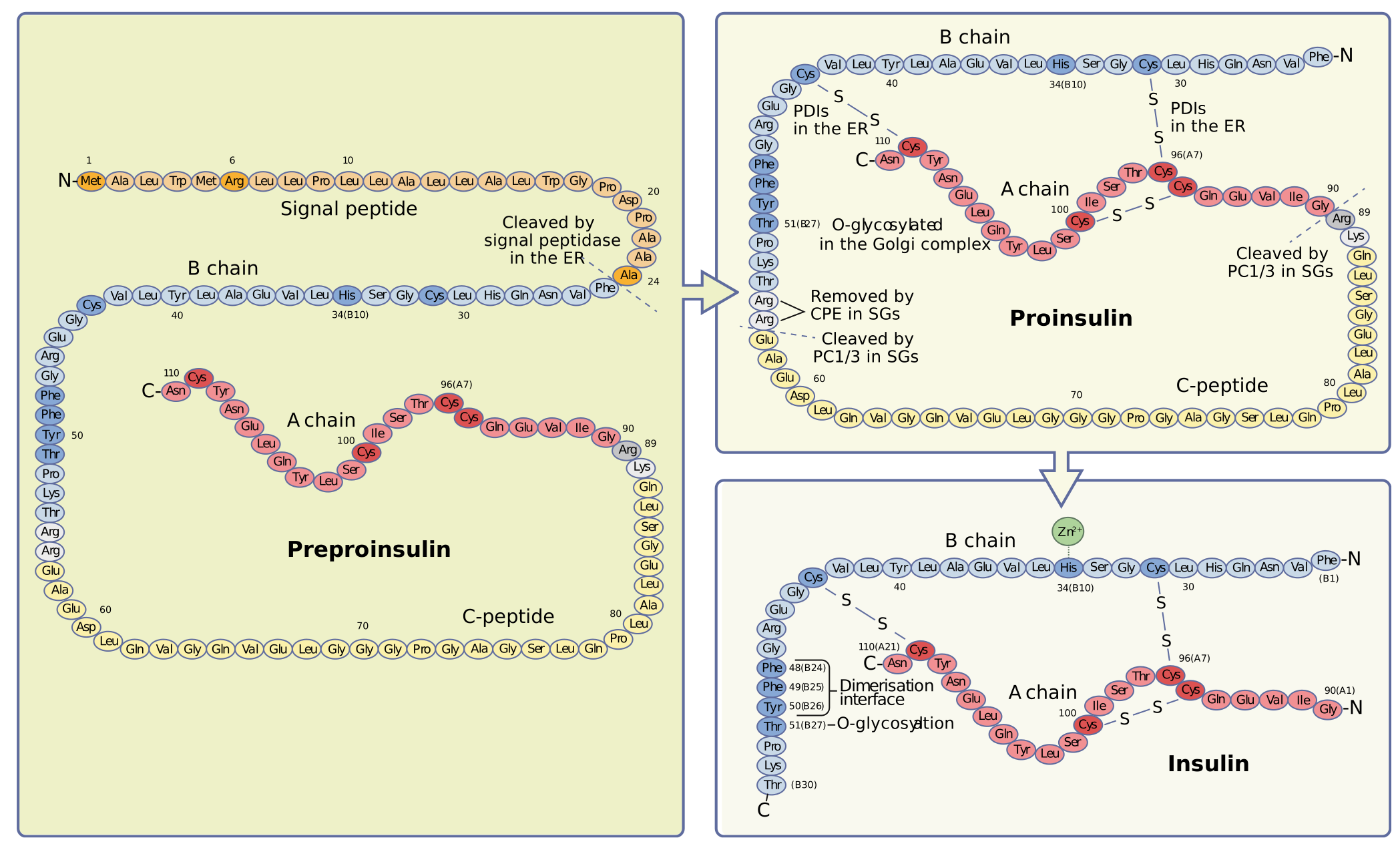
    Insulin is a peptide hormone composed of 51 amino acids, as shown in Figure \(\PageIndex{7}\). It is initially synthesized as preproinsulin, which is converted to proinsulin after removing the signal peptide.  Two disulfides are made in the ER (catalyzed by protein disulfide isomerase) along with selective proteolytic cleavage to form insulin.  Mature insulin consists of A and B chains that are connected in proinsulin by the C-peptide.  
    Flowchart divided into three sections, illustrating a complex process with labeled nodes and directional arrows.

    Figure \(\PageIndex{7}\): Conversion of preproinsulin to mature insulin.  Vasiljević, J. et al. Diabetologia 63, 1981–1989 (2020). https://doi.org/10.1007/s00125-020-05192-7.  http://creativecommons.org/licenses/by/4.0/.

    Figure \(\PageIndex{8}\) shows  interactive iCn3D models of human insulin (3I40) and human proinsulin (2KQP).  (Copyright; author via source). Click the image for a popup or use the external link provided:

    Human insulin (3I40) Human Proinsulin (2KQP)

    3D representation of a protein structure with intertwined blue loops and red helical segments.

    Colored code to show secondary structure

    External link:  https://structure.ncbi.nlm.nih.gov/i...A3QZdZpfEMxR17

    3D molecular structure with twisting lines in cyan, yellow, and magenta, representing protein folding or configuration.

    The "future" A chain in mature insulin is shown in magenta, the C-peptide connecting the A and B chains is shown in yellow, and the future B chain is in cyan.

    External link:  https://structure.ncbi.nlm.nih.gov/i...nQJXhrEfHD1GH9

    The maturation of preproinsulin to insulin is shown in more detail in  Figure \(\PageIndex{9}\).  The peptide is first translated on ribosomes linked to the rough endoplasmic reticulum (ER), where a signal peptide docks the peptide to the ER membrane. The proinsulin is folded, and the signal peptide is cleaved. It is transported to the Golgi, where it is further packaged into secretory vesicles. Within the secretory vesicles, the proinsulin is cleaved to release the C-peptide. The A and B peptides are held together by disulfide bridges and form the active insulin component.
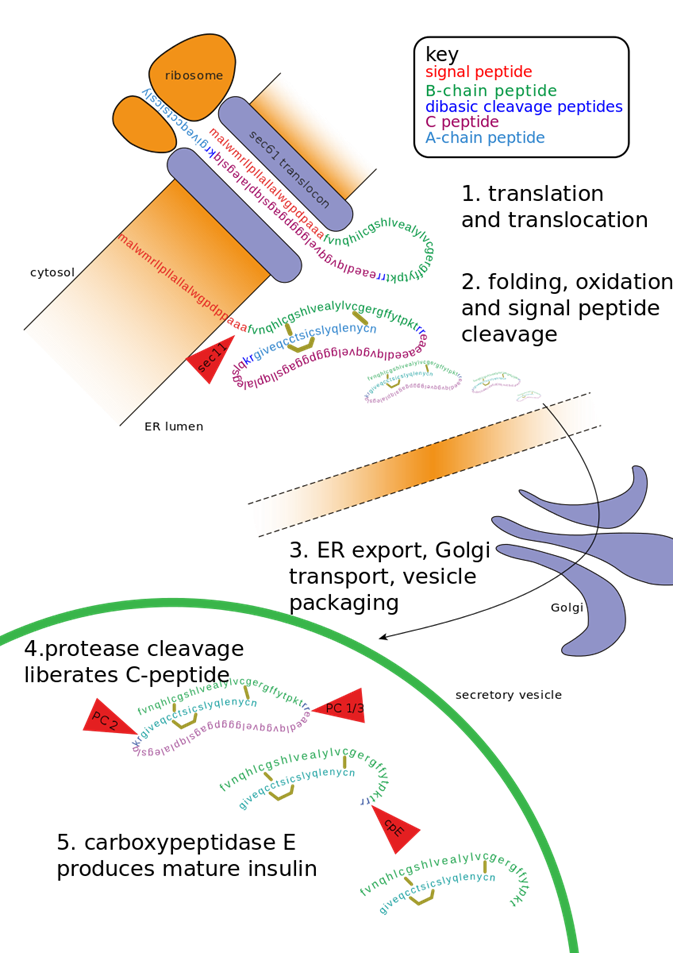
    Diagram illustrating molecular interactions and mechanisms, featuring labeled proteins, arrows, and a description of processes.
    Figure \(\PageIndex{9}\):  Insulin Production. The process of insulin production includes the translation of the insulin mRNA into the rough endoplasmic reticulum. The peptide is transported through the Golgi and packaged into secretory vesicles, where protease cleavage by carboxypeptidase E produces the mature insulin peptide and peptide C. Image from Fred the Oyster

    The C-peptide is a bioactive peptide secreted simultaneously and in equal amounts to the insulin hormone. It also has a longer half-life than insulin and is excreted by the kidneys into the urine, making detection easy. Furthermore, it allows for detecting patient-produced insulin, even if they are receiving insulin injections. Thus, C-peptide detection is often utilized to help distinguish between patients with type 1 diabetes and patients with type 2 diabetes (or maturity-onset diabetes). Details about the different forms of diabetes will be discussed later.

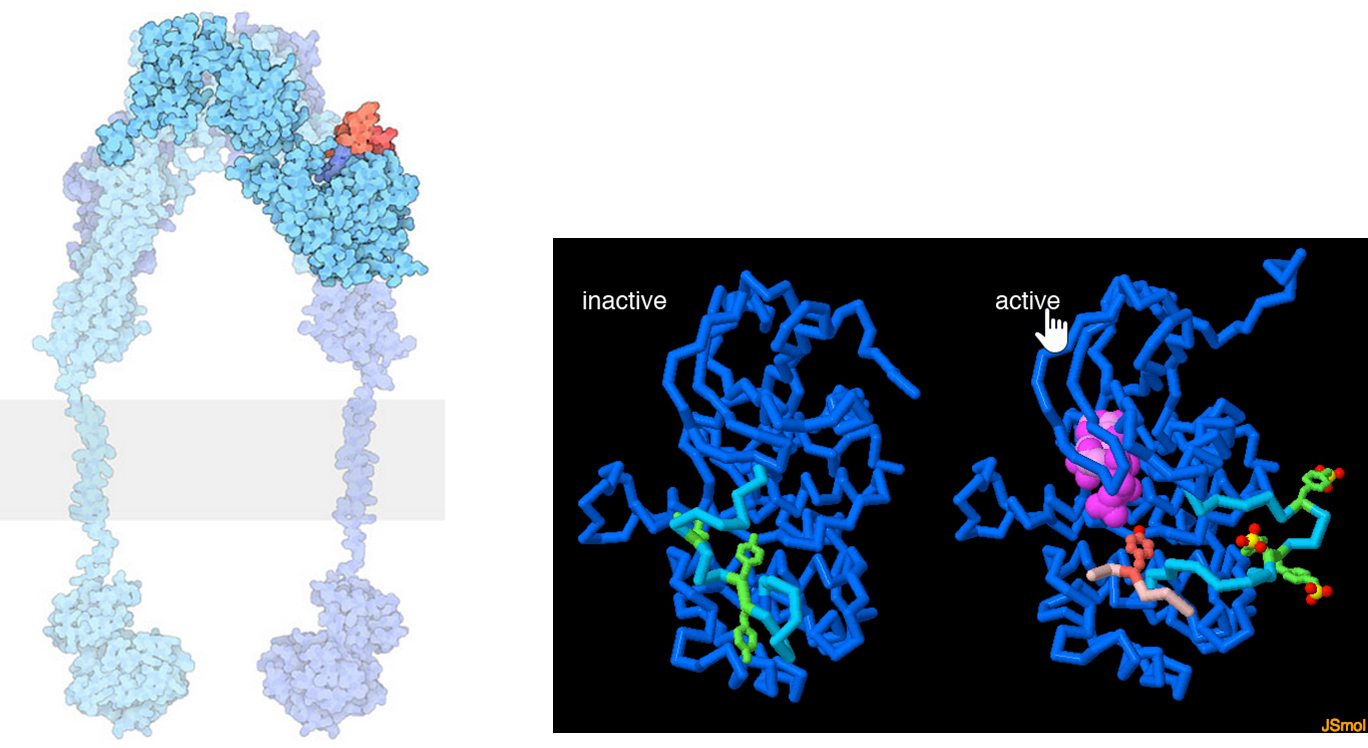
    Once insulin is released from the pancreas, it travels throughout the body and binds with cellular targets that contain the insulin receptor. The Insulin Receptor is a tyrosine kinase receptor that dimerizes upon insulin binding, as shown in Figure \(\PageIndex{10}\). Insulin receptors are located on most cell types throughout the body, causing pleiotropic effects during insulin response. The primary targets of insulin action are the liver, which promotes the uptake of glucose and the production of the glycogen storage molecule, as well as skeletal muscle and fat. The receptor's tyrosine kinase portion, located on the plasma membrane's internal side, is quite flexible.

    Visual representation of protein structures, with two detailed views of molecular models in blue, showing various colored elements.
    Figure \(\PageIndex{10}\): The Insulin Receptor.  Images from Goodsell, D., et al (2015) RCSB PDB-101 ‘Molecule of the Month’

    The left-hand diagram shows a space-filling model of the activated insulin receptor dimer embedded into the plasma membrane (the gray bar). The tyrosine kinase portion of the receptor is shown on the inside of the cell, whereas the insulin binding domain is present on the external side of the plasma membrane. The middle and right-hand diagrams show the inactive (middle) and active forms (far right) of the tyrosine kinase domain of an insulin receptor monomer. When activated, the tyrosine kinase domain binds to ATP (hot pink) and phosphorylates downstream targets, including several of its tyrosine residues (green). In the inactive state (middle), a mobile loop (turquoise) binds in the ATP binding site and prevents ATP association. When the insulin receptor is activated, the mobile loop opens, allowing for the binding of ATP and self-phosphorylation of tyrosine residues and other signaling proteins (a small peptide from one is shown in light pink).

    Figure \(\PageIndex{11}\) below, which shows an interactive iCn3D model of the Full-length mouse insulin receptor bound to four insulins (7SL7).

    3D molecular structure with intertwined strands in silver, gold, pink, and blue, representing a protein arrangement.

    A blue graphic with white text on the left, an arrow in the center, and yellow text on the right. Figure \(\PageIndex{11}\): Full-length mouse insulin receptor bound to four insulins (7SL7). (Copyright; author via source). Click the image for a popup or use this external link:  https://structure.ncbi.nlm.nih.gov/i...gkTrtvaqQF6o2A

    The receptor is a dimer (one monomer gray and the other light brown).  Four insulins are bound in maximally activated insulin receptors.  Two insulins (magenta) are bound at the same respective place in each monomer (site-1, the primary site), and the two others are bound at a second parallel site (site-2).  The full active state is a symmetric T-shape.  Less active receptors have fewer bound insulins, with receptor geometry more asymmetric (one insulin bound at site 1 gives a Γ-shaped conformation, while two produce a Ƭ-shaped conformation as the second insulin binds). When four insulins are bound at both sites, the asymmetric conformation can't be formed.  Although the structure is described as full-length, both monomers end at amino acid 910.  The single membrane-spanning alpha-helix occurs at amino acids 947-967 and is NOT shown in the model.

    Activation of the insulin receptor in the liver when insulin is present initiates a phosphorylation signaling cascade, as shown in Figure \(\PageIndex{12}\).  One of the proteins activated is Rab10. Rab 10 promotes the fusion of GLUT4-containing secretory vesicles (GSVs) with the plasma membrane, allowing for increased surface expression of GLUT4. GLUT4 is a glucose transporter protein. Thus, an increased protein concentration in the plasma membrane results in the upregulation of glucose import into the cell. Having GLUT4 proteins stored within secretory vesicles makes them available more readily than having to activate gene transcription pathways and production of the protein de novo. This allows a faster response to help lower blood glucose levels. The result is increased glucose uptake from the bloodstream into liver cells and other cellular targets, reducing blood glucose levels.
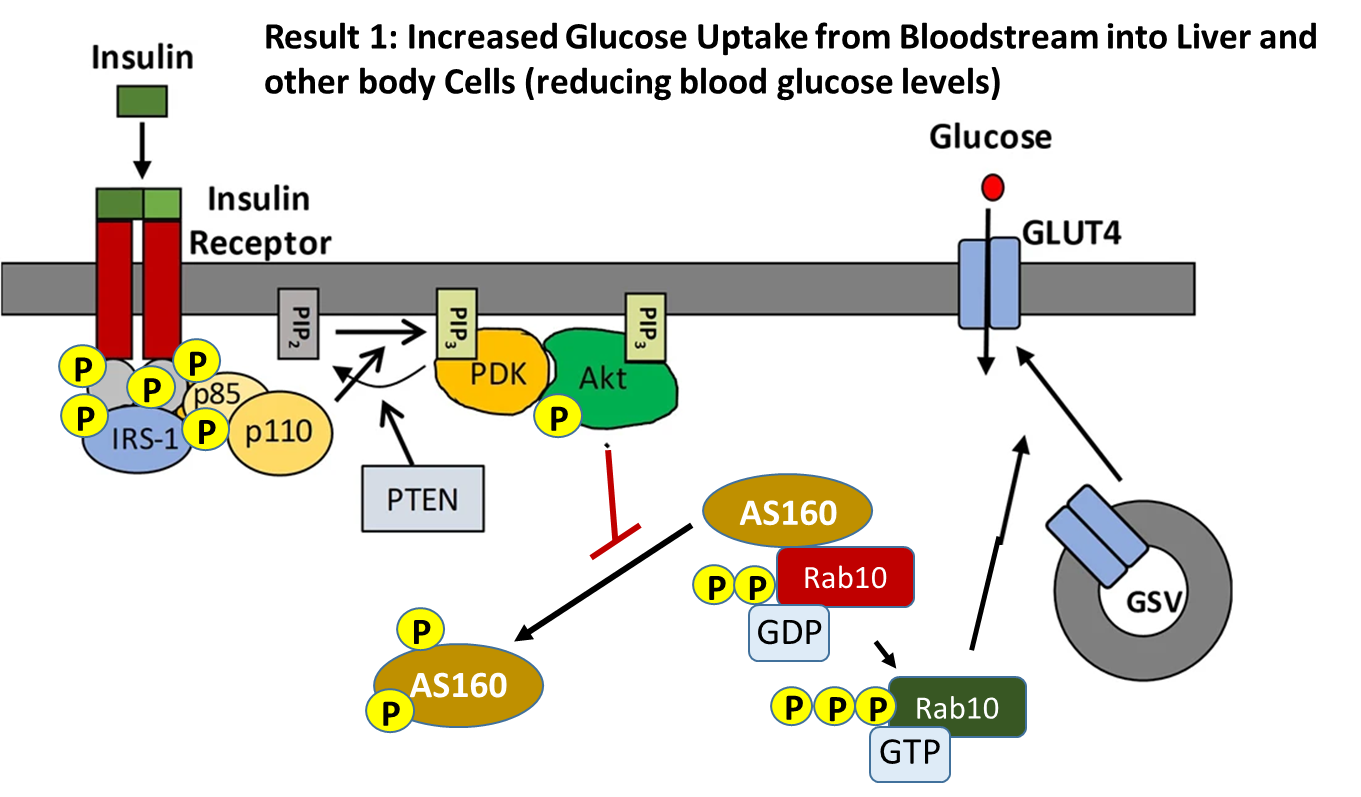
    Diagram illustrating insulin signaling pathways in body cells, showing interactions and effects on glucose levels.
    Figure \(\PageIndex{12}\):  Insulin Activation of Liver Cells and Glucose Uptake. Image from Carmichael, R.E., et al (2019) Scientific Reports 9:6477

    The insulin receptor is a receptor tyrosine kinase, which undergoes dimerization and autophosphorylation of Tyr residues upon insulin binding. The phosphorylated receptor also recruits and phosphorylates the insulin receptor substrate 1 (IRS-1) on tyrosine residues, which then recruits dimeric Phosphoinositol (PI)3-kinase (p85/p110 in the diagram above) and phosphorylates the p85 regulatory subunit. The PI3 kinase catalyzes the phosphorylation of phosphatidylinositol bisphosphate (PIP2) within the plasma membrane to form phosphoinositol, 3,4,5-triphosphate (PIP3). PIP3 recruits PIP3-dependent kinase (PDK), which phosphorylates and activates Akt. Once activated, Akt dissociates from the membrane into the cytosol, where one of its downstream targets is AS160. AS160 is a GTPase that binds typically with Rab10 (a G-protein), causing the cleavage of GTP to GDP. Thus, AS160 downregulates the activity of Rab10. In the phosphorylated state, AS160 cannot bind or inhibit Rab10, enabling Rab10 to release GDP and bind with a molecule of GTP. In the activated state, Rab10 helps promote the fusion of GLUT4-containing secretory vesicles (GSVs) with the plasma membrane.

    Figure \(\PageIndex{13}\) provides a deeper look at some of the initial activation steps in the insulin signaling pathway. This step shows the phosphorylation of Phosphoinositol 4,5-bisphosphate (PIP2) to Phosphatidylinositol 3,4,5-triphosphate (PIP3). PIP2 is a common phospholipid within the lipid bilayer structure. In future lectures, we will see the utilization of this phospholipid in other signaling pathways as well.
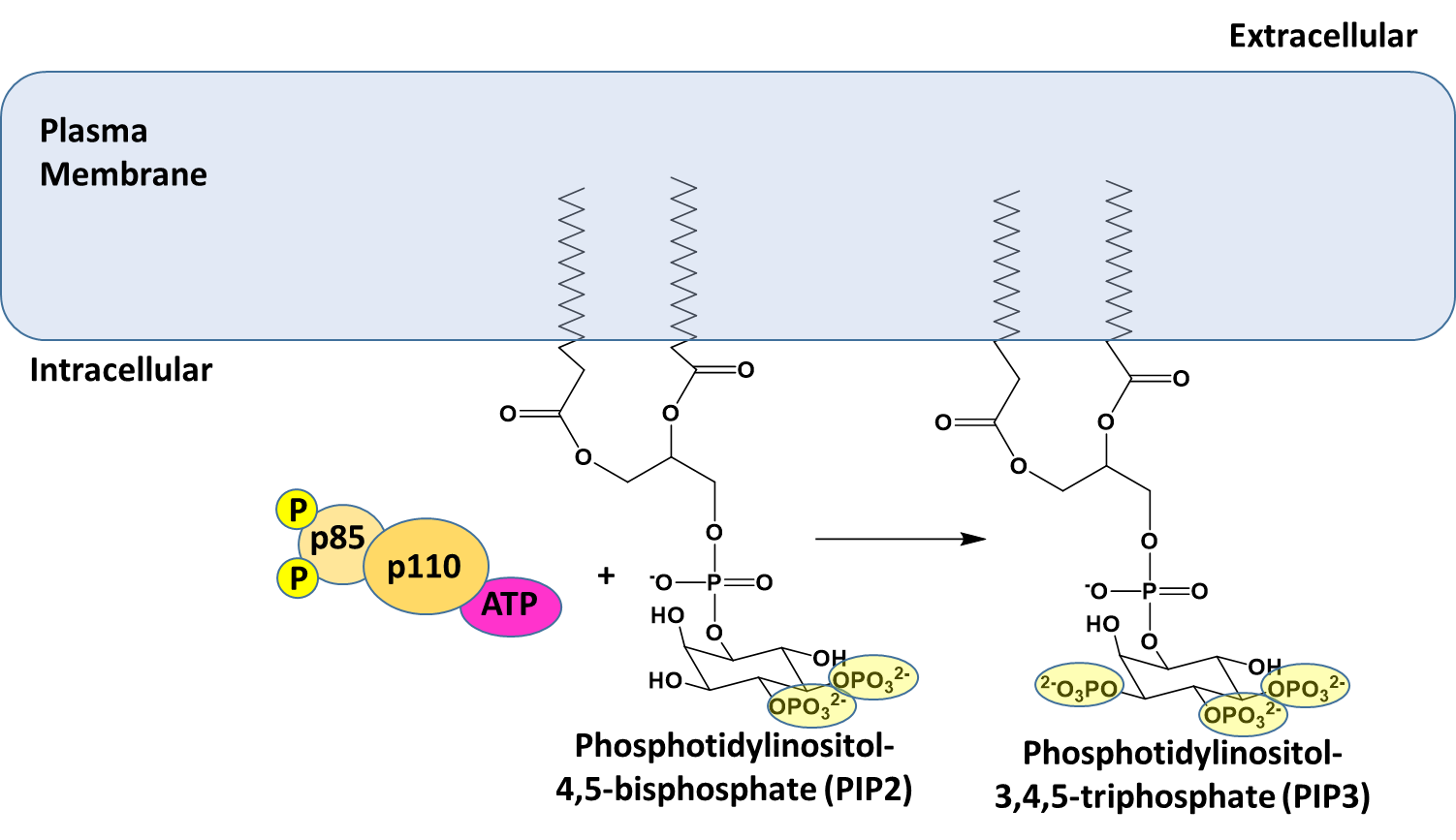
    Diagram illustrating a molecular interaction involving proteins and other molecules, labeled with various annotations.
    Figure \(\PageIndex{13}\):  Phosphorylation of phosphotidylinositol-4,5-bisphosphate During Insulin Signaling.

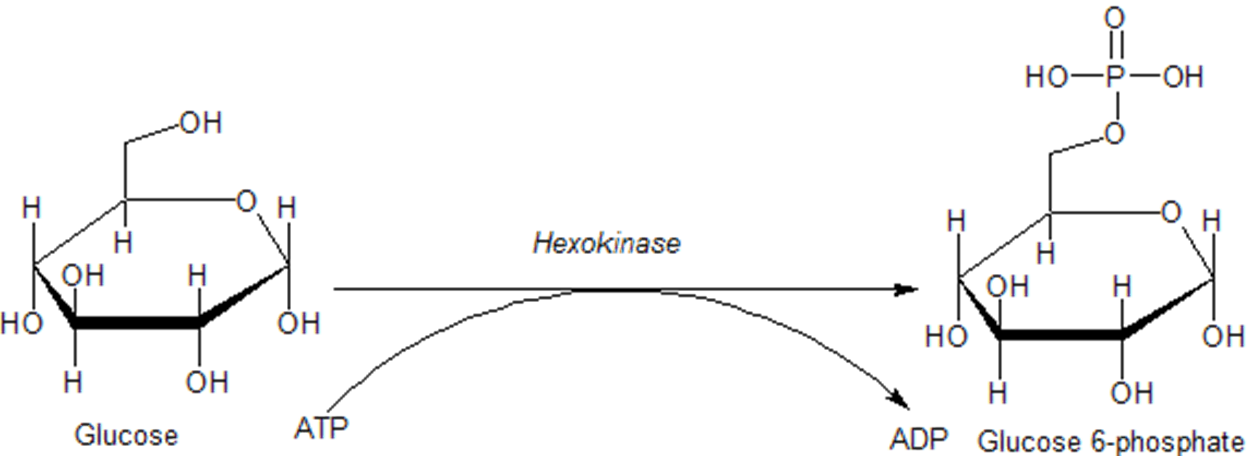
    Once glucose enters a cell, it is rapidly converted to glucose 6-phosphate via the enzyme hexokinase, as shown in Figure \(\PageIndex{14}\) below. This enzyme is covered in more detail in our section on glycolysis. Importantly, phosphorylation traps the glucose inside the cell, preventing its redistribution back into the bloodstream. This helps to maintain the homeostasis of glucose within the bloodstream. In addition, glucose 6-phosphate is the first step in many glucose pathways, including energy utilization and the formation of building blocks such as ribose and deoxyribose used in RNA and DNA synthesis.
    A diagram displaying different chemical elements with their symbols and atomic numbers arranged around a central label "Elements."
    Figure \(\PageIndex{14}\):  Conversion of Glucose to Glucose-6-Phosphate by Hexokinase. Image from Jmun7616

    Insulin signaling increases the number of GLUT4 transporters in the plasma membrane, causing an increased uptake of glucose into the cell. If glucose is not required for energy or other metabolic intermediates within liver and muscle tissue, it is then converted to glycogen for storage. The primary enzyme necessary for glycogen synthesis is also activated via insulin signaling, as shown in Figure \(\PageIndex{15}\).  In addition to phosphorylating the AS160 protein, Activated Akt also phosphorylates the Glycogen Synthase Kinase enzyme (GSK-3), which inactivates this protein. This allows protein phosphorylase 1 (PP1) to dephosphorylate the Glycogen Synthase enzyme, shifting it into a more active state and causing glycogen synthesis to commence.
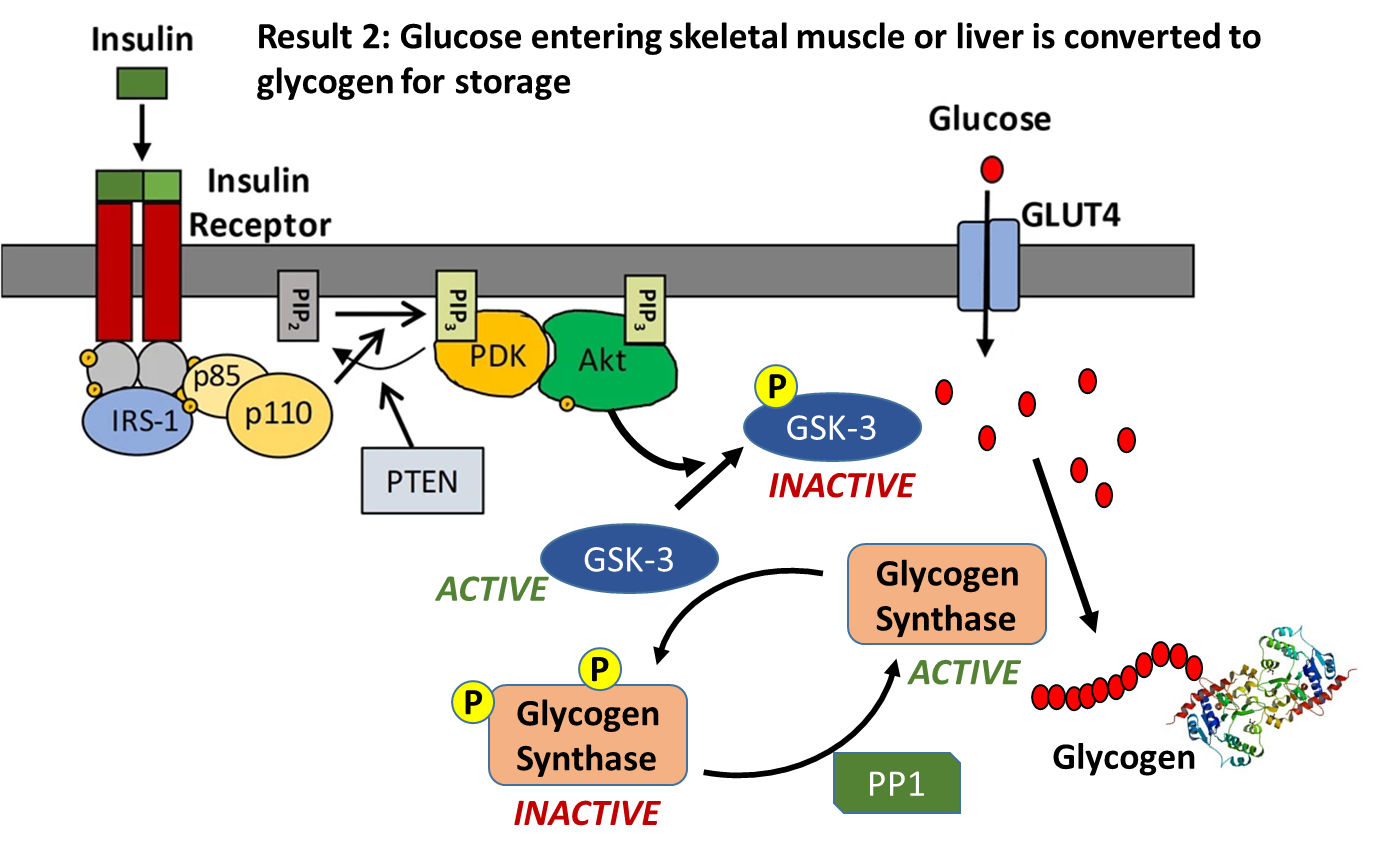
    Diagram showing insulin signaling for glucose uptake and conversion to glycogen in muscle cells.
    Figure \(\PageIndex{15}\):  Activation of Glycogen Synthase During Insulin Signaling. Image modified from Carmichael, R.E., et al (2019) Scientific Reports 9:6477

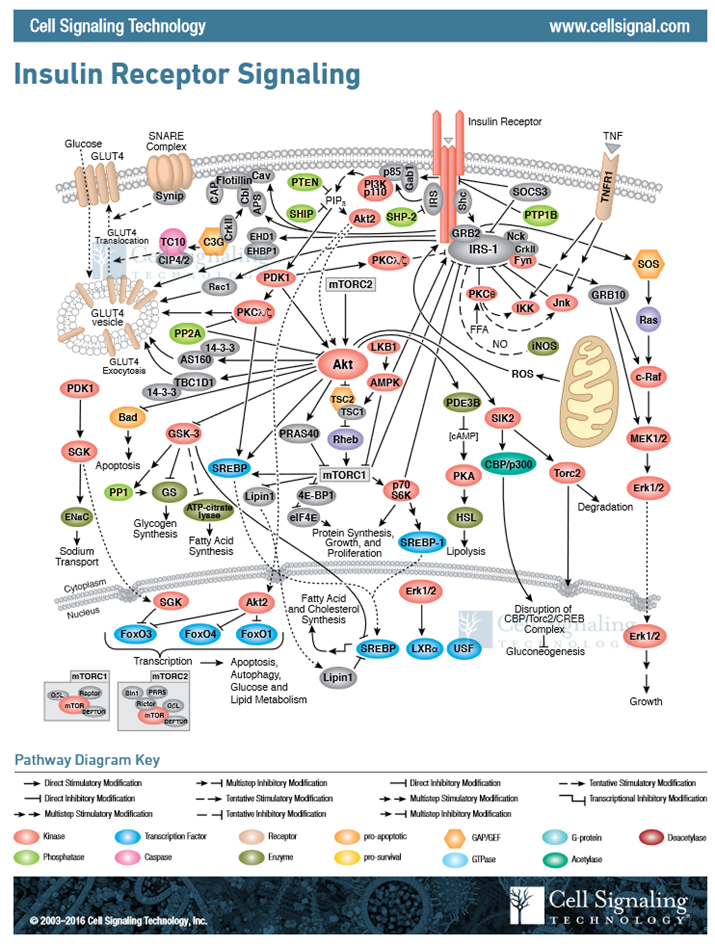
    In this section, we have covered two pathways activated during the cellular response to insulin signaling, and I am sure you are feeling a bit overwhelmed with the complexity. However, biological processes are incredibly complex, and signaling pathways have multiple pleiotropic downstream effects. We have only touched the tip of the iceberg for insulin signaling, as evidenced in Figure \(\PageIndex{16}\). This figure gives a more complete representation of the chemical changes induced within a liver cell in response to insulin signaling. For our purposes, we will restrict coverage to the two downstream effects: an increase in GLUT4 transporters in the plasma membrane and increased glycogen synthase activity.

    Diagram illustrating insulin receptor signaling pathways, showing various proteins, interactions, and cellular processes involved.
    Figure \(\PageIndex{16}\): Insulin Signaling Pathway. Image by Cell Signaling Technology

    Summary

    This chapter explores the critical role of insulin signaling in regulating glucose uptake and glycogen synthesis, emphasizing how these processes maintain blood glucose homeostasis and overall energy balance in the body.

    Glycogen Structure and Function:
    The chapter begins with an overview of glycogen—a large, highly branched polymer of glucose residues. Glycogen’s structure, characterized by alpha 1→4 linkages in the main chain and alpha 1→6 branch points approximately every 12–15 residues, allows for rapid mobilization of glucose. Glycogen is predominantly stored in the liver and skeletal muscle, where it serves distinct purposes: the liver maintains blood glucose levels for systemic homeostasis, while muscle glycogen provides an immediate energy source during contraction.

    Hormonal Regulation and Blood Glucose Homeostasis:
    Maintaining blood glucose levels is essential for proper brain function and overall cellular energy balance. The chapter outlines the complementary roles of insulin and glucagon—hormones secreted by the pancreatic islet cells—in regulating blood glucose. During hyperglycemia, insulin is released from beta cells to promote glucose uptake and glycogen synthesis, whereas during hypoglycemia, glucagon from alpha cells stimulates glycogenolysis and gluconeogenesis, ensuring a steady supply of glucose.

    Insulin Biosynthesis and Structure:
    Insulin is synthesized initially as preproinsulin, then processed to proinsulin and finally to mature insulin, with the C-peptide being cleaved off in the process. The chapter emphasizes the importance of the C-peptide not only as a marker for endogenous insulin production but also for distinguishing between type 1 and type 2 diabetes.

    Insulin Receptor and Signaling Cascade:
    Central to insulin’s action is its receptor—a receptor tyrosine kinase that dimerizes and autophosphorylates upon insulin binding. This activation initiates a cascade of events: the receptor phosphorylates IRS-1, which then recruits PI3-kinase. The kinase catalyzes the conversion of PIP2 to PIP3, leading to the activation of PDK and Akt. Activated Akt phosphorylates multiple downstream targets such as AS160 and GSK-3. Phosphorylation of AS160 facilitates the translocation of GLUT4-containing vesicles to the plasma membrane, thereby increasing glucose uptake, while the inactivation of GSK-3 promotes glycogen synthase activity and subsequent glycogen synthesis.

    Integration of Glucose Uptake and Metabolism:
    Once inside the cell, glucose is rapidly phosphorylated by hexokinase to form glucose 6-phosphate, a metabolic “trapping” step that commits glucose to intracellular pathways including glycolysis and glycogen synthesis. This integration ensures that, in the fed state, excess glucose is efficiently stored as glycogen, helping to maintain stable blood glucose levels.

    Physiological and Clinical Implications:
    The chapter underscores the physiological importance of these interconnected processes. In the liver, glycogen storage and release are vital for sustaining blood glucose levels, particularly for brain function, which relies almost exclusively on glucose under normal conditions. The discussion also hints at the clinical relevance of these pathways in the context of metabolic diseases such as diabetes, where dysregulation of insulin signaling can lead to severe systemic effects.

    Overall, the chapter provides a comprehensive view of how insulin signaling orchestrates a series of molecular events—from receptor activation to metabolic regulation—ensuring efficient energy storage and maintaining homeostasis in the body.


    This page titled 15.1: Insulin Signaling in the Liver is shared under a not declared license and was authored, remixed, and/or curated by Henry Jakubowski and Patricia Flatt.