

11: Sustainable Agriculture
- Page ID
- 191886

\( \newcommand{\vecs}[1]{\overset { \scriptstyle \rightharpoonup} {\mathbf{#1}} } \)
\( \newcommand{\vecd}[1]{\overset{-\!-\!\rightharpoonup}{\vphantom{a}\smash {#1}}} \)
\( \newcommand{\dsum}{\displaystyle\sum\limits} \)
\( \newcommand{\dint}{\displaystyle\int\limits} \)
\( \newcommand{\dlim}{\displaystyle\lim\limits} \)
\( \newcommand{\id}{\mathrm{id}}\) \( \newcommand{\Span}{\mathrm{span}}\)
( \newcommand{\kernel}{\mathrm{null}\,}\) \( \newcommand{\range}{\mathrm{range}\,}\)
\( \newcommand{\RealPart}{\mathrm{Re}}\) \( \newcommand{\ImaginaryPart}{\mathrm{Im}}\)
\( \newcommand{\Argument}{\mathrm{Arg}}\) \( \newcommand{\norm}[1]{\| #1 \|}\)
\( \newcommand{\inner}[2]{\langle #1, #2 \rangle}\)
\( \newcommand{\Span}{\mathrm{span}}\)
\( \newcommand{\id}{\mathrm{id}}\)
\( \newcommand{\Span}{\mathrm{span}}\)
\( \newcommand{\kernel}{\mathrm{null}\,}\)
\( \newcommand{\range}{\mathrm{range}\,}\)
\( \newcommand{\RealPart}{\mathrm{Re}}\)
\( \newcommand{\ImaginaryPart}{\mathrm{Im}}\)
\( \newcommand{\Argument}{\mathrm{Arg}}\)
\( \newcommand{\norm}[1]{\| #1 \|}\)
\( \newcommand{\inner}[2]{\langle #1, #2 \rangle}\)
\( \newcommand{\Span}{\mathrm{span}}\) \( \newcommand{\AA}{\unicode[.8,0]{x212B}}\)
\( \newcommand{\vectorA}[1]{\vec{#1}} % arrow\)
\( \newcommand{\vectorAt}[1]{\vec{\text{#1}}} % arrow\)
\( \newcommand{\vectorB}[1]{\overset { \scriptstyle \rightharpoonup} {\mathbf{#1}} } \)
\( \newcommand{\vectorC}[1]{\textbf{#1}} \)
\( \newcommand{\vectorD}[1]{\overrightarrow{#1}} \)
\( \newcommand{\vectorDt}[1]{\overrightarrow{\text{#1}}} \)
\( \newcommand{\vectE}[1]{\overset{-\!-\!\rightharpoonup}{\vphantom{a}\smash{\mathbf {#1}}}} \)
\( \newcommand{\vecs}[1]{\overset { \scriptstyle \rightharpoonup} {\mathbf{#1}} } \)
\(\newcommand{\longvect}{\overrightarrow}\)
\( \newcommand{\vecd}[1]{\overset{-\!-\!\rightharpoonup}{\vphantom{a}\smash {#1}}} \)
\(\newcommand{\ket}[1]{\left| #1 \right>}\)
\(\newcommand{\bra}[1]{\left< #1 \right|}\)
\(\newcommand{\braket}[2]{\left< #1 \vphantom{#2} \right| \left. #2 \vphantom{#1} \right>}\)
\(\newcommand{\braopket}[3]{\left< #1 \vphantom{#2}\vphantom{#3} \right| #2 \vphantom{#1}\vphantom{#3} \left| #3 \vphantom{#1}\vphantom{#2} \right>}\)
\(\newcommand{\qmvec}[1]{\mathbf{\vec{#1}}}\)
\(\newcommand{\op}[1]{\hat{\mathbf{#1}}}\)
\(\newcommand{\expect}[1]{\langle #1 \rangle}\)
\(\newcommand{\dfn}[1]{\emph{\textbf{#1}}}\)
- 11.1: The Sytems Philosophy
- This page explores systems philosophy in agriculture, emphasizing that farms are components of a larger ecosystem. It highlights the long-term effects of farming practices on local and global communities and the interconnections between animals and plants in resource cycling. Sustainable agriculture is presented as site-specific, suggesting best practices should be tailored to the unique environmental and resource conditions of each farm.
- 11.2: The Role of Animals in Sustainable Systems
- This page discusses the significance of animals in sustainable agriculture, particularly in populated areas. It emphasizes the integration of animals and plants for improved resource management, with ruminants aiding crop management and poultry controlling pests. Agroforestry is highlighted as a sustainable practice that combines trees with livestock or crops, enhancing ecosystem health and reducing deforestation.
- 11.3: Comparing Farming Systems
- This page contrasts monoculture and diversified agricultural systems, highlighting the low diversity and instability of monoculture, which relies heavily on chemicals and harms the environment. In contrast, sustainable systems promote diversity, stability, biological inputs, and environmental health. It also discusses the negative implications of factory farming, including animal exploitation and the loss of unique livestock breeds.
- 11.4: Challenges and the Path Forward
- This page outlines the challenges in transitioning U.S. agriculture to sustainable practices, highlighting the impracticality of an immediate shift due to economic pressures and current social norms. It advocates for a regional or national strategy that includes crop rotation, integrated pest management, and improved grazing techniques. Transitioning requires gradual changes in government policies, economic goals, and personal values regarding the environment.
- 11.5: Kiss the Ground
- This page highlights the documentary *Kiss the Ground*, which advocates for sustainable agriculture by contrasting harmful modern practices with regenerative techniques. It emphasizes principles such as Regenerative Grazing, biodiversity, and a holistic Triple Bottom Line approach that integrates ecological, economic, and social aspects.
- 11.6: Summary and Flashcards
- This page emphasizes the importance of sustainable agriculture, highlighting the need for a balanced relationship with land and animals. It advocates for a systems approach to enhance resource management and community health, while acknowledging the challenges of transitioning from monoculture to diversification. Incremental changes such as crop rotation and integrated pest management are suggested.
- 11.7: Capstone Project Instructions
- This page describes the Design a Farm project, a collaborative learning initiative that engages students in the intricacies of modern animal agriculture. It emphasizes a balance between animal welfare, environmental, regulatory, and economic aspects, promoting interdisciplinary research and systems thinking. Students will develop skills in scientific application, ethical consideration, effective communication, and personal reflection, enhancing both their academic and professional growth.
- 11.8: Part 1 -- The Farm Feasibility Study
- This page outlines how to create a feasibility report for a farm project, detailing necessary components such as farm name, location, climate, livestock selection, infrastructure, labor needs, crop integration, regulations, and compliance. It emphasizes the importance of including supporting evidence from peer-reviewed sources for key decisions.
- 11.9: Part 2 -- Environmental SWOT and Site Engineering
- This page presents a project framework for assessing a farm's design via SWOT analysis, focusing on biosecurity, risk management, and bio-economic strategies. Groups are tasked with identifying geographical strengths and weaknesses, forecasting market and disease risks, and creating a production flow chart. Furthermore, it emphasizes the establishment of biosecurity protocols that align with local regulations to ensure safety for both animals and consumers.
- 11.10: Part 3 -- Integrated Livestock Welfare
- This page details a holistic strategy for promoting animal welfare alongside farm productivity. It addresses tailored dietary plans for livestock, ingredient sourcing, feeding schedules, and water management. The balance between production efficiency and animal welfare, guided by the Five Domains, is emphasized. It also discusses safe animal handling practices, including training and protocols, and stresses the need for evidence-based decision-making supported by scientific literature.
- 11.11: Part 4 -- The Pitch Presentation
- This page discusses the final phase of a group project focused on presenting a sustainable and profitable farm design. It emphasizes the inclusion of livestock choices that foster a circular economy and strategies for waste reduction. Presentations should be visually appealing and well-organized, featuring quality graphics and clear fonts.
- 11.12: Reflection Paper
- This page outlines the requirements for a reflection paper on the Design a Farm project, emphasizing personal critical analysis of individual learning, contributions, and growth. It highlights the need to address challenges faced, personal beliefs influencing decisions, insights gained, and future improvements. Participation in peer grading is also required. The paper must follow specific formatting guidelines, source requirements, and include a review session at the Academic Support Center.
Modern agriculture in industrialized countries is currently seeing an active movement toward more sustainable practices. This shift is driven by a core belief that technologically driven, petrochemical-dependent specialization—while successful at maximizing production—carries high environmental and social costs that may eventually outweigh its benefits.
At its simplest, sustainable agriculture is defined as farming that meets the needs of the present generation without jeopardizing the ability of future generations to meet their own needs or limiting their choices. While many people mistakenly equate it solely with organic farming, it is a complex field that addresses philosophical, economic, and sociological issues alongside scientific and environmental questions.
To be considered truly sustainable, agricultural practices must satisfy the triple bottom line: they must be ecologically sound, economically viable, and socially responsible. The 1990 Farm Bill further expands this by recommending systems that enhance environmental quality, make efficient use of nonrenewable resources, and improve the quality of life for both farmers and society as a whole.
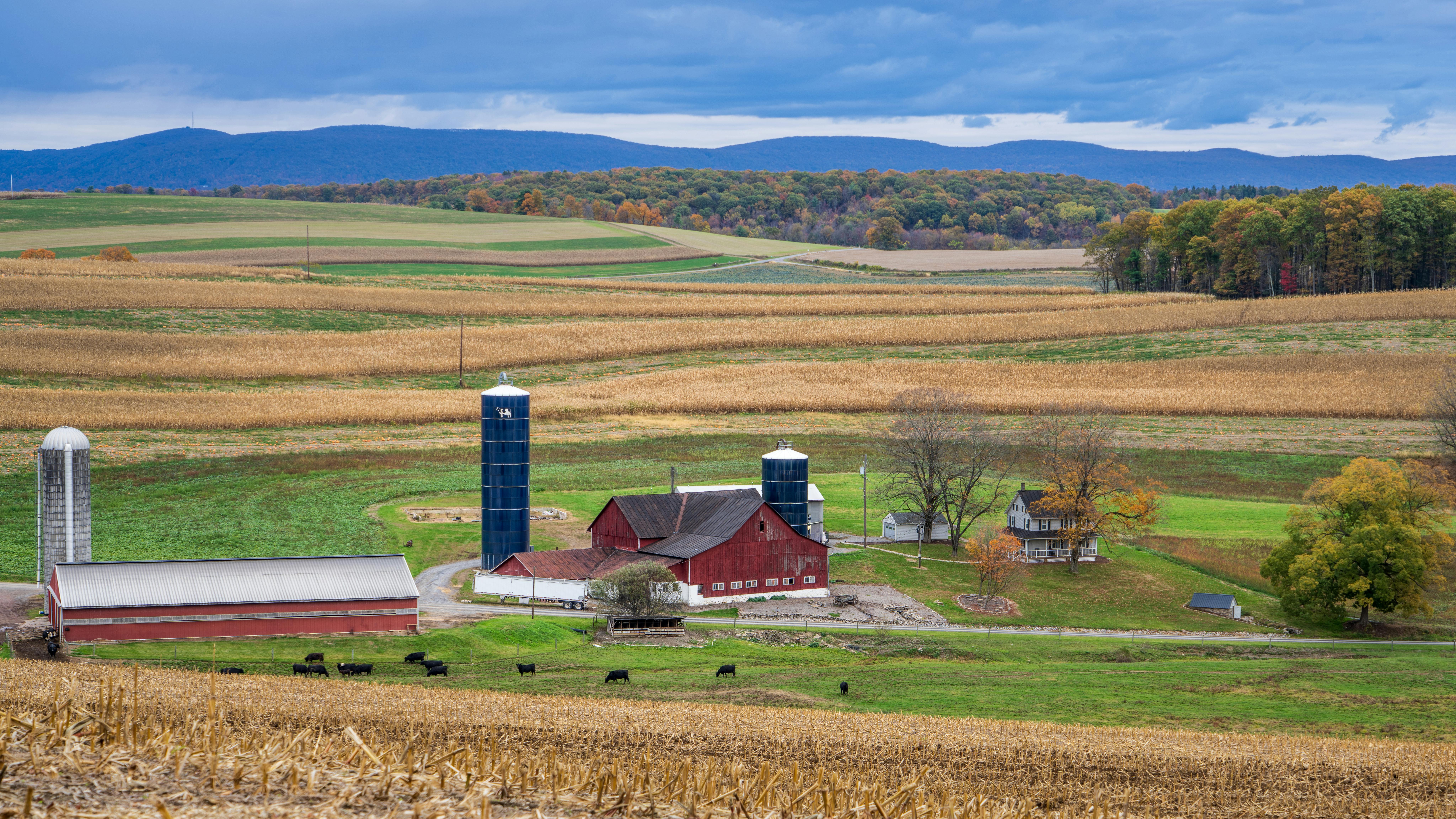 Image by: Phil Evenden: https://www.pexels.com/photo/scenic-...ania-34471682/