

9.2: Blood
- Page ID
- 191879

\( \newcommand{\vecs}[1]{\overset { \scriptstyle \rightharpoonup} {\mathbf{#1}} } \)
\( \newcommand{\vecd}[1]{\overset{-\!-\!\rightharpoonup}{\vphantom{a}\smash {#1}}} \)
\( \newcommand{\dsum}{\displaystyle\sum\limits} \)
\( \newcommand{\dint}{\displaystyle\int\limits} \)
\( \newcommand{\dlim}{\displaystyle\lim\limits} \)
\( \newcommand{\id}{\mathrm{id}}\) \( \newcommand{\Span}{\mathrm{span}}\)
( \newcommand{\kernel}{\mathrm{null}\,}\) \( \newcommand{\range}{\mathrm{range}\,}\)
\( \newcommand{\RealPart}{\mathrm{Re}}\) \( \newcommand{\ImaginaryPart}{\mathrm{Im}}\)
\( \newcommand{\Argument}{\mathrm{Arg}}\) \( \newcommand{\norm}[1]{\| #1 \|}\)
\( \newcommand{\inner}[2]{\langle #1, #2 \rangle}\)
\( \newcommand{\Span}{\mathrm{span}}\)
\( \newcommand{\id}{\mathrm{id}}\)
\( \newcommand{\Span}{\mathrm{span}}\)
\( \newcommand{\kernel}{\mathrm{null}\,}\)
\( \newcommand{\range}{\mathrm{range}\,}\)
\( \newcommand{\RealPart}{\mathrm{Re}}\)
\( \newcommand{\ImaginaryPart}{\mathrm{Im}}\)
\( \newcommand{\Argument}{\mathrm{Arg}}\)
\( \newcommand{\norm}[1]{\| #1 \|}\)
\( \newcommand{\inner}[2]{\langle #1, #2 \rangle}\)
\( \newcommand{\Span}{\mathrm{span}}\) \( \newcommand{\AA}{\unicode[.8,0]{x212B}}\)
\( \newcommand{\vectorA}[1]{\vec{#1}} % arrow\)
\( \newcommand{\vectorAt}[1]{\vec{\text{#1}}} % arrow\)
\( \newcommand{\vectorB}[1]{\overset { \scriptstyle \rightharpoonup} {\mathbf{#1}} } \)
\( \newcommand{\vectorC}[1]{\textbf{#1}} \)
\( \newcommand{\vectorD}[1]{\overrightarrow{#1}} \)
\( \newcommand{\vectorDt}[1]{\overrightarrow{\text{#1}}} \)
\( \newcommand{\vectE}[1]{\overset{-\!-\!\rightharpoonup}{\vphantom{a}\smash{\mathbf {#1}}}} \)
\( \newcommand{\vecs}[1]{\overset { \scriptstyle \rightharpoonup} {\mathbf{#1}} } \)
\(\newcommand{\longvect}{\overrightarrow}\)
\( \newcommand{\vecd}[1]{\overset{-\!-\!\rightharpoonup}{\vphantom{a}\smash {#1}}} \)
\(\newcommand{\avec}{\mathbf a}\) \(\newcommand{\bvec}{\mathbf b}\) \(\newcommand{\cvec}{\mathbf c}\) \(\newcommand{\dvec}{\mathbf d}\) \(\newcommand{\dtil}{\widetilde{\mathbf d}}\) \(\newcommand{\evec}{\mathbf e}\) \(\newcommand{\fvec}{\mathbf f}\) \(\newcommand{\nvec}{\mathbf n}\) \(\newcommand{\pvec}{\mathbf p}\) \(\newcommand{\qvec}{\mathbf q}\) \(\newcommand{\svec}{\mathbf s}\) \(\newcommand{\tvec}{\mathbf t}\) \(\newcommand{\uvec}{\mathbf u}\) \(\newcommand{\vvec}{\mathbf v}\) \(\newcommand{\wvec}{\mathbf w}\) \(\newcommand{\xvec}{\mathbf x}\) \(\newcommand{\yvec}{\mathbf y}\) \(\newcommand{\zvec}{\mathbf z}\) \(\newcommand{\rvec}{\mathbf r}\) \(\newcommand{\mvec}{\mathbf m}\) \(\newcommand{\zerovec}{\mathbf 0}\) \(\newcommand{\onevec}{\mathbf 1}\) \(\newcommand{\real}{\mathbb R}\) \(\newcommand{\twovec}[2]{\left[\begin{array}{r}#1 \\ #2 \end{array}\right]}\) \(\newcommand{\ctwovec}[2]{\left[\begin{array}{c}#1 \\ #2 \end{array}\right]}\) \(\newcommand{\threevec}[3]{\left[\begin{array}{r}#1 \\ #2 \\ #3 \end{array}\right]}\) \(\newcommand{\cthreevec}[3]{\left[\begin{array}{c}#1 \\ #2 \\ #3 \end{array}\right]}\) \(\newcommand{\fourvec}[4]{\left[\begin{array}{r}#1 \\ #2 \\ #3 \\ #4 \end{array}\right]}\) \(\newcommand{\cfourvec}[4]{\left[\begin{array}{c}#1 \\ #2 \\ #3 \\ #4 \end{array}\right]}\) \(\newcommand{\fivevec}[5]{\left[\begin{array}{r}#1 \\ #2 \\ #3 \\ #4 \\ #5 \\ \end{array}\right]}\) \(\newcommand{\cfivevec}[5]{\left[\begin{array}{c}#1 \\ #2 \\ #3 \\ #4 \\ #5 \\ \end{array}\right]}\) \(\newcommand{\mattwo}[4]{\left[\begin{array}{rr}#1 \amp #2 \\ #3 \amp #4 \\ \end{array}\right]}\) \(\newcommand{\laspan}[1]{\text{Span}\{#1\}}\) \(\newcommand{\bcal}{\cal B}\) \(\newcommand{\ccal}{\cal C}\) \(\newcommand{\scal}{\cal S}\) \(\newcommand{\wcal}{\cal W}\) \(\newcommand{\ecal}{\cal E}\) \(\newcommand{\coords}[2]{\left\{#1\right\}_{#2}}\) \(\newcommand{\gray}[1]{\color{gray}{#1}}\) \(\newcommand{\lgray}[1]{\color{lightgray}{#1}}\) \(\newcommand{\rank}{\operatorname{rank}}\) \(\newcommand{\row}{\text{Row}}\) \(\newcommand{\col}{\text{Col}}\) \(\renewcommand{\row}{\text{Row}}\) \(\newcommand{\nul}{\text{Nul}}\) \(\newcommand{\var}{\text{Var}}\) \(\newcommand{\corr}{\text{corr}}\) \(\newcommand{\len}[1]{\left|#1\right|}\) \(\newcommand{\bbar}{\overline{\bvec}}\) \(\newcommand{\bhat}{\widehat{\bvec}}\) \(\newcommand{\bperp}{\bvec^\perp}\) \(\newcommand{\xhat}{\widehat{\xvec}}\) \(\newcommand{\vhat}{\widehat{\vvec}}\) \(\newcommand{\uhat}{\widehat{\uvec}}\) \(\newcommand{\what}{\widehat{\wvec}}\) \(\newcommand{\Sighat}{\widehat{\Sigma}}\) \(\newcommand{\lt}{<}\) \(\newcommand{\gt}{>}\) \(\newcommand{\amp}{&}\) \(\definecolor{fillinmathshade}{gray}{0.9}\)From Bram Stoker’s famous novel about Count Dracula to the campy TV series Buffy the Vampire Slayer, fantasies featuring vampires, like the one in Figure \(\PageIndex{1}\), have been popular for decades. In fact, vampires are found in centuries-old myths from many cultures. In such myths, vampires are generally depicted as creatures that drink blood, preferably human blood, for sustenance. Dracula, for example, is based on Eastern European folklore about a human who attains immortality (and eternal damnation) by drinking the blood of others.

Blood
Blood is a fluid connective tissue that circulates throughout the body in blood vessels by the pumping action of the heart. Blood carries oxygen and nutrients to all the body’s cells, and it carries carbon dioxide and other wastes away from the cells to be excreted. Without the oxygen from blood, brain cells begin to die within just a few minutes.
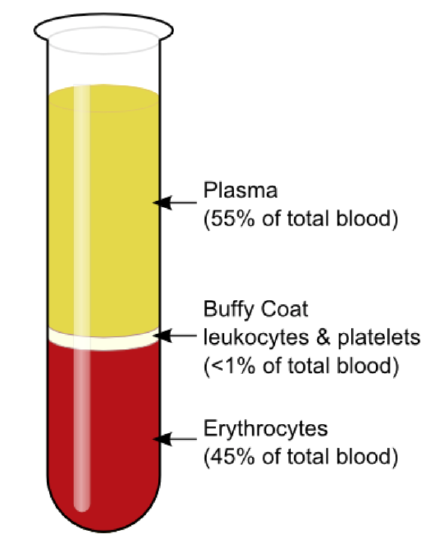
Blood also transports many other substances, defends the body against infection, repairs body tissues, and controls the body’s pH, among other functions. The average adult body contains between 4.7 and 5.7 liters (5-6 quarts) of blood. More than half of that amount is fluid (plasma).
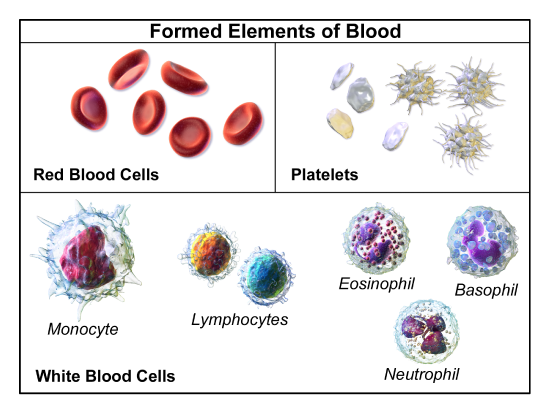
The formed elements in the blood compose most of the rest of the volume and include red blood cells, white blood cells, and platelets (Figure \(\PageIndex{2}\) and Figure \(\PageIndex{3}\)).
- Red blood cells primarily carry oxygen in the blood. Red blood cells consist mostly of hemoglobin, a protein containing iron that binds with oxygen.
- White blood cells are far fewer in number than red blood cells. They defend the body in various ways. For example, white blood cells called phagocytes swallow and destroy pathogens, dead cells, and other debris in the blood.
- Platelets are cell fragments involved in blood clotting. They stick to tears in blood vessels and to each other, forming a plug at the site of injury. They also release chemicals that are needed for clotting to occur.

Functions of Blood
Blood performs many important functions in the body. Major functions of blood include:
- supplying tissues with oxygen, which is needed by all cells for aerobic cellular respiration.
- supplying cells with nutrients, including glucose, amino acids, and fatty acids.
- removing metabolic wastes from cells, including carbon dioxide, urea, and lactic acid.
- helping to defend the body from pathogens and other foreign substances.
- forming clots to seal broken blood vessels and stop bleeding.
- transporting hormones and other messenger molecules.
- regulating the body's pH, which must be kept within a narrow range (7.35 to 7.45).
- helping to regulate body temperature (through vasoconstriction and vasodilation).
Blood Plasma
Plasma is a yellowish, watery liquid that contains many dissolved substances and blood cells, accounting for about 55% of blood volume (Figure \(\PageIndex{3}\)). It is ~92% water and contains many dissolved substances. Most of these substances are proteins, but plasma also contains trace amounts of glucose, mineral ions, hormones, carbon dioxide, and other substances.
Formed Elements
Red Blood Cells (RBCs)
RBCs or erythrocytes are the most numerous cells in the blood and make up ~25% of all cells in the human body. One microliter of blood contains 4.2-6.1 million red blood cells.
The cytoplasm of a mature RBC is almost completely filled with hemoglobin, the protein that binds oxygen to iron, giving the cell its red color. Mature RBCs lack a nucleus and most organelles to provide maximum space for hemoglobin. They are little more than sacks of hemoglobin.
RBCs also carry proteins called antigens that determine blood type, which is a genetic characteristic. The best-known human blood type systems are the ABO and Rhesus systems.
It’s often said that despite humanity’s many conflicts, we all bleed the same blood. It’s a nice thought, but not quite accurate. In fact, our blood comes in several varieties. Natalie S. Hodge defines the four major blood types and explains why some blood types can mix while others cannot.
White Blood Cells (WBCs)
WBCs, or leukocytes, are blood cells that defend the body against invading microorganisms and other threats. There are far fewer white blood cells (also called leukocytes) than red blood cells in the blood. There are normally only about 1,000 to 11,000 white blood cells per microliter of blood. Unlike red blood cells, white blood cells have a nucleus. White blood cells are part of the body’s immune system. They destroy and remove old or abnormal cells and cellular debris, and attack pathogens and foreign substances.
There are two categories of WBCs (Table \(\PageIndex{1}\)):
- Granulocytes contain visible granules in the cytoplasm and include neutrophils, eosinophils, and basophils.
- Agranulocytes do not contain granules and include lymphocytes and monocytes.
| Type of Leukocyte | Percent of All Leukocytes | Main Function(s) |
|---|---|---|
| Neutrophil | 62 | Phagocytize (engulf and destroy) bacteria and fungi in the blood |
| Eosinophil | 2 | Attack and kill large parasites; carry out allergic responses |
| Basophil | <1 | Release histamines in inflammatory responses |
| Lymphocyte | 30 | Attack and destroy virus-infected and tumor cells; create lasting immunity to specific pathogens |
| Monocyte | 5 | Phagocytize pathogens and debris in tissues |
Platelets
Platelets, also called thrombocytes, are actually cell fragments. Like red blood cells, they lack a nucleus and are more numerous than white blood cells. There are about 150,000 to 400,000 platelets per microliter of blood.
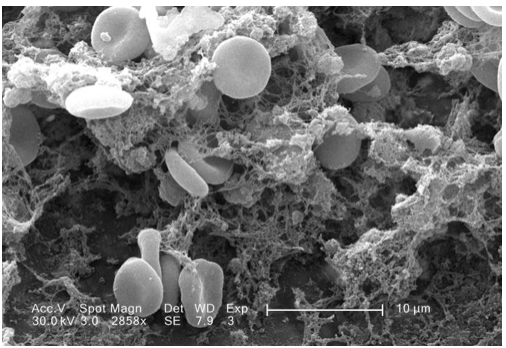
The main function of platelets is blood clotting or coagulation. This is the process by which blood changes from a liquid to a gel, forming a plug in a damaged blood vessel. If blood clotting is successful, it results in hemostasis, which is the cessation of blood loss from the damaged vessel. A blood clot consists of both platelets and proteins, especially the protein fibrin (Figure \(\PageIndex{4}\)).
Coagulation begins almost instantly after an injury to the endothelium of a blood vessel occurs. Platelets become activated and change their shape from spherical to star-shaped, helping them aggregate at the site of injury and forming a plug in the vessel wall.
Activated platelets also release substances into the blood that activate additional platelets, initiating a sequence of reactions that leads to fibrin formation. Strands of fibrin crisscross the platelet plug, strengthening it much as rebar strengthens concrete.
Formation and Degradation of Blood Cells
Blood is considered connective tissue because blood cells form within bones. All three types of blood cells are produced in the red marrow of bones, a process called hematopoiesis. Blood cell formation occurs through the proliferation of stem cells in the marrow. These stem cells are self-renewing: when they divide, some of the daughter cells remain stem cells, so the stem cell pool is not depleted. Other daughter cells follow different pathways to differentiate into various blood cell types. Once the cells have differentiated, they cannot divide to form copies of themselves.
Eventually, blood cells die and must be replaced through the formation of new blood cells from proliferating stem cells. After blood cells die, they are phagocytized (engulfed and destroyed) by white blood cells and removed from the circulation. This most often takes place in the spleen and liver.
Blood Disorders
Many human disorders primarily affect the blood. They include cancers, genetic disorders, poisoning, infections, and nutritional deficiencies.
- Women tend to experience bleeding disorders disproportionately due to their complications with menstruation, pregnancy, labor, and delivery. One of these diseases is von Willebrand disease (VWD), an inherited bleeding disorder. It occurs at the same rate in women and men, but affects women much more seriously. In addition, women are diagnosed with blood disorders overall at much lower rates than men, often due to women being misdiagnosed or underdiagnosed.
- Hemophilia refers to any of several genetic disorders that cause dysfunction in the blood clotting process. People with hemophilia are prone to potentially uncontrollable bleeding even with otherwise inconsequential injuries. They also commonly suffer bleeding into the spaces between joints, which can cause crippling.
- Sickle cell disease (SCD) is a group of inherited red blood cell disorders caused by a genetic mutation that forces hemoglobin to form rigid, sickle-shaped cells. These cells block blood flow, causing severe pain (crises), anemia, organ damage, and infections. While chronic, management has improved life expectancy to the 40s–50s, it remains a life-shortening condition. In the United States, it most often occurs in Black families, although any race can be affected.
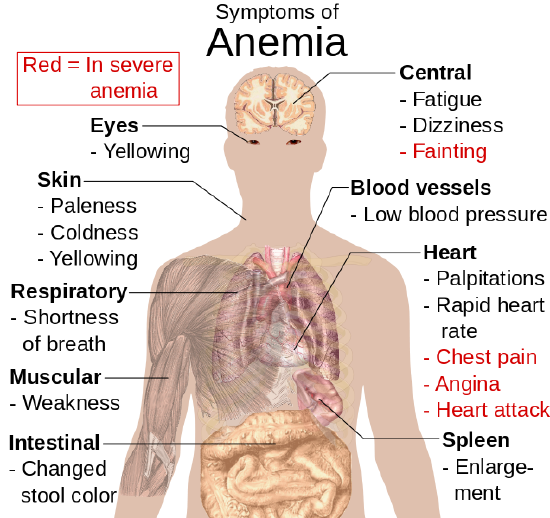
- Anemia is a disorder in which the blood has an inadequate volume of red blood cells. This reduces the amount of oxygen the blood can carry, which may cause weakness and fatigue. These and other signs and symptoms of anemia are shown in the figure below. Anemia has many possible causes, including excessive bleeding, inherited disorders such as sickle cell hemoglobin, or nutritional deficiencies (iron, folate, or B12). Severe anemia may require blood transfusions.
- Carbon monoxide poisoning occurs when inhaled carbon monoxide (for example, in fumes from a faulty home furnace) binds irreversibly to the hemoglobin in red blood cells. As a result, oxygen cannot bind to red blood cells for transport throughout the body, leading to rapid suffocation. Carbon monoxide is extremely dangerous because it is colorless and odorless, so it cannot be detected in the air by human senses.
Feature: Myth vs. Reality
Donating blood saves lives, up to three with each donation!
Knowing you have saved lives is well worth the short time it takes to donate blood.
Nonetheless, only a minority of potential donors actually donate blood. There are many myths about blood donation that contribute to the low donor rate.
Knowing the facts may reaffirm your decision to donate if you are already a donor. If you aren’t a donor already, getting the facts may help you decide to become one.
Myth: Your blood might become contaminated with an infection during the donation.
Reality: There is no risk of contamination because only single-use, disposable catheters, tubing, and other equipment are used to collect blood for a donation.
Myth: You are too old (or too young) to donate blood.
Reality: There is no upper age limit on donating blood as long as you are healthy. The lower age limit is 16 years.
Myth: You can’t donate blood if you have high blood pressure.
Reality: As long as your blood pressure is below 180/100 at the time of donation, you can give blood. Even if you take blood pressure medication to keep your blood pressure below this level, you can donate.
Myth: You can’t give blood if you have high cholesterol.
Reality: Having high cholesterol does not affect your ability to donate blood. Taking cholesterol-lowering medication also does not disqualify you.
Myth: You can’t donate blood if you have had a flu shot.
Reality: Having a flu shot has no effect on your ability to donate blood. You can even donate on the same day that you receive a flu shot.
Myth: You can’t donate blood if you take medication.
Reality: As long as you are healthy, in most cases, taking medication does not preclude you from donating blood.
Myth: Your blood isn’t needed if it’s a common blood type.
Reality: All types of blood are in constant demand.