7.6: The Adrenal Glands
- Page ID
- 191396

\( \newcommand{\vecs}[1]{\overset { \scriptstyle \rightharpoonup} {\mathbf{#1}} } \)
\( \newcommand{\vecd}[1]{\overset{-\!-\!\rightharpoonup}{\vphantom{a}\smash {#1}}} \)
\( \newcommand{\dsum}{\displaystyle\sum\limits} \)
\( \newcommand{\dint}{\displaystyle\int\limits} \)
\( \newcommand{\dlim}{\displaystyle\lim\limits} \)
\( \newcommand{\id}{\mathrm{id}}\) \( \newcommand{\Span}{\mathrm{span}}\)
( \newcommand{\kernel}{\mathrm{null}\,}\) \( \newcommand{\range}{\mathrm{range}\,}\)
\( \newcommand{\RealPart}{\mathrm{Re}}\) \( \newcommand{\ImaginaryPart}{\mathrm{Im}}\)
\( \newcommand{\Argument}{\mathrm{Arg}}\) \( \newcommand{\norm}[1]{\| #1 \|}\)
\( \newcommand{\inner}[2]{\langle #1, #2 \rangle}\)
\( \newcommand{\Span}{\mathrm{span}}\)
\( \newcommand{\id}{\mathrm{id}}\)
\( \newcommand{\Span}{\mathrm{span}}\)
\( \newcommand{\kernel}{\mathrm{null}\,}\)
\( \newcommand{\range}{\mathrm{range}\,}\)
\( \newcommand{\RealPart}{\mathrm{Re}}\)
\( \newcommand{\ImaginaryPart}{\mathrm{Im}}\)
\( \newcommand{\Argument}{\mathrm{Arg}}\)
\( \newcommand{\norm}[1]{\| #1 \|}\)
\( \newcommand{\inner}[2]{\langle #1, #2 \rangle}\)
\( \newcommand{\Span}{\mathrm{span}}\) \( \newcommand{\AA}{\unicode[.8,0]{x212B}}\)
\( \newcommand{\vectorA}[1]{\vec{#1}} % arrow\)
\( \newcommand{\vectorAt}[1]{\vec{\text{#1}}} % arrow\)
\( \newcommand{\vectorB}[1]{\overset { \scriptstyle \rightharpoonup} {\mathbf{#1}} } \)
\( \newcommand{\vectorC}[1]{\textbf{#1}} \)
\( \newcommand{\vectorD}[1]{\overrightarrow{#1}} \)
\( \newcommand{\vectorDt}[1]{\overrightarrow{\text{#1}}} \)
\( \newcommand{\vectE}[1]{\overset{-\!-\!\rightharpoonup}{\vphantom{a}\smash{\mathbf {#1}}}} \)
\( \newcommand{\vecs}[1]{\overset { \scriptstyle \rightharpoonup} {\mathbf{#1}} } \)
\(\newcommand{\longvect}{\overrightarrow}\)
\( \newcommand{\vecd}[1]{\overset{-\!-\!\rightharpoonup}{\vphantom{a}\smash {#1}}} \)
\(\newcommand{\avec}{\mathbf a}\) \(\newcommand{\bvec}{\mathbf b}\) \(\newcommand{\cvec}{\mathbf c}\) \(\newcommand{\dvec}{\mathbf d}\) \(\newcommand{\dtil}{\widetilde{\mathbf d}}\) \(\newcommand{\evec}{\mathbf e}\) \(\newcommand{\fvec}{\mathbf f}\) \(\newcommand{\nvec}{\mathbf n}\) \(\newcommand{\pvec}{\mathbf p}\) \(\newcommand{\qvec}{\mathbf q}\) \(\newcommand{\svec}{\mathbf s}\) \(\newcommand{\tvec}{\mathbf t}\) \(\newcommand{\uvec}{\mathbf u}\) \(\newcommand{\vvec}{\mathbf v}\) \(\newcommand{\wvec}{\mathbf w}\) \(\newcommand{\xvec}{\mathbf x}\) \(\newcommand{\yvec}{\mathbf y}\) \(\newcommand{\zvec}{\mathbf z}\) \(\newcommand{\rvec}{\mathbf r}\) \(\newcommand{\mvec}{\mathbf m}\) \(\newcommand{\zerovec}{\mathbf 0}\) \(\newcommand{\onevec}{\mathbf 1}\) \(\newcommand{\real}{\mathbb R}\) \(\newcommand{\twovec}[2]{\left[\begin{array}{r}#1 \\ #2 \end{array}\right]}\) \(\newcommand{\ctwovec}[2]{\left[\begin{array}{c}#1 \\ #2 \end{array}\right]}\) \(\newcommand{\threevec}[3]{\left[\begin{array}{r}#1 \\ #2 \\ #3 \end{array}\right]}\) \(\newcommand{\cthreevec}[3]{\left[\begin{array}{c}#1 \\ #2 \\ #3 \end{array}\right]}\) \(\newcommand{\fourvec}[4]{\left[\begin{array}{r}#1 \\ #2 \\ #3 \\ #4 \end{array}\right]}\) \(\newcommand{\cfourvec}[4]{\left[\begin{array}{c}#1 \\ #2 \\ #3 \\ #4 \end{array}\right]}\) \(\newcommand{\fivevec}[5]{\left[\begin{array}{r}#1 \\ #2 \\ #3 \\ #4 \\ #5 \\ \end{array}\right]}\) \(\newcommand{\cfivevec}[5]{\left[\begin{array}{c}#1 \\ #2 \\ #3 \\ #4 \\ #5 \\ \end{array}\right]}\) \(\newcommand{\mattwo}[4]{\left[\begin{array}{rr}#1 \amp #2 \\ #3 \amp #4 \\ \end{array}\right]}\) \(\newcommand{\laspan}[1]{\text{Span}\{#1\}}\) \(\newcommand{\bcal}{\cal B}\) \(\newcommand{\ccal}{\cal C}\) \(\newcommand{\scal}{\cal S}\) \(\newcommand{\wcal}{\cal W}\) \(\newcommand{\ecal}{\cal E}\) \(\newcommand{\coords}[2]{\left\{#1\right\}_{#2}}\) \(\newcommand{\gray}[1]{\color{gray}{#1}}\) \(\newcommand{\lgray}[1]{\color{lightgray}{#1}}\) \(\newcommand{\rank}{\operatorname{rank}}\) \(\newcommand{\row}{\text{Row}}\) \(\newcommand{\col}{\text{Col}}\) \(\renewcommand{\row}{\text{Row}}\) \(\newcommand{\nul}{\text{Nul}}\) \(\newcommand{\var}{\text{Var}}\) \(\newcommand{\corr}{\text{corr}}\) \(\newcommand{\len}[1]{\left|#1\right|}\) \(\newcommand{\bbar}{\overline{\bvec}}\) \(\newcommand{\bhat}{\widehat{\bvec}}\) \(\newcommand{\bperp}{\bvec^\perp}\) \(\newcommand{\xhat}{\widehat{\xvec}}\) \(\newcommand{\vhat}{\widehat{\vvec}}\) \(\newcommand{\uhat}{\widehat{\uvec}}\) \(\newcommand{\what}{\widehat{\wvec}}\) \(\newcommand{\Sighat}{\widehat{\Sigma}}\) \(\newcommand{\lt}{<}\) \(\newcommand{\gt}{>}\) \(\newcommand{\amp}{&}\) \(\definecolor{fillinmathshade}{gray}{0.9}\)Introduction to the Adrenal Glands
The adrenal glands are endocrine glands that produce a variety of hormones.
Adrenal hormones include the fight-or-flight hormone adrenaline and the steroid hormone cortisol. The two adrenal glands are located on both sides of the body, just above the kidneys, as shown in Figure \(\PageIndex{1}\). The right adrenal gland (on the left in the figure) is smaller and pyramidal. The left adrenal gland (on the right in the figure) is larger and has a half-moon shape.
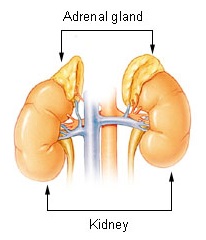
Each adrenal gland has two distinct parts, each with a different function, although both produce hormones.
- The outer layer is called the adrenal cortex and produces steroid hormones, including cortisol.
- The inner layer, called the adrenal medulla, produces non-steroid hormones including adrenaline.
Adrenal Cortex
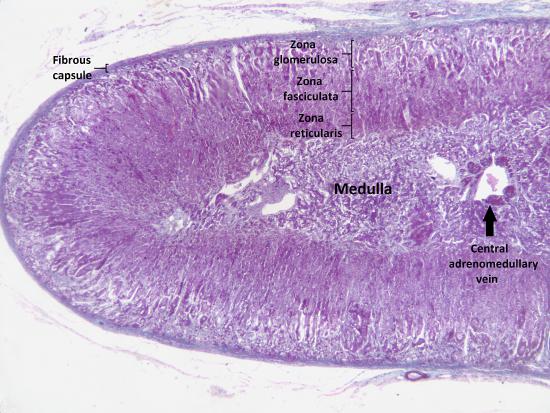
The adrenal cortex, or the outer layer of the adrenal gland, is divided, in turn, into three additional layers, called zones (Figure \(\PageIndex{2}\)).
Each zone has distinct enzymes that produce different hormones from the common precursor molecule cholesterol, which is a lipid.
- The zona glomerulosa is the outermost layer and lies immediately beneath the outer fibrous capsule that encloses the adrenal gland.
- The zona fasciculata is the middle layer and the largest of the three zones, accounting for nearly 80 percent of the adrenal cortex.
- The zona reticularis is the innermost layer and is directly adjacent to the adrenal medulla.
Types of Adrenal Cortex Hormones
Hormones produced by the adrenal cortex are called corticosteroids.
As steroid hormones, corticosteroids are endocrine lipids that exert their effects on target cells by crossing the plasma membrane and binding to receptors in the cytoplasm.
There are three types of corticosteroids synthesized and secreted by the adrenal cortex. Each type is produced by a different zone of the adrenal cortex, as shown in Figure \(\PageIndex{3}\).
Mineralocorticoids
Mineralocorticoids are produced in the zona glomerulosa and include the hormone aldosterone. These hormones help control the balance of mineral salts (electrolytes) in the body.
- In the kidneys, aldosterone increases the reabsorption of sodium ions and the excretion of potassium ions.
- Aldosterone also stimulates the retention of sodium ions by cells in the colon and by the sweat glands.
The amount of sodium in the body affects the volume of extracellular fluids, including blood, thereby influencing blood pressure. In this way, mineralocorticoids help control blood volume and blood pressure.
Glucocorticoids
Glucocorticoids are produced in the zona fasciculata and include the hormone cortisol, which is released in response to stress and is considered the primary stress hormone.
- Glucocorticoids help control the rate of metabolism of proteins, fats, and sugars. In general, they increase circulating glucose and fatty acid levels. Cells rely primarily on glucose for energy, but they can also use fatty acids for energy as an alternative to glucose.
- Glucocorticoids also suppress the immune system, exerting a potent anti-inflammatory effect.
- In addition, cortisol reduces bone formation and decreases calcium absorption from the gastrointestinal tract.
Androgens
Androgens are produced in the zona reticularis and include the hormone DHEA (dehydroepiandrosterone).
Androgens are a general term for male sex hormones, although this is misleading, as adrenal cortex androgens are produced by both males and females.
- In adult males, they are converted to more potent androgens such as testosterone in the male gonads (testes).
- In adult females, they are converted to female sex hormones called estrogens in the female gonads (ovaries).
Regulation of Adrenal Cortex Hormones
Steroid hormone production by the three zones of the adrenal cortex is regulated by hormones secreted by the anterior lobe of the pituitary gland as well as by other physiological stimuli. For example,
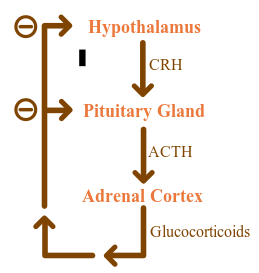
- The production of glucocorticoids such as cortisol is stimulated by adrenocorticotropic hormone (ACTH) from the anterior pituitary.
- This is stimulated by corticotropin-releasing hormone (CRH) from the hypothalamus.
- When glucocorticoid levels rise too high, they provide negative feedback to the hypothalamus and pituitary gland, inhibiting CRH and ACTH secretion, respectively (Figure \(\PageIndex{3}\)).
The opposite occurs when glucocorticoid levels fall too low.
Adrenal Medulla
The adrenal medulla is at the center of each adrenal gland and is surrounded by the adrenal cortex. It contains a dense network of blood vessels into which it secretes its hormones.
The hormones synthesized and secreted by the adrenal medulla are catecholamines, including adrenaline (also called epinephrine) and noradrenaline (also called norepinephrine). These are water-soluble, non-steroidal hormones made of amino acids.
Catecholamines function to produce a rapid response throughout the body in stressful situations. They cause changes such as increased heart rate, rapid breathing, constriction of blood vessels in certain parts of the body, and increased blood pressure. The release of catecholamines by the adrenal medulla is stimulated by activation of the sympathetic division of the autonomic nervous system.
Stress isn’t always a bad thing; it can be handy for a burst of extra energy and focus, like when you’re playing a competitive sport or have to speak in public. But when it’s continuous, it actually begins to change your brain. Madhumita Murgia shows how chronic stress can affect brain size, structure, and function, right down to the level of your genes.
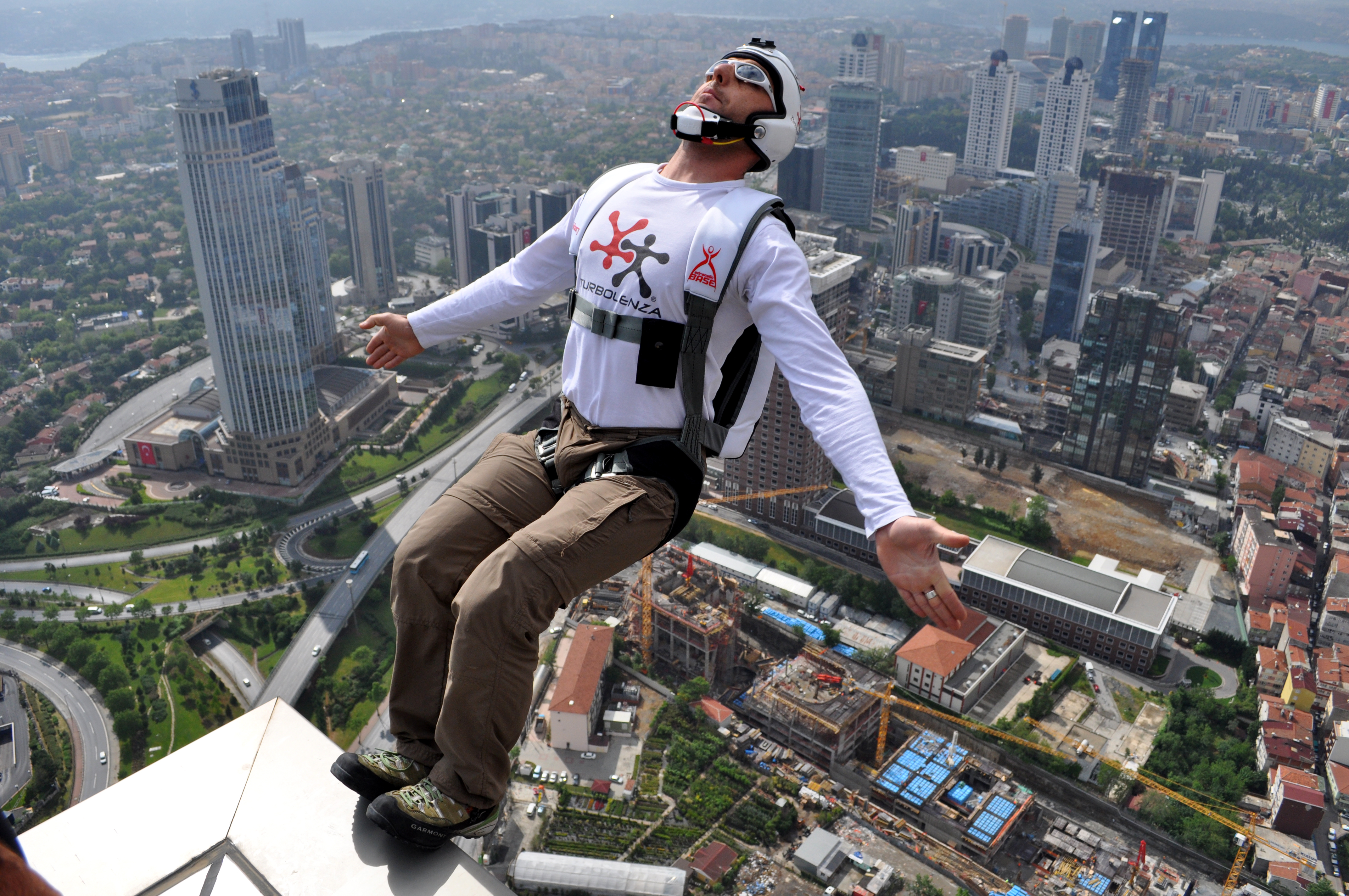
Does just looking at this photo cause you to break out in a cold sweat and experience heart palpitations? Imagine how scary it would be to fling yourself backward off a tall building like BASE jumping (Figure \(\PageIndex{4}\)). There would be very little time to use a parachute to slow your fall before you hit the ground. BASE jumping is called the most dangerous sport on Earth. In fact, it is so dangerous that it is outlawed in some places.
People who participate in such dangerous activities as BASE jumping are likely to be adrenaline “junkies.” They are addicted to the adrenaline rush and euphoria, or “high,” it causes when their fight-or-flight response is triggered by danger. Why does adrenaline have this effect? Adrenaline is closely related to dopamine, a chemical messenger in the brain that plays a major role in pleasure and addiction.
Adrenaline addicts don’t have to participate in BASE jumping or other dangerous sports to get an adrenaline rush. They might choose a dangerous occupation, engage in risky behaviors, such as reckless driving or bank robbery, or just pick fights with other people. They might even create their own stress by always taking on too much work or delaying projects until close to their deadline.
While some excitement in one’s life is generally a good thing, always putting oneself in danger or constantly being under stress are obviously not good things. If you think you might be an adrenaline addict, note that there are healthier ways to experience a hormonal “high.” Running, biking, or participating in some other form of vigorous aerobic exercise causes the pituitary gland and hypothalamus to produce opiate-like endorphins, leading to a so-called “runner’s high.” Like the euphoric feeling adrenaline causes, a runner’s high may last for hours.
Disorders of the Adrenal Glands
Disorders of the adrenal glands generally include either hypersecretion or hyposecretion of adrenal hormones.
The underlying cause of the abnormal secretion may be a problem with the adrenal glands or with the pituitary gland, which controls adrenal cortex hormone production.
Both the adrenal and pituitary glands are susceptible to tumor formation, which can lead to adrenal disorders. The adrenal gland may also be affected by infections or autoimmune diseases.
Adrenal Hypersecretion: Cushing’s Syndrome
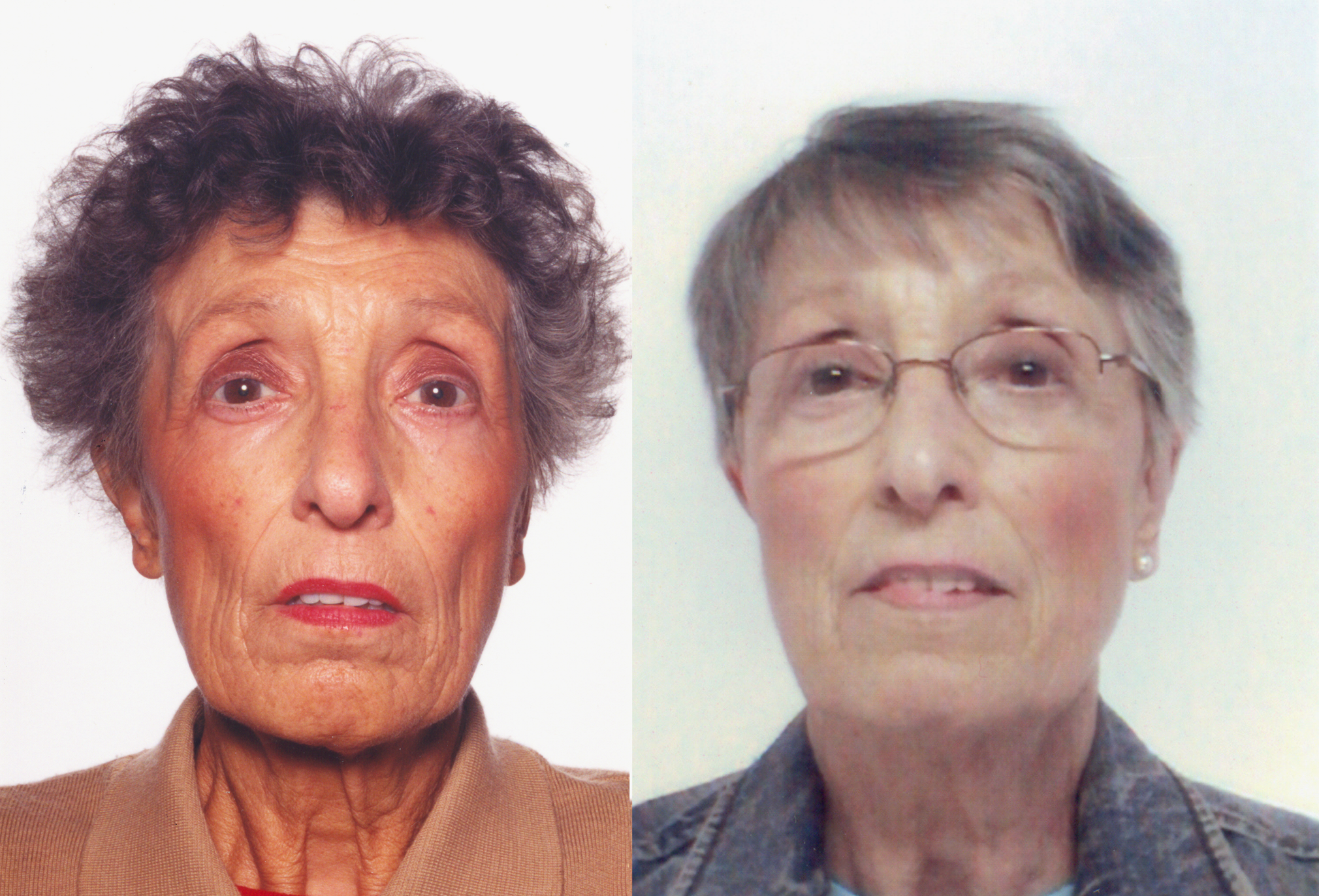
Hypersecretion of the glucocorticoid hormone cortisol leads to a disorder named Cushing’s syndrome.
The most common cause of Cushing’s syndrome is a pituitary tumor, which causes excessive production of ACTH.
The disease produces a wide variety of signs and symptoms, which may include obesity, diabetes, high blood pressure (hypertension), excessive body hair, osteoporosis, and depression.
A distinctive sign of Cushing’s syndrome is the appearance of stretch marks in the skin, as the skin becomes progressively thinner. Another distinctive sign is a moon face, characterized by excess fat deposits giving the face a rounded appearance.
Treatment of Cushing’s syndrome depends on its cause and may include surgery to remove a tumor or medications to suppress the activity of the adrenal glands.
Adrenal Hyposecretion: Addison’s Disease
Hyposecretion of the glucocorticoid hormone cortisol leads to a disorder named Addison’s disease. There may also be hyposecretion of mineralocorticoids with this disorder.
Addison’s disease is generally an autoimmune disorder in which the immune system produces abnormal antibodies that attack cells of the adrenal cortex. Untreated infections, especially of tuberculosis, may also damage the adrenal cortex and cause Addison’s disease. A third possible cause is decreased ACTH secretion by the pituitary gland, typically due to a pituitary tumor.
A distinctive sign of Addison’s disease is hyperpigmentation of the skin (Figure \(\PageIndex{5}\)). Other symptoms are typically nonspecific and include excessive fatigue. Addison’s disease is generally treated with replacement hormones in pill form.