

1.8: Themes and Concepts of Biology
- Page ID
- 94757

\( \newcommand{\vecs}[1]{\overset { \scriptstyle \rightharpoonup} {\mathbf{#1}} } \)
\( \newcommand{\vecd}[1]{\overset{-\!-\!\rightharpoonup}{\vphantom{a}\smash {#1}}} \)
\( \newcommand{\dsum}{\displaystyle\sum\limits} \)
\( \newcommand{\dint}{\displaystyle\int\limits} \)
\( \newcommand{\dlim}{\displaystyle\lim\limits} \)
\( \newcommand{\id}{\mathrm{id}}\) \( \newcommand{\Span}{\mathrm{span}}\)
( \newcommand{\kernel}{\mathrm{null}\,}\) \( \newcommand{\range}{\mathrm{range}\,}\)
\( \newcommand{\RealPart}{\mathrm{Re}}\) \( \newcommand{\ImaginaryPart}{\mathrm{Im}}\)
\( \newcommand{\Argument}{\mathrm{Arg}}\) \( \newcommand{\norm}[1]{\| #1 \|}\)
\( \newcommand{\inner}[2]{\langle #1, #2 \rangle}\)
\( \newcommand{\Span}{\mathrm{span}}\)
\( \newcommand{\id}{\mathrm{id}}\)
\( \newcommand{\Span}{\mathrm{span}}\)
\( \newcommand{\kernel}{\mathrm{null}\,}\)
\( \newcommand{\range}{\mathrm{range}\,}\)
\( \newcommand{\RealPart}{\mathrm{Re}}\)
\( \newcommand{\ImaginaryPart}{\mathrm{Im}}\)
\( \newcommand{\Argument}{\mathrm{Arg}}\)
\( \newcommand{\norm}[1]{\| #1 \|}\)
\( \newcommand{\inner}[2]{\langle #1, #2 \rangle}\)
\( \newcommand{\Span}{\mathrm{span}}\) \( \newcommand{\AA}{\unicode[.8,0]{x212B}}\)
\( \newcommand{\vectorA}[1]{\vec{#1}} % arrow\)
\( \newcommand{\vectorAt}[1]{\vec{\text{#1}}} % arrow\)
\( \newcommand{\vectorB}[1]{\overset { \scriptstyle \rightharpoonup} {\mathbf{#1}} } \)
\( \newcommand{\vectorC}[1]{\textbf{#1}} \)
\( \newcommand{\vectorD}[1]{\overrightarrow{#1}} \)
\( \newcommand{\vectorDt}[1]{\overrightarrow{\text{#1}}} \)
\( \newcommand{\vectE}[1]{\overset{-\!-\!\rightharpoonup}{\vphantom{a}\smash{\mathbf {#1}}}} \)
\( \newcommand{\vecs}[1]{\overset { \scriptstyle \rightharpoonup} {\mathbf{#1}} } \)
\(\newcommand{\longvect}{\overrightarrow}\)
\( \newcommand{\vecd}[1]{\overset{-\!-\!\rightharpoonup}{\vphantom{a}\smash {#1}}} \)
\(\newcommand{\avec}{\mathbf a}\) \(\newcommand{\bvec}{\mathbf b}\) \(\newcommand{\cvec}{\mathbf c}\) \(\newcommand{\dvec}{\mathbf d}\) \(\newcommand{\dtil}{\widetilde{\mathbf d}}\) \(\newcommand{\evec}{\mathbf e}\) \(\newcommand{\fvec}{\mathbf f}\) \(\newcommand{\nvec}{\mathbf n}\) \(\newcommand{\pvec}{\mathbf p}\) \(\newcommand{\qvec}{\mathbf q}\) \(\newcommand{\svec}{\mathbf s}\) \(\newcommand{\tvec}{\mathbf t}\) \(\newcommand{\uvec}{\mathbf u}\) \(\newcommand{\vvec}{\mathbf v}\) \(\newcommand{\wvec}{\mathbf w}\) \(\newcommand{\xvec}{\mathbf x}\) \(\newcommand{\yvec}{\mathbf y}\) \(\newcommand{\zvec}{\mathbf z}\) \(\newcommand{\rvec}{\mathbf r}\) \(\newcommand{\mvec}{\mathbf m}\) \(\newcommand{\zerovec}{\mathbf 0}\) \(\newcommand{\onevec}{\mathbf 1}\) \(\newcommand{\real}{\mathbb R}\) \(\newcommand{\twovec}[2]{\left[\begin{array}{r}#1 \\ #2 \end{array}\right]}\) \(\newcommand{\ctwovec}[2]{\left[\begin{array}{c}#1 \\ #2 \end{array}\right]}\) \(\newcommand{\threevec}[3]{\left[\begin{array}{r}#1 \\ #2 \\ #3 \end{array}\right]}\) \(\newcommand{\cthreevec}[3]{\left[\begin{array}{c}#1 \\ #2 \\ #3 \end{array}\right]}\) \(\newcommand{\fourvec}[4]{\left[\begin{array}{r}#1 \\ #2 \\ #3 \\ #4 \end{array}\right]}\) \(\newcommand{\cfourvec}[4]{\left[\begin{array}{c}#1 \\ #2 \\ #3 \\ #4 \end{array}\right]}\) \(\newcommand{\fivevec}[5]{\left[\begin{array}{r}#1 \\ #2 \\ #3 \\ #4 \\ #5 \\ \end{array}\right]}\) \(\newcommand{\cfivevec}[5]{\left[\begin{array}{c}#1 \\ #2 \\ #3 \\ #4 \\ #5 \\ \end{array}\right]}\) \(\newcommand{\mattwo}[4]{\left[\begin{array}{rr}#1 \amp #2 \\ #3 \amp #4 \\ \end{array}\right]}\) \(\newcommand{\laspan}[1]{\text{Span}\{#1\}}\) \(\newcommand{\bcal}{\cal B}\) \(\newcommand{\ccal}{\cal C}\) \(\newcommand{\scal}{\cal S}\) \(\newcommand{\wcal}{\cal W}\) \(\newcommand{\ecal}{\cal E}\) \(\newcommand{\coords}[2]{\left\{#1\right\}_{#2}}\) \(\newcommand{\gray}[1]{\color{gray}{#1}}\) \(\newcommand{\lgray}[1]{\color{lightgray}{#1}}\) \(\newcommand{\rank}{\operatorname{rank}}\) \(\newcommand{\row}{\text{Row}}\) \(\newcommand{\col}{\text{Col}}\) \(\renewcommand{\row}{\text{Row}}\) \(\newcommand{\nul}{\text{Nul}}\) \(\newcommand{\var}{\text{Var}}\) \(\newcommand{\corr}{\text{corr}}\) \(\newcommand{\len}[1]{\left|#1\right|}\) \(\newcommand{\bbar}{\overline{\bvec}}\) \(\newcommand{\bhat}{\widehat{\bvec}}\) \(\newcommand{\bperp}{\bvec^\perp}\) \(\newcommand{\xhat}{\widehat{\xvec}}\) \(\newcommand{\vhat}{\widehat{\vvec}}\) \(\newcommand{\uhat}{\widehat{\uvec}}\) \(\newcommand{\what}{\widehat{\wvec}}\) \(\newcommand{\Sighat}{\widehat{\Sigma}}\) \(\newcommand{\lt}{<}\) \(\newcommand{\gt}{>}\) \(\newcommand{\amp}{&}\) \(\definecolor{fillinmathshade}{gray}{0.9}\)Unit 1.2 - Themes and Concepts of Biology
- Please read and watch the following Mandatory Resources
- Reading the material to understand and taking notes during the videos will take approximately 1 hour.
- Optional Activities and Resources are embedded.
- Bolded terms are located at the end of the unit in the Glossary. There is also a Unit Summary at the end of the Unit.
- To navigate to Unit 1.3, use the Contents menu at the top of the page OR the right arrow on the side of the page.
- If on a mobile device, use the Contents menu at the top of the page OR the links at the bottom of the page.
- Identify and describe the properties of life
- Describe the levels of organization among living things
- Identify the shared characteristics of the natural sciences
- Identify examples of different subdisciplines in biology
What is Biology?
In simple terms, biology is the study of living organisms and their interactions with one another and their environments. This is a very broad definition because biology spans a vast range. Biologists may study anything from the microscopic or submicroscopic view of a cell to ecosystems and the whole living planet (Figure \(\PageIndex{1}\)).


Listening to the daily news, you will quickly realize how many aspects of biology are discussed every day. For example, recent news topics include Escherichia coli (Figure \(\PageIndex{2}\)) outbreaks in spinach and Salmonella contamination in peanut butter. Other subjects include efforts toward finding a cure for AIDS, Alzheimer’s disease, and cancer. On a global scale, many researchers are committed to protecting the planet, addressing environmental issues, and mitigating the effects of climate change. All of these diverse endeavors are related to different facets of the discipline of biology.

Find up-to-date news on biology at Science Daily.
Biology is the science that studies life, but what exactly is life? This may sound like a silly question with an obvious answer, but defining life is not always easy. For example, a branch of biology called virology studies viruses, which exhibit some of the characteristics of living entities but lack others. It turns out that although viruses can attack living organisms, cause diseases, and even reproduce, they do not meet the criteria that biologists use to define life. Consequently, virologists are not biologists, strictly speaking. Similarly, some biologists study the early molecular evolution that gave rise to life; since the events that preceded life are not biological events, these scientists are also excluded from biology in the strict sense of the term.
From its earliest beginnings, biology has wrestled with three questions:
- What are the shared properties that make something “alive”?
- And once we know something is alive, how do we find meaningful levels of organization in its structure?
- And, finally, when faced with the remarkable diversity of life, how do we organize the different kinds of organisms so that we can better understand them?
As new organisms are discovered every day, biologists continue to seek answers to these and other questions.
Watch this 1.5-minute video as multiple scientists and professors describe what biology means to them.
Question after watching:
What does biology mean to you?
Properties of Life
All living organisms share several key characteristics or functions: order, sensitivity or response to the environment, reproduction, adaptation, growth and development, regulation, homeostasis, energy processing, and evolution. When viewed together, these are nine characteristics that can serve to define life. However, different scientists have used varying definitions to classify matter as living (biotic) or non-living (abiotic). Some use seven or fewer of these characteristics, some use all nine. One of the most concise definitions of life is from the National Aeronautics and Space Administration: "Life is a self-sustaining chemical system capable of Darwinian evolution" (NASA, 2022).
Order
Organisms are highly organized, coordinated structures that consist of one or more cells. Even very simple, single-celled organisms are remarkably complex: inside each cell, atoms make up molecules; these, in turn, make up cell organelles and other cellular inclusions. In multicellular organisms (Figure \(\PageIndex{1}\)), similar cells form tissues. Tissues, in turn, collaborate to form organs (body structures with distinct functions). Organs work together to form organ systems.

Sensitivity or Response to Stimuli
Organisms respond to diverse stimuli. For example, plants can bend toward a source of light (phototaxis), climb on fences and walls, or respond to touch (Figure \(\PageIndex{2}\)). Even tiny bacteria can move toward or away from chemicals (chemotaxis) or light.

Reproduction
Single-celled organisms reproduce by first duplicating their DNA, and then dividing it equally as the cell prepares to divide to form two new cells. Multicellular organisms often produce specialized reproductive germline cells, such as eggs and sperm, that will form new individuals. When reproduction occurs, genes containing DNA are passed along to an organism’s offspring. These genes ensure that offspring belong to the same species and have similar characteristics, such as size and shape.
Growth and Development
Organisms grow and develop according to specific instructions encoded by their genes. These genes provide instructions that will direct cellular growth and development, ensuring that a species’ young will grow up to exhibit many of the same characteristics as its parents (Figure \(\PageIndex{3}\)).

Regulation
Even the smallest organisms are complex and require multiple regulatory mechanisms to coordinate internal functions, respond to stimuli, and cope with environmental stresses. Two examples of internal functions regulated in an organism are nutrient transport and blood flow. Organs (groups of tissues working together) perform specific functions, such as carrying oxygen throughout the body, removing wastes, delivering nutrients to every cell, and cooling the body.
Homeostasis
To function properly, cells require suitable conditions, including a proper temperature, pH, and appropriate concentrations of various chemicals. These conditions, however, may change from one moment to the next. Organisms are able to maintain internal conditions within a narrow range almost constantly, despite environmental changes, through homeostasis (literally, “steady state”)—the ability of an organism to maintain constant internal conditions.
For example, an organism needs to regulate its body temperature through thermoregulation. Organisms that live in cold climates, such as the polar bear (Figure \(\PageIndex{4}\)), have body structures that help them withstand low temperatures and conserve body heat. Structures that aid in this type of insulation include fur, feathers, blubber, and fat. In hot climates, organisms have methods (such as perspiration in humans or panting in dogs) that help them to shed excess body heat.

Energy Processing/Metabolism
All organisms use a source of energy for their metabolic activities. Some organisms capture energy from the sun and convert it into chemical energy in food; others use chemical energy in molecules they take in as food (Figure \(\PageIndex{5}\)).

Evolution
All organisms evolve over time.
Use this video from Dr. Sammy to better understand evolution.
Question after watching: How is the genetic code evidence for evolution?
Use these two videos to help you synthesize the ideas from above about the processes of life.
Question after watching:
Which features help scientists separate the biotic from the abiotic?
Levels of Organization of Living Things
Living things are highly organized and structured, following a hierarchy that can be examined on a scale from small to large.
- The atom is the smallest and most fundamental unit of matter. It consists of a nucleus surrounded by electrons. Atoms form molecules.
- A molecule is a chemical structure consisting of at least two atoms held together by one or more chemical bonds.
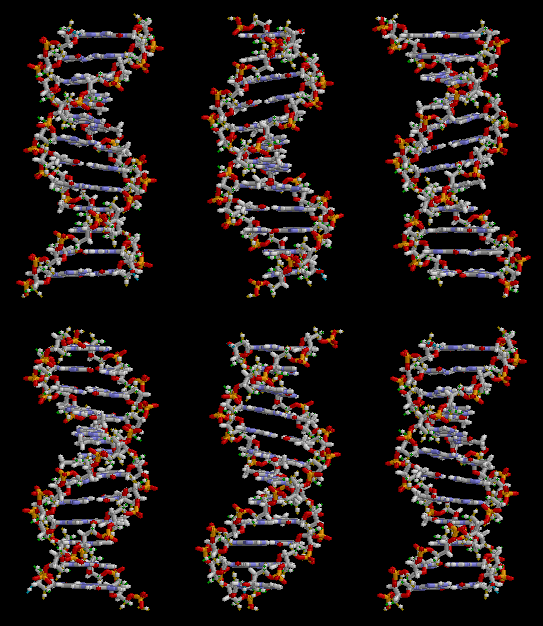
- Many biologically important molecules are macromolecules, large molecules typically formed by polymerization (a process in which smaller units, called monomers, are combined to form a larger molecule).
- An example of a macromolecule is deoxyribonucleic acid (DNA) (Figure \(\PageIndex{6}\)), which contains the instructions for the structure and functioning of all living organisms.
- Some cells contain membrane-bound aggregates of macromolecules; these are called organelles.
- Organelles are small structures that exist within cells.
- Examples of organelles include mitochondria and chloroplasts, which carry out indispensable functions: mitochondria produce energy to power the cell, while chloroplasts enable green plants to harness sunlight's energy to make sugars.
- All living things are made of cells; the cell itself is the smallest fundamental unit of structure and function in living organisms.
- This requirement is why viruses are not considered living organisms: they lack cells. To make new viruses, they have to invade and hijack the reproductive mechanism of a living cell; only then can they obtain the materials they need to reproduce.)
- Some organisms consist of a single cell, and others are multicellular.
- Cells are classified as prokaryotic or eukaryotic. Prokaryotes are single-celled or colonial organisms that do not have membrane-bound nuclei; in contrast, eukaryotes do have membrane-bound organelles and a membrane-bound nucleus.
- In larger organisms, cells combine to form tissues, groups of similar cells that perform related functions.
- Organs are collections of tissues grouped together to perform a common function. Organs are present not only in animals but also in plants.
- An organ system is a higher-level organization of functionally related organs.
- Mammals (which include humans) have many organ systems.
- For instance, the circulatory system transports blood throughout the body and between the lungs; it comprises organs such as the heart and blood vessels.
- Organisms are individual living entities.
- For example, each tree in a forest is an organism.
- Single-celled prokaryotes and single-celled eukaryotes are also considered organisms and are typically referred to as microorganisms.
- All the individuals of a species living within a specific area are collectively referred to as a population.
- For example, a forest may include many pine trees.
- All of these pine trees represent the population of pine trees in this forest.
- A community is the sum of all different populations inhabiting a particular area.
- For instance, all of the trees, flowers, insects, microbes, and other populations in a forest form the forest’s community.
- The forest itself is an ecosystem.
- An ecosystem consists of all the living things in a particular area, together with the abiotic, non-living parts of that environment, such as nitrogen in soil or rainwater.
- At the highest level of organization, the biosphere comprises all ecosystems.
- It represents the zones of life on earth (Figure \(\PageIndex{7}\)).
- It includes land, water, and even the atmosphere to a certain extent.

Discover the many different levels of organization of life in this 5-minute video.
Question after watching:
Many scientists specialize in a level of organization. If you were to study only one section of biological organization, which would you choose and why
Which of the following statements is false? Refer to the text above for the correct answer.
- Tissues exist within organs, which exist within organ systems.
- Communities exist within populations, which exist within ecosystems.
- Organelles exist within cells, which exist within tissues.
- Communities exist within ecosystems, which exist within the biosphere.
- Answer
-
B. Communities exist within populations, which exist within ecosystems. This is an incorrect answer as populations ar least inclusive, then communities, then ecosystems.