

2.2: The Human Animal
- Page ID
- 92570

\( \newcommand{\vecs}[1]{\overset { \scriptstyle \rightharpoonup} {\mathbf{#1}} } \)
\( \newcommand{\vecd}[1]{\overset{-\!-\!\rightharpoonup}{\vphantom{a}\smash {#1}}} \)
\( \newcommand{\dsum}{\displaystyle\sum\limits} \)
\( \newcommand{\dint}{\displaystyle\int\limits} \)
\( \newcommand{\dlim}{\displaystyle\lim\limits} \)
\( \newcommand{\id}{\mathrm{id}}\) \( \newcommand{\Span}{\mathrm{span}}\)
( \newcommand{\kernel}{\mathrm{null}\,}\) \( \newcommand{\range}{\mathrm{range}\,}\)
\( \newcommand{\RealPart}{\mathrm{Re}}\) \( \newcommand{\ImaginaryPart}{\mathrm{Im}}\)
\( \newcommand{\Argument}{\mathrm{Arg}}\) \( \newcommand{\norm}[1]{\| #1 \|}\)
\( \newcommand{\inner}[2]{\langle #1, #2 \rangle}\)
\( \newcommand{\Span}{\mathrm{span}}\)
\( \newcommand{\id}{\mathrm{id}}\)
\( \newcommand{\Span}{\mathrm{span}}\)
\( \newcommand{\kernel}{\mathrm{null}\,}\)
\( \newcommand{\range}{\mathrm{range}\,}\)
\( \newcommand{\RealPart}{\mathrm{Re}}\)
\( \newcommand{\ImaginaryPart}{\mathrm{Im}}\)
\( \newcommand{\Argument}{\mathrm{Arg}}\)
\( \newcommand{\norm}[1]{\| #1 \|}\)
\( \newcommand{\inner}[2]{\langle #1, #2 \rangle}\)
\( \newcommand{\Span}{\mathrm{span}}\) \( \newcommand{\AA}{\unicode[.8,0]{x212B}}\)
\( \newcommand{\vectorA}[1]{\vec{#1}} % arrow\)
\( \newcommand{\vectorAt}[1]{\vec{\text{#1}}} % arrow\)
\( \newcommand{\vectorB}[1]{\overset { \scriptstyle \rightharpoonup} {\mathbf{#1}} } \)
\( \newcommand{\vectorC}[1]{\textbf{#1}} \)
\( \newcommand{\vectorD}[1]{\overrightarrow{#1}} \)
\( \newcommand{\vectorDt}[1]{\overrightarrow{\text{#1}}} \)
\( \newcommand{\vectE}[1]{\overset{-\!-\!\rightharpoonup}{\vphantom{a}\smash{\mathbf {#1}}}} \)
\( \newcommand{\vecs}[1]{\overset { \scriptstyle \rightharpoonup} {\mathbf{#1}} } \)
\(\newcommand{\longvect}{\overrightarrow}\)
\( \newcommand{\vecd}[1]{\overset{-\!-\!\rightharpoonup}{\vphantom{a}\smash {#1}}} \)
\(\newcommand{\avec}{\mathbf a}\) \(\newcommand{\bvec}{\mathbf b}\) \(\newcommand{\cvec}{\mathbf c}\) \(\newcommand{\dvec}{\mathbf d}\) \(\newcommand{\dtil}{\widetilde{\mathbf d}}\) \(\newcommand{\evec}{\mathbf e}\) \(\newcommand{\fvec}{\mathbf f}\) \(\newcommand{\nvec}{\mathbf n}\) \(\newcommand{\pvec}{\mathbf p}\) \(\newcommand{\qvec}{\mathbf q}\) \(\newcommand{\svec}{\mathbf s}\) \(\newcommand{\tvec}{\mathbf t}\) \(\newcommand{\uvec}{\mathbf u}\) \(\newcommand{\vvec}{\mathbf v}\) \(\newcommand{\wvec}{\mathbf w}\) \(\newcommand{\xvec}{\mathbf x}\) \(\newcommand{\yvec}{\mathbf y}\) \(\newcommand{\zvec}{\mathbf z}\) \(\newcommand{\rvec}{\mathbf r}\) \(\newcommand{\mvec}{\mathbf m}\) \(\newcommand{\zerovec}{\mathbf 0}\) \(\newcommand{\onevec}{\mathbf 1}\) \(\newcommand{\real}{\mathbb R}\) \(\newcommand{\twovec}[2]{\left[\begin{array}{r}#1 \\ #2 \end{array}\right]}\) \(\newcommand{\ctwovec}[2]{\left[\begin{array}{c}#1 \\ #2 \end{array}\right]}\) \(\newcommand{\threevec}[3]{\left[\begin{array}{r}#1 \\ #2 \\ #3 \end{array}\right]}\) \(\newcommand{\cthreevec}[3]{\left[\begin{array}{c}#1 \\ #2 \\ #3 \end{array}\right]}\) \(\newcommand{\fourvec}[4]{\left[\begin{array}{r}#1 \\ #2 \\ #3 \\ #4 \end{array}\right]}\) \(\newcommand{\cfourvec}[4]{\left[\begin{array}{c}#1 \\ #2 \\ #3 \\ #4 \end{array}\right]}\) \(\newcommand{\fivevec}[5]{\left[\begin{array}{r}#1 \\ #2 \\ #3 \\ #4 \\ #5 \\ \end{array}\right]}\) \(\newcommand{\cfivevec}[5]{\left[\begin{array}{c}#1 \\ #2 \\ #3 \\ #4 \\ #5 \\ \end{array}\right]}\) \(\newcommand{\mattwo}[4]{\left[\begin{array}{rr}#1 \amp #2 \\ #3 \amp #4 \\ \end{array}\right]}\) \(\newcommand{\laspan}[1]{\text{Span}\{#1\}}\) \(\newcommand{\bcal}{\cal B}\) \(\newcommand{\ccal}{\cal C}\) \(\newcommand{\scal}{\cal S}\) \(\newcommand{\wcal}{\cal W}\) \(\newcommand{\ecal}{\cal E}\) \(\newcommand{\coords}[2]{\left\{#1\right\}_{#2}}\) \(\newcommand{\gray}[1]{\color{gray}{#1}}\) \(\newcommand{\lgray}[1]{\color{lightgray}{#1}}\) \(\newcommand{\rank}{\operatorname{rank}}\) \(\newcommand{\row}{\text{Row}}\) \(\newcommand{\col}{\text{Col}}\) \(\renewcommand{\row}{\text{Row}}\) \(\newcommand{\nul}{\text{Nul}}\) \(\newcommand{\var}{\text{Var}}\) \(\newcommand{\corr}{\text{corr}}\) \(\newcommand{\len}[1]{\left|#1\right|}\) \(\newcommand{\bbar}{\overline{\bvec}}\) \(\newcommand{\bhat}{\widehat{\bvec}}\) \(\newcommand{\bperp}{\bvec^\perp}\) \(\newcommand{\xhat}{\widehat{\xvec}}\) \(\newcommand{\vhat}{\widehat{\vvec}}\) \(\newcommand{\uhat}{\widehat{\uvec}}\) \(\newcommand{\what}{\widehat{\wvec}}\) \(\newcommand{\Sighat}{\widehat{\Sigma}}\) \(\newcommand{\lt}{<}\) \(\newcommand{\gt}{>}\) \(\newcommand{\amp}{&}\) \(\definecolor{fillinmathshade}{gray}{0.9}\)Among all animals, humans are "cousins" to both chimpanzees and bonobos, sharing ~98.8% of our DNA with each species. From genes to morphology to behavior, we are all similar in many ways, including being primates and sharing an evolutionary past.
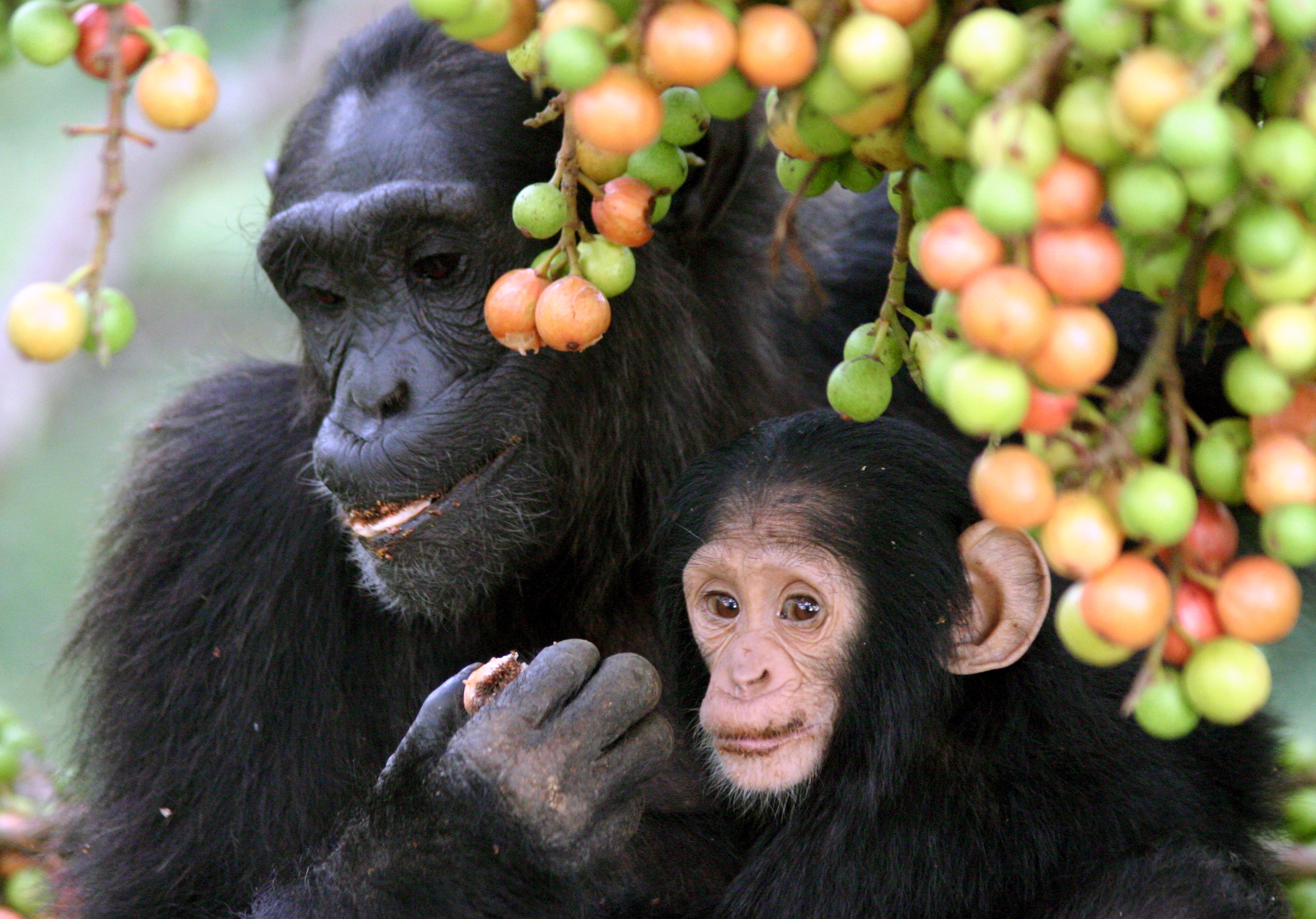

Figure \(\PageIndex{1}\): (1) Mother and infant chimpanzees in a fig tree (Alain Houle, CC-BY-4.0), (2) Bonobo in the rainforest (Pierre Fidenci, CC-SA-2.5)
Humans Classification
You probably know that modern humans belong to the species Homo sapiens. But what is our place in nature? How are our species classified? A simple classification is represented in Figure \(\PageIndex{3}\).
Humans:
- can move on their own and are in the kingdom Animalia.
- have a vertebral column and so are in the phylum Chordata.
- have hair and milk glands, so are placed in class Mammalia.
- are placed in the order Primates due to the many traits you will read about below.
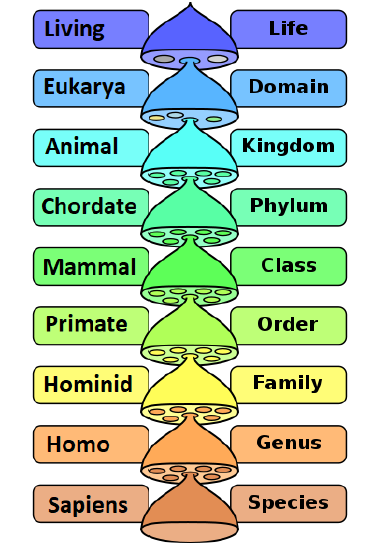
Figure \(\PageIndex{3}\): This taxonomic diagram shows how our species, Homo sapiens, is classified. Our scientific name indicates that we belong to the genus Homo and the species sapiens.
Our family is the hominid, within the order primate, within the class mammal, within the phylum chordate, within the kingdom animalia, within the domain Eukarya. (Suzanne Wakim, CC0)
Humans as Primates
Living members of the primate order include monkeys, apes, and humans; and any member of this order of mammals is called a primate. At some point in the past, we shared common ape-like ancestors with all modern primate groups. Evidence includes a 93%-98% genetic similarity between humans and other primates, indicating very recent common ancestry.
Besides genes, what traits do we share with other primates? Primates are considered generalists among mammals. A generalist is an organism that can thrive in a wide variety of environmental conditions and use a wide range of resources, such as consuming many different types of food. Although primates exhibit a wide range of characteristics, several traits are shared by most species.
Primate Traits
- The primate body is generally semi-erect or erect.
- Primates have one of several modes of locomotion, including walking on all four legs (quadrupedalism), vertical clinging and leaping, swinging from branch to branch in trees (brachiation), or walking on two legs (bipedalism, only humans in the modern era).
- The primate shoulder girdle has a collar bone (clavicle), which is associated with a wide range of motion of the upper limbs.
- Primates rely less on their sense of smell than other mammals do. They have a reduced snout and a relatively small olfactory (odor) processing center in the brain.
- Primates rely more on vision than many other mammals, with better acuity.
- Most primates can see in color, and the visual processing center in the occipital lobe of the brain is relatively large.
- Primates also tend to have large eyes, placed forward-facing, on a relatively flat face protected by a complete bony eye socket. This results in an overlap of the visual fields of the two eyes, enabling stereoscopic, or three-dimensional, vision.
- Primates have relatively large brains, high intelligence, and complex behaviors.
- The cerebrum, which analyzes and synthesizes sensory information and transforms it into motor behaviors appropriate to the environment, is particularly enlarged.
- Primates tend to have longer lifespans than most other mammals, with extended prenatal and postnatal periods.
- Infants and juveniles spend longer relative periods dependent on adults, providing an extended opportunity for learning.
- Most primates live in social groups and are among the most social of animals.
- Adult nonhuman primates may live in mated pairs or in groups of hundreds.
- Primates have five digits (fingers or toes) on each extremity (hand or foot).
- Their fingers and toes have nails instead of claws and are covered with sensitive tactile pads.
- Their thumbs (and in many species the big toes as well) are opposable, meaning they can be brought into opposition with the other digits, allowing both a power grasp and a precision grip (Figure \(\PageIndex{4}\)).
Life in the Trees
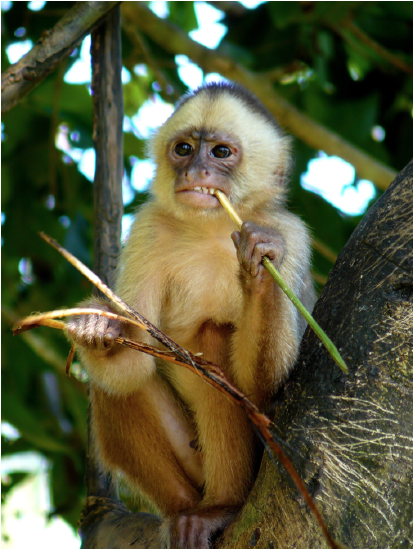
Scientists think that many primate traits are adaptations to an arboreal, or tree-dwelling, lifestyle. Primates likely evolved in trees, and most still utilize trees to some extent (for feeding, evading predators, or quick travel). Vision is more important than smell for being arboreal, especially three-dimensional vision, in grasping the next branch or limb. Mobile limbs, a good grip, and manual dexterity are matters of life and death high above the ground.
Nonhuman primate species are distributed worldwide (Figure \(\PageIndex{5}\)). Central and South America are home to many species of monkeys in tropical forests, including the capuchin monkey above. Tropical forests in Africa and Asia are home to many other primate species, including many monkeys and all modern apes.

Humans as Hominids
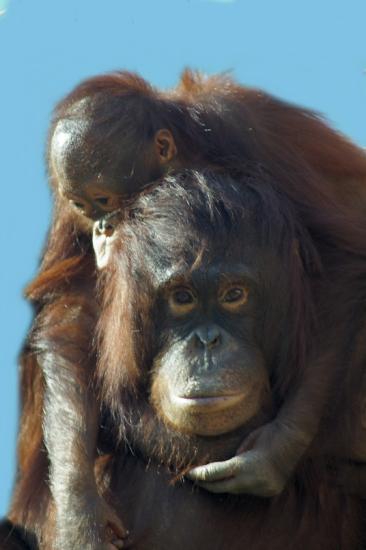
Humans are the family Hominidae. Any member of this family is called a hominid and includes five living genera: chimpanzees, bonobos, gorillas, orangutans, and humans. The orangutan mother pictured in figure \(\PageIndex{6}\) cradling her child shows how similar these hominids are to us.
Among these five genera, there are just seven living species: two in each genus, except humans. Modern humans, Homo sapiens, are the sole living species in the Homo genus.
Hominids are relatively large, tailless primates, ranging in size from the bonobo, which may weigh as little as 30 kg (66 lb), to the eastern gorilla, which may weigh over 200 kg (440 lb). Most modern humans fall somewhere in between that range. In all species of hominids, males are somewhat larger and stronger, on average, than females, but the differences may not be great.
Except for humans, hominids are mainly quadrupedal, although they can get around bipedally for short periods of time. Quadrupedal primates have broader pelvises, longer legs, and arched feet than those in the Homo genus. However, from the neck up, they were still quite different from us. They typically have bigger jaws and teeth, a sloping forehead, and a relatively smaller brain.
Humans are the only living hominids to be habitually bipedal. By about 2.8 million years ago, early Homo species such as Homo erectus were probably nearly as efficient at bipedal locomotion as modern humans
Homo sapiens
During the roughly 2.8 million years of the evolution of Homo, the remaining features of the genus evolved. It is also worth noting that early in our species' evolution, we likely lived alongside at least two other Homo species for a time: Homo floresiensis and Homo neanderthalensis ("Neanderthals").
Our species Homo sapiens is the most recent iteration of the basic primate body plan.
These features include:
- small front teeth (incisors and canines) with relatively large molars, at least compared to other primates.
- a decrease in the size of the jaws and face, and an increase in the size of the cranium, forming a nearly vertical forehead.
- a tremendous enlargement of the brain, especially in the cerebrum, which is the site of higher intellectual functions.
Evidence for our evolution comes from many sources, including fossils, biochemical analysis, radioisotope dating, molecular clocks, and more (Figure \(\PageIndex{7}\)).
_and_her_husband_Louis_Seymour_Bazett_Leakey_(1903-1972).jpg?revision=1&size=bestfit&width=437&height=314)
In evolutionary time, brain size increased very rapidly, between about 800,000 and 100,000 years ago, from ~600 cm3 to ~1400 cm3 when the earliest Homo sapiens appeared. This happened during a period of rapid climate change. Many scientists hypothesize that rapid environmental changes were the primary drivers for the evolution of a larger, more complex brain. In other words, bigger, "smarter" brains helped our ancestors survive in a more unpredictable environment.
With the evolution of a bigger brain came the development of culture and technology as behavioral adaptations to utilize more resources from the environment. These developments allowed modern humans and their ancestors to migrate across the world and become the dominant land animals.
Because of our large, complex brain, we clearly have a greater capacity for abstract thought and technological advancement than any other primate, even our closest living relatives, the chimpanzees. However, it is important to recognize by other measures, we are not as adept as other living hominid species: we are physically weaker than gorillas, far less agile than orangutans, and less well-mannered and socialized than bonobos.
Learn more about the evolutionary history of humans from the Smithsonian Institution.
The story of human evolution began about 7 million years ago, when the lineages that led to Homo sapiens and chimpanzees separated.
Question after watching: How does the natural selection of certain physical and behavioral traits define what it means to be human?
Imagine squeezing through a seven-inch slit in rock to enter a completely dark cave full of many old bones. It might sound like a nightmare to most people, but it was a necessary part of an exploration of human origins in South Africa. The cave and its bones were actually first discovered by spelunkers (cave explorers) in 2013, who then reported it to paleontologists. The researchers eventually concluded the cave was a place for the dead of a new-to-science early species of Homo, then named Homo naledi, who lived in South Africa around 335,000 - 236,000 years ago (Figure \(\PageIndex{8}\)).
Homo naledi stood about 5 feet tall and weighed around 100 pounds, so they probably had no trouble squeezing into the cave. To retrieve the fossilized bones, six very slender female researchers were recruited from social media. The work was difficult and dangerous, but very exciting. The site is one of the largest samples of any extinct early Homo species, and the fossils suggest that early members of our genus intentionally deposited their dead in a remote, special place, a behavior previously thought to be limited to later humans.
Like other early Homo species, Homo naledi exhibits a mix of old and modern traits. From the neck down, Homo naledi were well adapted for bipedalism. Their feet are virtually indistinguishable from modern humans' (Figure \(\PageIndex{8}\)), and their legs were also long like ours. Homo naledi had relatively small front teeth but also a small brain, no larger than an average orange. Clearly, rapid brain growth did not evolve in this species.
