

28: EFFECTS OF UV LIGHT ON BACTERIA
- Page ID
- 157098

\( \newcommand{\vecs}[1]{\overset { \scriptstyle \rightharpoonup} {\mathbf{#1}} } \)
\( \newcommand{\vecd}[1]{\overset{-\!-\!\rightharpoonup}{\vphantom{a}\smash {#1}}} \)
\( \newcommand{\dsum}{\displaystyle\sum\limits} \)
\( \newcommand{\dint}{\displaystyle\int\limits} \)
\( \newcommand{\dlim}{\displaystyle\lim\limits} \)
\( \newcommand{\id}{\mathrm{id}}\) \( \newcommand{\Span}{\mathrm{span}}\)
( \newcommand{\kernel}{\mathrm{null}\,}\) \( \newcommand{\range}{\mathrm{range}\,}\)
\( \newcommand{\RealPart}{\mathrm{Re}}\) \( \newcommand{\ImaginaryPart}{\mathrm{Im}}\)
\( \newcommand{\Argument}{\mathrm{Arg}}\) \( \newcommand{\norm}[1]{\| #1 \|}\)
\( \newcommand{\inner}[2]{\langle #1, #2 \rangle}\)
\( \newcommand{\Span}{\mathrm{span}}\)
\( \newcommand{\id}{\mathrm{id}}\)
\( \newcommand{\Span}{\mathrm{span}}\)
\( \newcommand{\kernel}{\mathrm{null}\,}\)
\( \newcommand{\range}{\mathrm{range}\,}\)
\( \newcommand{\RealPart}{\mathrm{Re}}\)
\( \newcommand{\ImaginaryPart}{\mathrm{Im}}\)
\( \newcommand{\Argument}{\mathrm{Arg}}\)
\( \newcommand{\norm}[1]{\| #1 \|}\)
\( \newcommand{\inner}[2]{\langle #1, #2 \rangle}\)
\( \newcommand{\Span}{\mathrm{span}}\) \( \newcommand{\AA}{\unicode[.8,0]{x212B}}\)
\( \newcommand{\vectorA}[1]{\vec{#1}} % arrow\)
\( \newcommand{\vectorAt}[1]{\vec{\text{#1}}} % arrow\)
\( \newcommand{\vectorB}[1]{\overset { \scriptstyle \rightharpoonup} {\mathbf{#1}} } \)
\( \newcommand{\vectorC}[1]{\textbf{#1}} \)
\( \newcommand{\vectorD}[1]{\overrightarrow{#1}} \)
\( \newcommand{\vectorDt}[1]{\overrightarrow{\text{#1}}} \)
\( \newcommand{\vectE}[1]{\overset{-\!-\!\rightharpoonup}{\vphantom{a}\smash{\mathbf {#1}}}} \)
\( \newcommand{\vecs}[1]{\overset { \scriptstyle \rightharpoonup} {\mathbf{#1}} } \)
\(\newcommand{\longvect}{\overrightarrow}\)
\( \newcommand{\vecd}[1]{\overset{-\!-\!\rightharpoonup}{\vphantom{a}\smash {#1}}} \)
\(\newcommand{\avec}{\mathbf a}\) \(\newcommand{\bvec}{\mathbf b}\) \(\newcommand{\cvec}{\mathbf c}\) \(\newcommand{\dvec}{\mathbf d}\) \(\newcommand{\dtil}{\widetilde{\mathbf d}}\) \(\newcommand{\evec}{\mathbf e}\) \(\newcommand{\fvec}{\mathbf f}\) \(\newcommand{\nvec}{\mathbf n}\) \(\newcommand{\pvec}{\mathbf p}\) \(\newcommand{\qvec}{\mathbf q}\) \(\newcommand{\svec}{\mathbf s}\) \(\newcommand{\tvec}{\mathbf t}\) \(\newcommand{\uvec}{\mathbf u}\) \(\newcommand{\vvec}{\mathbf v}\) \(\newcommand{\wvec}{\mathbf w}\) \(\newcommand{\xvec}{\mathbf x}\) \(\newcommand{\yvec}{\mathbf y}\) \(\newcommand{\zvec}{\mathbf z}\) \(\newcommand{\rvec}{\mathbf r}\) \(\newcommand{\mvec}{\mathbf m}\) \(\newcommand{\zerovec}{\mathbf 0}\) \(\newcommand{\onevec}{\mathbf 1}\) \(\newcommand{\real}{\mathbb R}\) \(\newcommand{\twovec}[2]{\left[\begin{array}{r}#1 \\ #2 \end{array}\right]}\) \(\newcommand{\ctwovec}[2]{\left[\begin{array}{c}#1 \\ #2 \end{array}\right]}\) \(\newcommand{\threevec}[3]{\left[\begin{array}{r}#1 \\ #2 \\ #3 \end{array}\right]}\) \(\newcommand{\cthreevec}[3]{\left[\begin{array}{c}#1 \\ #2 \\ #3 \end{array}\right]}\) \(\newcommand{\fourvec}[4]{\left[\begin{array}{r}#1 \\ #2 \\ #3 \\ #4 \end{array}\right]}\) \(\newcommand{\cfourvec}[4]{\left[\begin{array}{c}#1 \\ #2 \\ #3 \\ #4 \end{array}\right]}\) \(\newcommand{\fivevec}[5]{\left[\begin{array}{r}#1 \\ #2 \\ #3 \\ #4 \\ #5 \\ \end{array}\right]}\) \(\newcommand{\cfivevec}[5]{\left[\begin{array}{c}#1 \\ #2 \\ #3 \\ #4 \\ #5 \\ \end{array}\right]}\) \(\newcommand{\mattwo}[4]{\left[\begin{array}{rr}#1 \amp #2 \\ #3 \amp #4 \\ \end{array}\right]}\) \(\newcommand{\laspan}[1]{\text{Span}\{#1\}}\) \(\newcommand{\bcal}{\cal B}\) \(\newcommand{\ccal}{\cal C}\) \(\newcommand{\scal}{\cal S}\) \(\newcommand{\wcal}{\cal W}\) \(\newcommand{\ecal}{\cal E}\) \(\newcommand{\coords}[2]{\left\{#1\right\}_{#2}}\) \(\newcommand{\gray}[1]{\color{gray}{#1}}\) \(\newcommand{\lgray}[1]{\color{lightgray}{#1}}\) \(\newcommand{\rank}{\operatorname{rank}}\) \(\newcommand{\row}{\text{Row}}\) \(\newcommand{\col}{\text{Col}}\) \(\renewcommand{\row}{\text{Row}}\) \(\newcommand{\nul}{\text{Nul}}\) \(\newcommand{\var}{\text{Var}}\) \(\newcommand{\corr}{\text{corr}}\) \(\newcommand{\len}[1]{\left|#1\right|}\) \(\newcommand{\bbar}{\overline{\bvec}}\) \(\newcommand{\bhat}{\widehat{\bvec}}\) \(\newcommand{\bperp}{\bvec^\perp}\) \(\newcommand{\xhat}{\widehat{\xvec}}\) \(\newcommand{\vhat}{\widehat{\vvec}}\) \(\newcommand{\uhat}{\widehat{\uvec}}\) \(\newcommand{\what}{\widehat{\wvec}}\) \(\newcommand{\Sighat}{\widehat{\Sigma}}\) \(\newcommand{\lt}{<}\) \(\newcommand{\gt}{>}\) \(\newcommand{\amp}{&}\) \(\definecolor{fillinmathshade}{gray}{0.9}\)- Compare the effects of different UV exposure times on bacterial survival and analyze how sunscreen protection (SPF 15 vs. SPF 50) influences bacterial survival under UV radiation.
- Relate experimental results to real-world issues such as human skin protection, the importance of sunscreen, and risks of overexposure to UV radiation.
BACKGROUND
Mutations are heritable changes in the base sequence of DNA (deoxyribonucleic acid). While some mutations are neutral or even beneficial to an organism, most tend to be harmful because they can disrupt essential cellular functions. In bacteria, mutations occur spontaneously during DNA replication at a natural rate of approximately 1 in 10^8 to 10^9 nucleotides base pairs. However, exposure to a mutagen (an agent that increases the mutation rate) can cause this rate to rise significantly. Mutagens may be chemical—such as nicotine—or physical, such as certain forms of electromagnetic radiation.
There are two primary types of mutagenic electromagnetic radiation: ionizing radiation and non-ionizing radiation.
- Ionizing radiation (e.g., X-rays and gamma rays) carries enough energy to eject electrons from atoms and molecules, forming unstable ions known as free radicals. These free radicals can damage a wide variety of cellular components, including DNA, RNA, and essential enzymes, through oxidative reactions.
- Non-ionizing radiation, such as ultraviolet (UV) light, lacks sufficient energy to ionize atoms but can still damage DNA by exciting electrons. This excitation often leads to the formation of pyrimidine dimers, which are abnormal covalent bonds between adjacent pyrimidine bases—usually thymine—on a DNA strand. Pyrimidine dimers distort the DNA structure and interfere with transcription and replication, frequently resulting in mutations if not repaired.
Radiation is classified by its wavelength, frequency, and energy. Generally, the shorter the wavelength, the higher the energy.
- Ionizing radiation has wavelengths typically shorter than 1 nanometer and energies greater than 100 electron volts (eV).
- Non-ionizing radiation spans wavelengths from about 100 to 390 nanometers and has lower energy levels (a few to 100 eV).
Because of its high energy, ionizing radiation is considered more hazardous and is capable of deeply penetrating cells and structures. For example, X-rays require protective lead shielding, while UV light can be blocked by clothing or plastic covers.
Both ionizing and non-ionizing radiation are widely used to control microbial growth in clinical, food, and laboratory settings. Due to its strong penetrating power, ionizing radiation is effective for sterilizing medical supplies and food products. In contrast, only specific forms of non-ionizing UV light are suitable for microbial control.
There are three types of UV radiation classified by wavelength:
- UV-A (longest wavelength, lowest energy)
- UV-B (medium wavelength and energy)
- UV-C (shortest wavelength, highest energy within the UV spectrum)
UV-C, typically around 254 nm, is the most effective type for microbial control and is considered germicidal. It is used in hospitals, food service areas, and HVAC systems to reduce microbial contamination. UV-C radiation damages microbial DNA, and if the exposure is sufficient, it can lead to cell death.
Sub-lethal UV exposure may not immediately kill bacterial cells but can induce enough DNA damage to interfere with their ability to reproduce. Some bacteria may repair this damage through photoreactivation (light-dependent enzyme repair) or nucleotide excision repair mechanisms. However, if the damage overwhelms these systems, cells may die or accumulate mutations.
UV light can also harm human cells. Prolonged exposure to UV-B and UV-C rays can damage skin cell DNA and may impair the cell’s ability to regulate division, potentially leading to skin cancers such as melanoma. For this reason, sunscreen products are widely recommended. Sunscreens are labeled with a Sun Protection Factor (SPF) rating, which indicates their effectiveness at blocking UV-B radiation. SPF 15, 30, and 45 are common formulations, with higher values theoretically offering longer protection.
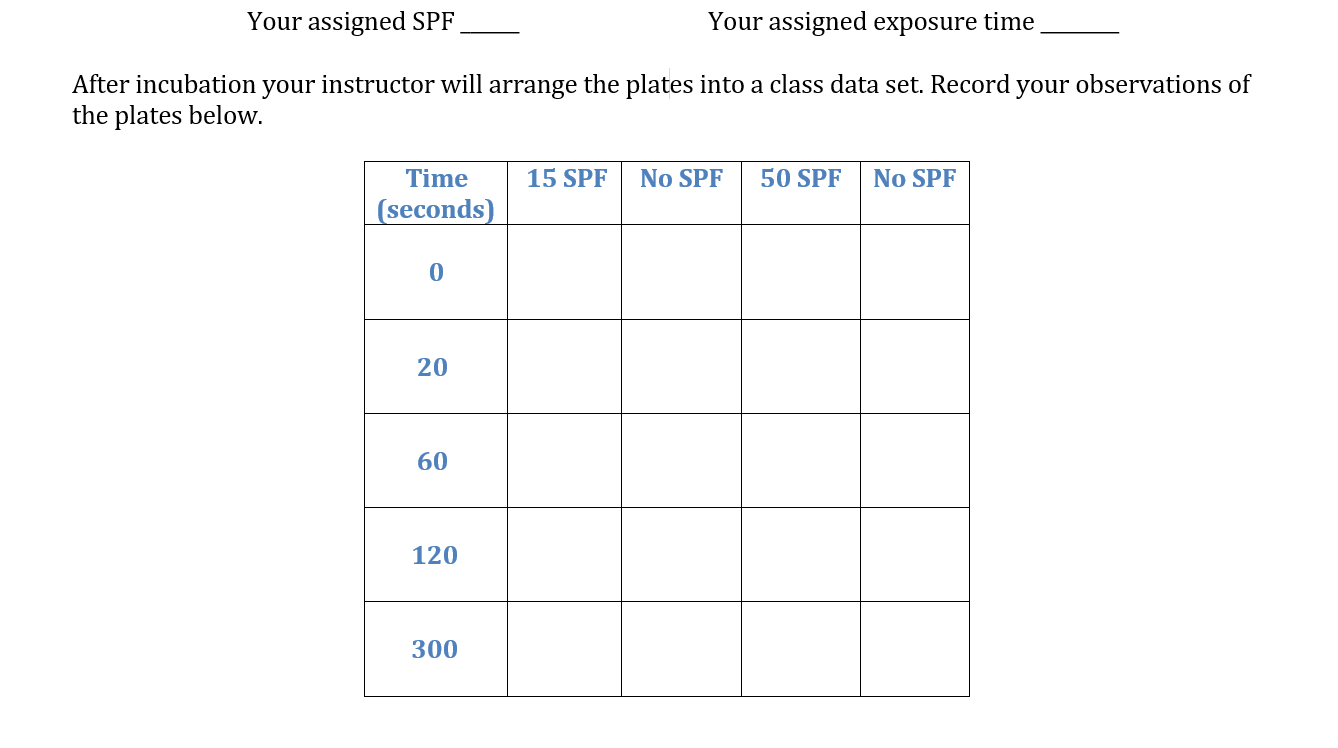
In this experiment, we will evaluate how bacterial survival is affected by UV exposure over various time intervals, with and without protection from two different SPF-rated sunscreens. By comparing the number of surviving bacteria, we will assess how effectively SPF 15 and SPF 50 sunscreens prevent UV-induced damage in a model microbial system.
MATERIALS
1 Nutrient agar plate
1 Assigned culture (per table)
Assigned sunscreen
Plastic wrap
UV lamp
METHODS/PROCEDURES
1. Label the nutrient agar plate with the following: your name, organism name, and assigned exposure time.
2. Use a sharpie to divide the plate into two quadrants. Label one quadrant exposed (exp). Label the other quadrant with your assigned sunscreen SPF.
3. Aseptically pipet 0.10 mL of the bacterial culture onto the surface of the nutrient agar.
4. Using a sterile cell spreader gently and evenly spread the bacteria over the entire surface of the agar plate to create a uniform bacterial lawn.
5. Allow the bacteria to soak in to the agar for at least 10 minutes.
6. Remove the lid and quickly cover the plate with plastic wrap. Take care to avoid contact between the plastic wrap and the agar surface. The wrap
should be smooth and tight enough so that the plate sits flat on the bench. Once the agar plate is covered with plastic, invert the lid and place it
under the plate.
7. Using a clean finger, gently apply a thin, even layer of your assigned sunscreen SPF only over the quadrant you labeled with your assigned sunscreen
SPF. Only half of the plate should be covered with sunscreen. Do not allow the plastic wrap to touch the surface of the agar. Spread the sunscreen
evenly to simulate realistic application on skin. Over time the sunscreen will absorb into the plastic and no longer be visible. If you can still see the
sunscreen on the plastic after 15 minutes there is too much, remove some.
8. When your exposure time is announced, bring your plate to the UV exposure station.
9. After UV exposure is complete, carefully remove the plastic wrap and immediately replace the lid.
10. Incubate the plate, agar side up, until the next lab period.
EXERCISE 28 Effects of UV Light on Bacteria NAME ______________________
EXPECTATIONS
Do you expect to observe a difference in bacterial growth between the two quadrants? Describe what differences, if any, you anticipate and explain your reasoning.
RESULTS
CONCLUSIONS
1. Describe any trends observed in the class data.
2. What can you conclude from the data?
3. Based on the data above, how might sunscreen affect UV-induced damage in human skin cells?
4. Would UV light be an appropriate method to sterilize a syringe packaged in plastic wrap? Explain your reasoning based on the properties of UV light and its ability to penetrate materials.
5. Ionizing radiation is often used to treat fresh fruits and vegetables before they are sold to consumers. Would UV light be equally effective for this purpose? Explain your reasoning based on the properties and limitations of UV radiation.