

17: ANTIBIOTICS
- Page ID
- 157085

\( \newcommand{\vecs}[1]{\overset { \scriptstyle \rightharpoonup} {\mathbf{#1}} } \)
\( \newcommand{\vecd}[1]{\overset{-\!-\!\rightharpoonup}{\vphantom{a}\smash {#1}}} \)
\( \newcommand{\dsum}{\displaystyle\sum\limits} \)
\( \newcommand{\dint}{\displaystyle\int\limits} \)
\( \newcommand{\dlim}{\displaystyle\lim\limits} \)
\( \newcommand{\id}{\mathrm{id}}\) \( \newcommand{\Span}{\mathrm{span}}\)
( \newcommand{\kernel}{\mathrm{null}\,}\) \( \newcommand{\range}{\mathrm{range}\,}\)
\( \newcommand{\RealPart}{\mathrm{Re}}\) \( \newcommand{\ImaginaryPart}{\mathrm{Im}}\)
\( \newcommand{\Argument}{\mathrm{Arg}}\) \( \newcommand{\norm}[1]{\| #1 \|}\)
\( \newcommand{\inner}[2]{\langle #1, #2 \rangle}\)
\( \newcommand{\Span}{\mathrm{span}}\)
\( \newcommand{\id}{\mathrm{id}}\)
\( \newcommand{\Span}{\mathrm{span}}\)
\( \newcommand{\kernel}{\mathrm{null}\,}\)
\( \newcommand{\range}{\mathrm{range}\,}\)
\( \newcommand{\RealPart}{\mathrm{Re}}\)
\( \newcommand{\ImaginaryPart}{\mathrm{Im}}\)
\( \newcommand{\Argument}{\mathrm{Arg}}\)
\( \newcommand{\norm}[1]{\| #1 \|}\)
\( \newcommand{\inner}[2]{\langle #1, #2 \rangle}\)
\( \newcommand{\Span}{\mathrm{span}}\) \( \newcommand{\AA}{\unicode[.8,0]{x212B}}\)
\( \newcommand{\vectorA}[1]{\vec{#1}} % arrow\)
\( \newcommand{\vectorAt}[1]{\vec{\text{#1}}} % arrow\)
\( \newcommand{\vectorB}[1]{\overset { \scriptstyle \rightharpoonup} {\mathbf{#1}} } \)
\( \newcommand{\vectorC}[1]{\textbf{#1}} \)
\( \newcommand{\vectorD}[1]{\overrightarrow{#1}} \)
\( \newcommand{\vectorDt}[1]{\overrightarrow{\text{#1}}} \)
\( \newcommand{\vectE}[1]{\overset{-\!-\!\rightharpoonup}{\vphantom{a}\smash{\mathbf {#1}}}} \)
\( \newcommand{\vecs}[1]{\overset { \scriptstyle \rightharpoonup} {\mathbf{#1}} } \)
\(\newcommand{\longvect}{\overrightarrow}\)
\( \newcommand{\vecd}[1]{\overset{-\!-\!\rightharpoonup}{\vphantom{a}\smash {#1}}} \)
\(\newcommand{\avec}{\mathbf a}\) \(\newcommand{\bvec}{\mathbf b}\) \(\newcommand{\cvec}{\mathbf c}\) \(\newcommand{\dvec}{\mathbf d}\) \(\newcommand{\dtil}{\widetilde{\mathbf d}}\) \(\newcommand{\evec}{\mathbf e}\) \(\newcommand{\fvec}{\mathbf f}\) \(\newcommand{\nvec}{\mathbf n}\) \(\newcommand{\pvec}{\mathbf p}\) \(\newcommand{\qvec}{\mathbf q}\) \(\newcommand{\svec}{\mathbf s}\) \(\newcommand{\tvec}{\mathbf t}\) \(\newcommand{\uvec}{\mathbf u}\) \(\newcommand{\vvec}{\mathbf v}\) \(\newcommand{\wvec}{\mathbf w}\) \(\newcommand{\xvec}{\mathbf x}\) \(\newcommand{\yvec}{\mathbf y}\) \(\newcommand{\zvec}{\mathbf z}\) \(\newcommand{\rvec}{\mathbf r}\) \(\newcommand{\mvec}{\mathbf m}\) \(\newcommand{\zerovec}{\mathbf 0}\) \(\newcommand{\onevec}{\mathbf 1}\) \(\newcommand{\real}{\mathbb R}\) \(\newcommand{\twovec}[2]{\left[\begin{array}{r}#1 \\ #2 \end{array}\right]}\) \(\newcommand{\ctwovec}[2]{\left[\begin{array}{c}#1 \\ #2 \end{array}\right]}\) \(\newcommand{\threevec}[3]{\left[\begin{array}{r}#1 \\ #2 \\ #3 \end{array}\right]}\) \(\newcommand{\cthreevec}[3]{\left[\begin{array}{c}#1 \\ #2 \\ #3 \end{array}\right]}\) \(\newcommand{\fourvec}[4]{\left[\begin{array}{r}#1 \\ #2 \\ #3 \\ #4 \end{array}\right]}\) \(\newcommand{\cfourvec}[4]{\left[\begin{array}{c}#1 \\ #2 \\ #3 \\ #4 \end{array}\right]}\) \(\newcommand{\fivevec}[5]{\left[\begin{array}{r}#1 \\ #2 \\ #3 \\ #4 \\ #5 \\ \end{array}\right]}\) \(\newcommand{\cfivevec}[5]{\left[\begin{array}{c}#1 \\ #2 \\ #3 \\ #4 \\ #5 \\ \end{array}\right]}\) \(\newcommand{\mattwo}[4]{\left[\begin{array}{rr}#1 \amp #2 \\ #3 \amp #4 \\ \end{array}\right]}\) \(\newcommand{\laspan}[1]{\text{Span}\{#1\}}\) \(\newcommand{\bcal}{\cal B}\) \(\newcommand{\ccal}{\cal C}\) \(\newcommand{\scal}{\cal S}\) \(\newcommand{\wcal}{\cal W}\) \(\newcommand{\ecal}{\cal E}\) \(\newcommand{\coords}[2]{\left\{#1\right\}_{#2}}\) \(\newcommand{\gray}[1]{\color{gray}{#1}}\) \(\newcommand{\lgray}[1]{\color{lightgray}{#1}}\) \(\newcommand{\rank}{\operatorname{rank}}\) \(\newcommand{\row}{\text{Row}}\) \(\newcommand{\col}{\text{Col}}\) \(\renewcommand{\row}{\text{Row}}\) \(\newcommand{\nul}{\text{Nul}}\) \(\newcommand{\var}{\text{Var}}\) \(\newcommand{\corr}{\text{corr}}\) \(\newcommand{\len}[1]{\left|#1\right|}\) \(\newcommand{\bbar}{\overline{\bvec}}\) \(\newcommand{\bhat}{\widehat{\bvec}}\) \(\newcommand{\bperp}{\bvec^\perp}\) \(\newcommand{\xhat}{\widehat{\xvec}}\) \(\newcommand{\vhat}{\widehat{\vvec}}\) \(\newcommand{\uhat}{\widehat{\uvec}}\) \(\newcommand{\what}{\widehat{\wvec}}\) \(\newcommand{\Sighat}{\widehat{\Sigma}}\) \(\newcommand{\lt}{<}\) \(\newcommand{\gt}{>}\) \(\newcommand{\amp}{&}\) \(\definecolor{fillinmathshade}{gray}{0.9}\)- Explain the purpose of antibiotic susceptibility testing and describe why it is essential for selecting effective antibiotic treatments in clinical settings
- Describe how the Kirby-Bauer disk diffusion method works, including the role of antibiotic diffusion, bacterial sensitivity, and standardized reference tables in interpreting results.
BACKGROUND
Antibiotics have revolutionized the treatment of bacterial infections and remain one of the most powerful tools in modern medicine. However, to use them responsibly and effectively, it is essential to determine which antibiotics are likely to be successful against a specific infection. Choosing the wrong antibiotic—or using the right one incorrectly—can have serious consequences. Not only does the patient receive no benefit, but side effects may occur unnecessarily, and effective treatment may be delayed. Worse still, inappropriate antibiotic use increases the likelihood of developing antibiotic resistance (the ability of bacteria to survive and grow in the presence of drugs designed to kill them).
Antibiotic resistance can arise from several factors, including:
- Using antibiotics when they are not needed
- Selecting the wrong drug for the type of infection
- Prescribing incorrect dosages
- Ending treatment too early
Each exposure to an antibiotic increases the selective pressure on bacteria, encouraging the survival of resistant strains. Over time, this can lead to the loss of effectiveness for antibiotics that were once reliable.
In life-threatening situations, healthcare providers may start treatment with a "best guess" antibiotic before laboratory test results are available. Even in these cases, it is critical to collect a sample and perform an antibiotic susceptibility test (a laboratory test that determines how effective different antibiotics are against a particular bacterial strain). This allows physicians to adjust therapy if the initial treatment proves ineffective.
One of the most widely used tests to determine antibiotic effectiveness is the Kirby-Bauer disk diffusion test, also known as a culture and sensitivity test. In this method, the bacteria isolated from the patient are spread evenly across the surface of a special nutrient-rich agar medium called Mueller-Hinton agar. This medium supports the growth of most bacteria and allows for consistent and reliable diffusion of antibiotics.
Sterile paper discs containing known concentrations of different antibiotics are placed on the surface of the agar. As the plate is incubated, the antibiotics diffuse outward from each disc, creating a gradient of concentration in the surrounding agar. If the bacteria are sensitive to a particular antibiotic, a zone of inhibition (a clear, circular area where bacteria do not grow) will appear around the disc.
The size of the zone of inhibition provides important information:
- A large zone suggests the bacteria are very sensitive to the antibiotic.
- A small zone may indicate that the bacteria are only slightly sensitive.
- If there is no clear zone, the bacteria are resistant.
However, zone size alone is not enough to determine effectiveness. Different antibiotics diffuse through agar at different rates depending on their molecular size and chemical properties. For example, smaller antibiotic molecules spread farther than larger ones, so a small zone for a large molecule antibiotic might still indicate effectiveness at low concentrations.
To account for these differences, standardized reference tables have been developed. These tables list the minimum zone sizes that correspond to effective concentrations in the human body. By measuring the diameter of the clear zone around each antibiotic disc and comparing it to the table, microbiologists can classify each bacterial response as:
- Sensitive (S): The antibiotic is likely to work at standard doses.
- Intermediate (I): The antibiotic may be effective at higher doses or in combination with others.
- Resistant (R): The antibiotic is unlikely to be effective.
If the organism is resistant to all tested antibiotics, the lab may recommend combining two or more drugs to which the bacteria showed intermediate responses. However, an antibiotic with a clear resistance profile should never be used.
Accurate antibiotic testing is essential not only for effective patient care but also for preserving the long-term usefulness of antibiotic medications. Tests like the Kirby-Bauer method help ensure that treatment decisions are guided by scientific evidence rather than guesswork.
MATERIALS (Per Student Group of 4)
- 4 Large plates Mueller-Hinton agar
- 2 Cell spreaders
- 1 Jars of alcohol
- 2 Turn tables
- 8 Antibiotic Discs
- 1 Forcep
- 4 Sterile 1.0 ml pipets
- 2 Gram negative cultures
- 2 Gram positive cultures
-
METHODS
1. Each student will work with one of the four assigned bacterial cultures. Record the name of the bacterial species you are using in the results table.
2. Record the name of the antibiotics you are going to test and the associated code in the results table.
3. Using aseptic technique, transfer approximately 0.5–0.6 mL of your assigned bacterial culture onto the surface of the agar plate.
4. Immediately spread the culture evenly across the surface of the plate using a sterile cell spreader to create a bacterial lawn (a continuous, even layer
of bacterial growth).
5. Allow the culture to absorb into the agar by letting the plate sit undisturbed for a few minutes with the lid closed and the agar side facing down.
6. Using flamed, alcohol-sterilized forceps, gently press each antibiotic disc to ensure full contact with the surface of the agar. This step is essential for consistent diffusion of the antibiotic into the medium. Make sure the discs are evenly spaced on the agar surface to prevent overlapping zones of inhibition. Try not to touch the forceps to the surface of the agar as this would compromise sterility and could disturb the lawn of bacteria. Once a disc touches the agar, do not move the disc. If a disc accidentally lands in the wrong location. If a disc falls off the plate completely, do not reuse it—replace it with a new sterile disc if needed.
7. Incubate the plates agar side down at 30°C until the next class period.
NAME ______________________
EX 17 Antibiotic Resistance
EXPECTATIONS
Do you think all antibiotics will produce the same size zone of inhibition for your assigned bacterium? Why or why not?
Do you expect all the zones of inhibition for the bacteria that are susceptible to a particular antibiotic to be the same or different? Explain your reasoning.
RESULTS
Assigned Organism ________________________________
1. If a zone of inhibition is preset (without any colonies growing in the zone), measure the zone diameter in millimeters then record the value in the table below.


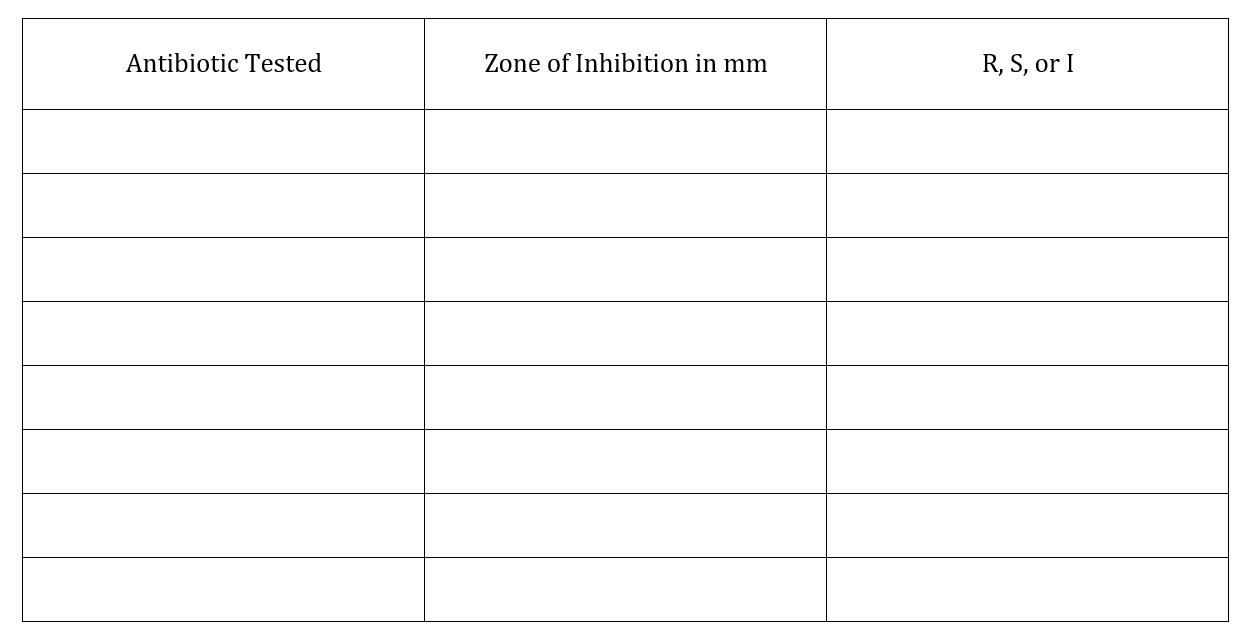
2. Compare the diameter you measure for each antibiotic to the value in the Kirby-Bauer Zone Diameter table to determine if the bacteria is resistant, intermediate or sensitive to the antibiotic.

CONCLUSIONS
1. Explain what it means for bacteria to be susceptible to an antibiotic.
2. Define zone of inhibition. What does the presence or absence of a zone indicate about the bacterial response to an antibiotic?
3. Why is the diameter of the zone of inhibition alone insufficient for determining whether an antibiotic is effective?
4. How did performing the Kirby-Bauer test help you better understand the relationship between microbiology laboratory data and real-world clinical decisions?
5. It is not unusual for a healthcare provider to begin antibiotic treatment before susceptibility results are available. Based on this lab, explain why it is still important to perform antibiotic susceptibility testing even after treatment has already started.