

11.3: Catalase Test
- Page ID
- 132453
\( \newcommand{\vecs}[1]{\overset { \scriptstyle \rightharpoonup} {\mathbf{#1}} } \)
\( \newcommand{\vecd}[1]{\overset{-\!-\!\rightharpoonup}{\vphantom{a}\smash {#1}}} \)
\( \newcommand{\dsum}{\displaystyle\sum\limits} \)
\( \newcommand{\dint}{\displaystyle\int\limits} \)
\( \newcommand{\dlim}{\displaystyle\lim\limits} \)
\( \newcommand{\id}{\mathrm{id}}\) \( \newcommand{\Span}{\mathrm{span}}\)
( \newcommand{\kernel}{\mathrm{null}\,}\) \( \newcommand{\range}{\mathrm{range}\,}\)
\( \newcommand{\RealPart}{\mathrm{Re}}\) \( \newcommand{\ImaginaryPart}{\mathrm{Im}}\)
\( \newcommand{\Argument}{\mathrm{Arg}}\) \( \newcommand{\norm}[1]{\| #1 \|}\)
\( \newcommand{\inner}[2]{\langle #1, #2 \rangle}\)
\( \newcommand{\Span}{\mathrm{span}}\)
\( \newcommand{\id}{\mathrm{id}}\)
\( \newcommand{\Span}{\mathrm{span}}\)
\( \newcommand{\kernel}{\mathrm{null}\,}\)
\( \newcommand{\range}{\mathrm{range}\,}\)
\( \newcommand{\RealPart}{\mathrm{Re}}\)
\( \newcommand{\ImaginaryPart}{\mathrm{Im}}\)
\( \newcommand{\Argument}{\mathrm{Arg}}\)
\( \newcommand{\norm}[1]{\| #1 \|}\)
\( \newcommand{\inner}[2]{\langle #1, #2 \rangle}\)
\( \newcommand{\Span}{\mathrm{span}}\) \( \newcommand{\AA}{\unicode[.8,0]{x212B}}\)
\( \newcommand{\vectorA}[1]{\vec{#1}} % arrow\)
\( \newcommand{\vectorAt}[1]{\vec{\text{#1}}} % arrow\)
\( \newcommand{\vectorB}[1]{\overset { \scriptstyle \rightharpoonup} {\mathbf{#1}} } \)
\( \newcommand{\vectorC}[1]{\textbf{#1}} \)
\( \newcommand{\vectorD}[1]{\overrightarrow{#1}} \)
\( \newcommand{\vectorDt}[1]{\overrightarrow{\text{#1}}} \)
\( \newcommand{\vectE}[1]{\overset{-\!-\!\rightharpoonup}{\vphantom{a}\smash{\mathbf {#1}}}} \)
\( \newcommand{\vecs}[1]{\overset { \scriptstyle \rightharpoonup} {\mathbf{#1}} } \)
\(\newcommand{\longvect}{\overrightarrow}\)
\( \newcommand{\vecd}[1]{\overset{-\!-\!\rightharpoonup}{\vphantom{a}\smash {#1}}} \)
\(\newcommand{\avec}{\mathbf a}\) \(\newcommand{\bvec}{\mathbf b}\) \(\newcommand{\cvec}{\mathbf c}\) \(\newcommand{\dvec}{\mathbf d}\) \(\newcommand{\dtil}{\widetilde{\mathbf d}}\) \(\newcommand{\evec}{\mathbf e}\) \(\newcommand{\fvec}{\mathbf f}\) \(\newcommand{\nvec}{\mathbf n}\) \(\newcommand{\pvec}{\mathbf p}\) \(\newcommand{\qvec}{\mathbf q}\) \(\newcommand{\svec}{\mathbf s}\) \(\newcommand{\tvec}{\mathbf t}\) \(\newcommand{\uvec}{\mathbf u}\) \(\newcommand{\vvec}{\mathbf v}\) \(\newcommand{\wvec}{\mathbf w}\) \(\newcommand{\xvec}{\mathbf x}\) \(\newcommand{\yvec}{\mathbf y}\) \(\newcommand{\zvec}{\mathbf z}\) \(\newcommand{\rvec}{\mathbf r}\) \(\newcommand{\mvec}{\mathbf m}\) \(\newcommand{\zerovec}{\mathbf 0}\) \(\newcommand{\onevec}{\mathbf 1}\) \(\newcommand{\real}{\mathbb R}\) \(\newcommand{\twovec}[2]{\left[\begin{array}{r}#1 \\ #2 \end{array}\right]}\) \(\newcommand{\ctwovec}[2]{\left[\begin{array}{c}#1 \\ #2 \end{array}\right]}\) \(\newcommand{\threevec}[3]{\left[\begin{array}{r}#1 \\ #2 \\ #3 \end{array}\right]}\) \(\newcommand{\cthreevec}[3]{\left[\begin{array}{c}#1 \\ #2 \\ #3 \end{array}\right]}\) \(\newcommand{\fourvec}[4]{\left[\begin{array}{r}#1 \\ #2 \\ #3 \\ #4 \end{array}\right]}\) \(\newcommand{\cfourvec}[4]{\left[\begin{array}{c}#1 \\ #2 \\ #3 \\ #4 \end{array}\right]}\) \(\newcommand{\fivevec}[5]{\left[\begin{array}{r}#1 \\ #2 \\ #3 \\ #4 \\ #5 \\ \end{array}\right]}\) \(\newcommand{\cfivevec}[5]{\left[\begin{array}{c}#1 \\ #2 \\ #3 \\ #4 \\ #5 \\ \end{array}\right]}\) \(\newcommand{\mattwo}[4]{\left[\begin{array}{rr}#1 \amp #2 \\ #3 \amp #4 \\ \end{array}\right]}\) \(\newcommand{\laspan}[1]{\text{Span}\{#1\}}\) \(\newcommand{\bcal}{\cal B}\) \(\newcommand{\ccal}{\cal C}\) \(\newcommand{\scal}{\cal S}\) \(\newcommand{\wcal}{\cal W}\) \(\newcommand{\ecal}{\cal E}\) \(\newcommand{\coords}[2]{\left\{#1\right\}_{#2}}\) \(\newcommand{\gray}[1]{\color{gray}{#1}}\) \(\newcommand{\lgray}[1]{\color{lightgray}{#1}}\) \(\newcommand{\rank}{\operatorname{rank}}\) \(\newcommand{\row}{\text{Row}}\) \(\newcommand{\col}{\text{Col}}\) \(\renewcommand{\row}{\text{Row}}\) \(\newcommand{\nul}{\text{Nul}}\) \(\newcommand{\var}{\text{Var}}\) \(\newcommand{\corr}{\text{corr}}\) \(\newcommand{\len}[1]{\left|#1\right|}\) \(\newcommand{\bbar}{\overline{\bvec}}\) \(\newcommand{\bhat}{\widehat{\bvec}}\) \(\newcommand{\bperp}{\bvec^\perp}\) \(\newcommand{\xhat}{\widehat{\xvec}}\) \(\newcommand{\vhat}{\widehat{\vvec}}\) \(\newcommand{\uhat}{\widehat{\uvec}}\) \(\newcommand{\what}{\widehat{\wvec}}\) \(\newcommand{\Sighat}{\widehat{\Sigma}}\) \(\newcommand{\lt}{<}\) \(\newcommand{\gt}{>}\) \(\newcommand{\amp}{&}\) \(\definecolor{fillinmathshade}{gray}{0.9}\)- Describe what catalase is and why it is important for bacterial survival.
- Give the chemical reaction catalyzed by catalase.
- Explain how testing for catalase is useful for characterizing and identifying bacterial species.
- Discuss the types of bacterial species that typically produce catalase and those that typically do not produce catalase.
- Successfully conduct a catalase test.
- Interpret results for a catalase test.
Catalase
Catalase is an enzyme produced by some species of bacteria. This enzyme protects bacteria from hydrogen peroxide (H2O2) that can damage and kill them. Catalase will convert hydrogen peroxide into liquid water (H2O) and oxygen gas (O2) (Fig.1). As a result, if catalase is very active due to an abundance of hydrogen peroxide, the rapid production of oxygen gas (O2) will produce bubbles (Fig.2).
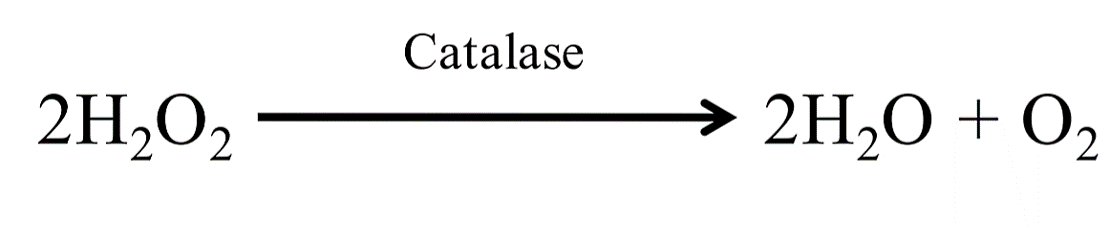
Figure 1: The reaction catalyzed by the enzyme catalase. Two hydrogen peroxide molecules (2 H2O2) are converted into two water molecules (2 H2O) and an oxygen molecule (O2). "Catalase" is written over the reaction arrow to show that this is the enzyme that enables this chemical reaction to occur.
Bacteria that conduct aerobic metabolism (biological reactions that require O2) produce hydrogen peroxide (H2O2) as a toxic byproduct of their metabolism. Toxic hydrogen peroxide can cause intracellular damage, such as damage to DNA, lipids, and proteins. To remove H2O2 and other similar compounds, cells produce enzymes to break them down, such as catalase.
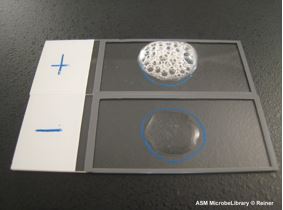
Figure 2: Slide catalase test results. Hydrogen peroxide was added directly to bacteria placed on a microscope slide. A catalase-positive reaction is indicated by bubbling (top); a negative reaction is indicated by lack of bubbling (bottom). Image by Karen Reiner, Andrews University, Berrien Springs, MI.
A simple test to determine if bacteria produce catalase is to add hydrogen peroxide to bacteria. This may be done by adding the hydrogen peroxide to bacteria placed on a slide or adding it to bacteria growing on an agar slant. If catalase is present, the hydrogen peroxide will be broken down into water and oxygen gas, resulting in the production of bubbles (catalase positive) (Fig.2). This test does not require any special type of medium, however, it should never be performed on organisms that have been grown on blood agar (a medium that contains blood). This is because there is a catalase activity in the blood that would produce a false positive result.
Most aerobic bacteria (bacteria that require O2) and facultatively anaerobic bacteria (bacteria that live and metabolize O2 or in an environment without O2) produce catalase. Obligate anaerobe bacterial species (bacteria that must live in an environment without O2 to survive) lack catalase, which is why they cannot survive in an atmosphere containing oxygen. However, some of them have modified versions of catalase to deal with any possible exposure to oxygen.
Streptococcus pyogenes
Infections caused by group A Streptococcus (e.g., Streptococcus pyogenes) are common in healthcare settings. The catalase test is a key diagnostic tool that helps differentiate these infections from those caused by other bacteria. Since Streptococcus species do not produce catalase, they are easily distinguished from catalase-positive organisms like Staphylococcus, which can also cause similar infections. Given the potential for complications with untreated Streptococcus infections, rapid identification is critical to preventing severe outcomes such as heart damage from rheumatic fever.
Rheumatic fever is an autoimmune response that can develop if strep throat, scarlet fever, or impetigo is left untreated. During a Streptococcal infection, the immune system creates antibodies to mark the bacteria for destruction. Unfortunately, these antibodies cross-react with human tissues, triggering Rheumatic fever. The body’s immune system mistakenly attacks its tissues, leading to inflammation in the heart, joints, skin, and brain. This can result in long-term heart damage, known as rheumatic heart disease. Early diagnosis and treatment of Streptococcus infections with appropriate antibiotics are crucial in preventing rheumatic fever and protecting patients from potentially lifelong complications.
Laboratory Instructions
Catalase Test
- Obtain a glass slide and a bottle of hydrogen peroxide.
- Using a sterilized inoculating loop, smear a sample of bacteria onto the dry slide.
- Using a transfer pipet, place a drop of hydrogen peroxide on top of the bacteria.
- Look for bubbles immediately:
- bubbles = catalase positive
- no bubbles = catalase negative
- Dispose of the slide in the biohazardous sharps container.
Attributions
- "Microbiology Laboratory Manual: Labs, 1.18 Catalase Test" by Dr. Rosanna Hartline, West Hills College Lemoore, LibreTexts: Biology is licensed under CC BY-NC 4.0
- Centers for Disease Control and Prevention. (2024, March 1). About rheumatic fever. https://www.cdc.gov/group-a-strep/about/rheumatic-fever.html
- Chapter Image: Catalase reaction.jpg by Nase assumed (based on copyright claims) is licensed under CC BY-SA 3.0
- MB352 General Microbiology Laboratory 2021 (Lee) by Alice_Lee@ncsu.edu is licensed under CC BY-NC-SA 4.0
- Red Mountain Microbiology by Jill Raymond Ph.D.; Graham Boorse, Ph.D.; Anne Mason M.S. is licensed under CC BY-NC 4.0