

2.5: Lipids
- Page ID
- 177203
\( \newcommand{\vecs}[1]{\overset { \scriptstyle \rightharpoonup} {\mathbf{#1}} } \)
\( \newcommand{\vecd}[1]{\overset{-\!-\!\rightharpoonup}{\vphantom{a}\smash {#1}}} \)
\( \newcommand{\dsum}{\displaystyle\sum\limits} \)
\( \newcommand{\dint}{\displaystyle\int\limits} \)
\( \newcommand{\dlim}{\displaystyle\lim\limits} \)
\( \newcommand{\id}{\mathrm{id}}\) \( \newcommand{\Span}{\mathrm{span}}\)
( \newcommand{\kernel}{\mathrm{null}\,}\) \( \newcommand{\range}{\mathrm{range}\,}\)
\( \newcommand{\RealPart}{\mathrm{Re}}\) \( \newcommand{\ImaginaryPart}{\mathrm{Im}}\)
\( \newcommand{\Argument}{\mathrm{Arg}}\) \( \newcommand{\norm}[1]{\| #1 \|}\)
\( \newcommand{\inner}[2]{\langle #1, #2 \rangle}\)
\( \newcommand{\Span}{\mathrm{span}}\)
\( \newcommand{\id}{\mathrm{id}}\)
\( \newcommand{\Span}{\mathrm{span}}\)
\( \newcommand{\kernel}{\mathrm{null}\,}\)
\( \newcommand{\range}{\mathrm{range}\,}\)
\( \newcommand{\RealPart}{\mathrm{Re}}\)
\( \newcommand{\ImaginaryPart}{\mathrm{Im}}\)
\( \newcommand{\Argument}{\mathrm{Arg}}\)
\( \newcommand{\norm}[1]{\| #1 \|}\)
\( \newcommand{\inner}[2]{\langle #1, #2 \rangle}\)
\( \newcommand{\Span}{\mathrm{span}}\) \( \newcommand{\AA}{\unicode[.8,0]{x212B}}\)
\( \newcommand{\vectorA}[1]{\vec{#1}} % arrow\)
\( \newcommand{\vectorAt}[1]{\vec{\text{#1}}} % arrow\)
\( \newcommand{\vectorB}[1]{\overset { \scriptstyle \rightharpoonup} {\mathbf{#1}} } \)
\( \newcommand{\vectorC}[1]{\textbf{#1}} \)
\( \newcommand{\vectorD}[1]{\overrightarrow{#1}} \)
\( \newcommand{\vectorDt}[1]{\overrightarrow{\text{#1}}} \)
\( \newcommand{\vectE}[1]{\overset{-\!-\!\rightharpoonup}{\vphantom{a}\smash{\mathbf {#1}}}} \)
\( \newcommand{\vecs}[1]{\overset { \scriptstyle \rightharpoonup} {\mathbf{#1}} } \)
\(\newcommand{\longvect}{\overrightarrow}\)
\( \newcommand{\vecd}[1]{\overset{-\!-\!\rightharpoonup}{\vphantom{a}\smash {#1}}} \)
\(\newcommand{\ket}[1]{\left| #1 \right>}\)
\(\newcommand{\bra}[1]{\left< #1 \right|}\)
\(\newcommand{\braket}[2]{\left< #1 \vphantom{#2} \right| \left. #2 \vphantom{#1} \right>}\)
\(\newcommand{\braopket}[3]{\left< #1 \vphantom{#2}\vphantom{#3} \right| #2 \vphantom{#1}\vphantom{#3} \left| #3 \vphantom{#1}\vphantom{#2} \right>}\)
\(\newcommand{\qmvec}[1]{\mathbf{\vec{#1}}}\)
\(\newcommand{\op}[1]{\hat{\mathbf{#1}}}\)
\(\newcommand{\expect}[1]{\langle #1 \rangle}\)
\(\newcommand{\dfn}[1]{\emph{\textbf{#1}}}\)
Statins are among the most widely-prescribed medications in the United States due to their ability to decrease LDL-cholesterol and lower the risk of developing cardiovascular diseases. Their development started with the works of Drs. Brown and Goldstein on the underlying mechanisms of cholesterol metabolism, for which they were awarded the 1985 Nobel Prize in Physiology or Medicine. Their findings eventually led to the discovery of the first statins by the Japanese biochemist Akira Endo and the subsequent development of statin drugs.
Learn more about the history, mechanism, and side effects of statins by watching the video below.
Introduction
Lipids include a diverse group of compounds that are largely non-polar in nature. This is because they are hydrocarbons that include mostly non-polar carbon–carbon or carbon–hydrogen bonds. Non-polar molecules are hydrophobic (“water fearing”), or insoluble in water. Lipids perform many different functions in a cell. Cells store energy for long-term use in the form of fats. Lipids also provide insulation from the environment for plants and animals. For example, they help keep aquatic birds and mammals dry when forming a protective layer over fur or feathers because of their water-repellant hydrophobic nature. Lipids are also the building blocks of many hormones and are an important constituent of all cellular membranes.
Lipids include the following:
- triglycerides (fats, oils)
- phospholipids
- steroids (cholesterol, bile salts, hormones)
- fatty acids (omega family)
- fat-soluble vitamins
- eicanosoids (prostaglandins, leukotrienes)
- lipoproteins (HDL, LDL)
- waxes
- pigments
Lipids are a diverse group of non-polar macromolecules. By the end of this section, you will be able to:
- Describe the four major types of lipids
- Explain the role of fats in storing energy
- Differentiate between saturated and unsaturated fatty acids
- Describe phospholipids and their role in cells
- Define the basic structure of a steroid and some functions of steroids
- Explain the how cholesterol helps to maintain the fluid nature of the plasma membrane

Triglycerides: Fats and Oils
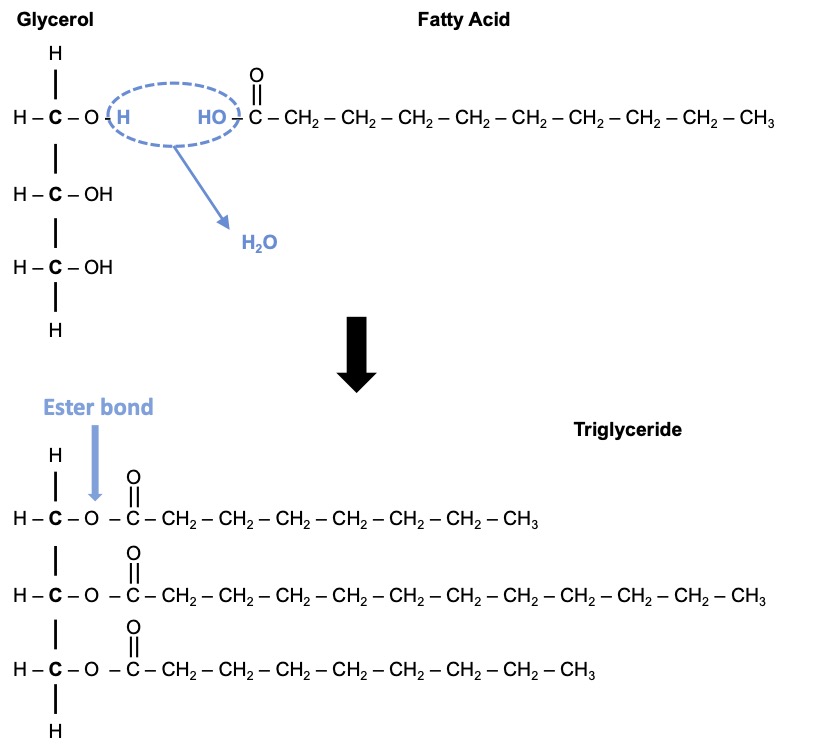
A triglyceride molecule consists of two main components: glycerol and fatty acids. A solid triglyceride is referred to as a fat. A liquid triglyceride is known as an oil
- Glycerol is an organic compound (alcohol) with three carbons, five hydrogens, and three hydroxyl (OH) groups.
- Fatty acids have a long chain of hydrocarbons to which a carboxyl group is attached, hence the name “fatty acid.” The number of carbons in the fatty acid may range from 4 to 36; most common are those containing 12–18 carbons.
To form a triglyceride, three fatty acids attach to the glycerol molecule through three separate dehydration synthesis reactions. The bond that forms between a fatty acid and the glycerol is called an ester linkage or ester bond (Figure \(\PageIndex{2}\)). To form an ester bond, a hydrogen from the glycerol's hydroxyl group and a hydroxyl group from the fatty acid's carboxyl group are removed to form a molecule of water. During triglyceride synthesis a total of three water molecules are formed and released and three ester bonds are created.
The three fatty acids in the triglyceride may be similar to or different from one another. Some fatty acids have common names that specify their origin. For example, palmitic acid, is a fatty acid derived from the palm tree. Arachidic acid is derived from Arachis hypogea, the scientific name for peanuts. Fatty acids can be classified as saturated and unsaturated. In a saturated fatty acid, all carbons in the hydrocarbon chain are linked to each other through single bonds. Because of this, saturated fatty acids are said to be "saturated" with hydrogen; in other words, the number of hydrogen atoms attached to the carbon skeleton is maximized and no more hydrogen may be added to the carbon atoms of the chain. The saturated fatty acid is a long, linear molecule. Stearic acid is an example of a saturated fatty acid (Figure \(\PageIndex{3}\)).

In an unsaturated fatty acid, the hydrocarbon chain contains one or multiple carbon-carbon double bonds. In other words, carbons are not saturated with hydrogens. Oleic acid is an example of an unsaturated fatty acid (Figure \(\PageIndex{4}\)). If there is one double bond in the molecule, then it is known as a monounsaturated fatty acid (e.g., found in olive oil), and if there is more than one double bond, then it is known as a polyunsaturated fatty acid (e.g., found in canola oil). Only one of the three fatty acids needs to be unsaturated for the triglyceride to be classified as unsaturated.

The position of the hydrogen atoms around the carbon-carbon double bond can be used to further classify the unsaturated fatty acid as either cis or trans. If hydrogen atoms are present in the same plane at this bond (i.e. on the same side of the double bond), the unsaturated fatty acid is called a cis fatty acid (Figure \(\PageIndex{5}\)). The cis double bond causes a bend or a “kink” in the fatty acid. This bend prevents triglycerides from packing tightly on top of one another and results in a liquid triglyceride at room temperature, otherwise known as an oil (Figure \(\PageIndex{5}\)). Olive oil, corn oil, canola oil, and cod liver oil are examples of cis unsaturated fats. If the hydrogen atoms at the double bond are on two different planes (i.e. across the double bond), the fatty acid is called a trans fatty acid. Because of the position of these hydrogen atoms, the trans fatty acid is a long, straight molecule. A triglyceride made of trans fatty acids or saturated fatty acids tend to be solid at room temperature because these long, straight fatty acids can be densely packed on top of one another. A solid triglyceride is called a fat. Examples of animal fats are stearic acid and palmitic acid (common in meat) and the fat butyric acid found in butter. Mammals store fats in specialized cells called adipocytes, where globules of fat occupy most of the cell’s volume.

In the food industry, oils are artificially hydrogenated to increase their shelf-life and give them a semi-solid consistency that desirable for many processed foods. In hydrogenation, hydrogen gas is bubbled through polyunsaturated oils to solidify them. During this hydrogenation process, some double bonds of the cis conformation in the hydrocarbon chain may be converted to the trans conformation. Margarine, some types of peanut butter, and shortening are examples of artificially hydrogenated trans fats. Recent studies have shown that an increase in trans fats in the human diet may lead to an increase in levels of low-density lipoproteins (LDL), or “bad” cholesterol, which in turn may lead to plaque deposition in the arteries, resulting in heart disease. Many fast food restaurants have recently banned the use of trans fats, and food labels are required to display the trans fat content.
Like carbohydrates, fats (i.e. triglycerides) have received a lot of bad publicity. It is true that eating an excess of fried foods and other “fatty” foods leads to weight gain. However, fats do have important functions. Many vitamins are fat soluble, and fats serve as a long-term storage form of fatty acids: a source of energy. They also provide insulation for the body. Therefore, “healthy” fats in moderate amounts should be consumed on a regular basis.
Phospholipids
Phospholipids are modified triglycerides. Like triglycerides, they are composed of non-polar fatty acid chains attached to a glycerol backbone. However, instead of three fatty acids, the phospholipid has only two fatty acids, with the third carbon of the glycerol bound to a phosphate group (Figure \(\PageIndex{6}\)). This phosphate group is modified with a functional group that may be charged or polar in nature. The functional group determines the chemical and physical properties of the phospholipid and can range from something as simple as a hydroxyl group (e.g. phosphatidic acid) to more complex compounds like carbon rings (e.g. phosphatidylinositol).

The phospholipid is comprised of both hydrophobic and hydrophilic regions. The modified phosphate group bound to the glycerol backbone is often called the polar head group of the phospholipid and the two fatty acids are called the hydrophobic tails. The hydrophobic and hydrophilic nature of the phospholipid makes it an amphipathic molecule. It also means that when added to an aqueous environment, phospholipids will spontaneously arrange themselves into a phospholipid bilayer, with the hydrophobic fatty acids tails facing away from water (towards the inside of the bilayer) and the hydrophilic head groups facing out towards the aqueous environment (Figure \(\PageIndex{7}\)). In a cell, the phospholipid bilayer makes up the majority of the plasma membrane and they are responsible for its dynamic nature.

Steroids
A steroid is a lipid with a fused ring structure. Although they do not resemble the other lipids, they are grouped with them because they are also hydrophobic and insoluble in water. All steroids have four linked carbon rings and are modified with specific function groups that determine their function (Figure \(\PageIndex{8}\)).

The most common steroid is cholesterol. As with all steroids, cholesterol is made of four fused carbon rings, giving the molecule rigidity. A hydrocarbon chain fused to one ring makes the molecule mostly non-polar and a hydroxyl group at the other end makes the molecule slightly polar. As such, cholesterol is an amphipathic molecule. Cholesterol is mainly synthesized by animals in the cells of the liver or it can be ingested through food. Although cholesterol is often spoken of in negative terms by lay people, it is necessary for proper functioning of the body. For example, cholesterol is a component of the phospholipid bilayer and is the precursor to many steroid hormones such as testosterone, estradiol, cortisol, and aldosterone. It is also the precursor to Vitamin D and to bile salts, which help in the emulsification and absorption of fats.
Fatty Acids
Essential fatty acids are fatty acids that are not synthesized by an organism but must be obtained through the diet. There are two main types of essential fatty acids: omega-3 and omega-6. Omega-3 fatty acids (e.g. alpha-linoleic acid) are a type of polyunsaturated fat that have their first double bond between the third and fourth carbon from the end of the fatty acid chain (Figure \(\PageIndex{9}\)). Examples of omega-3 fatty acids are alpha-linoleic acid (ALA) and docosahexaenoic acid (DHA). Omega-6 fatty acids are also a type of polyunsaturated fat. The omega-6 fatty acid has its first double bond at the sixth carbon from the end of the fatty acid chain.

Salmon, trout, and tuna are good sources of omega-3 fatty acids. Research shows that omega-3 fatty acids are important in brain function and normal growth and development. They may also prevent heart disease, decrease inflammation, and reduce the risk of cancer.
Lipids are a class of macromolecules that are nonpolar and hydrophobic in nature. Major types include triglycerides, phospholipids, fatty acids, and steroids.
Some major concepts to remember are:
- Fats and oils are a stored form of energy and are also known as triacylglycerols or triglycerides.
- Triglycerides are made up of three fatty acids bound to a glycerol.
- Fatty acids may be unsaturated or saturated, depending on the presence or absence of double bonds in the hydrocarbon chain. If only single bonds are present, they are known as saturated fatty acids. Unsaturated fatty acids may have one or more double bonds in the hydrocarbon chain.
- Phospholipids have a glycerol backbone to which two fatty acid chains and a phosphate-containing group are attached. Phospholipids form the bilayers that make up the plasma membrane.
- Steroids are made of four fused carbon rings modified through the addition of functional groups.
- Cholesterol is the most basic type of steroid
- Modifications to cholesterol result in the production of the steroid hormones (e.g. sex hormones, aldosterone, cortisol)
- Omega-3 and omega-6 fatty acids are known as essential fatty acids
Glossary
Amphipathic - a molecule that has both hydrophilic and hydrophobic regions
Cis - a term used in chemistry and biochemistry to describe the arrangement of atoms or functional groups in a molecule, such as an unsaturated fatty acid
Cis isomer - an isomer that has similar or identical functional groups positioned on the same side of a double bond
Cholesterol - a lipid made of fused carbon rings bound to unique functional groups; a precursor for steroid hormones and bile
Eicosanoids - a group of signaling molecules derived from fatty acids; include the prostaglandins and leukotrienes; involved in inflammation and immunity
Essential fatty acid - a fatty acid that must be obtained through the diet
Fat - a triglyceride that is solid at room temperature
Fatty acid - a hydrocarbon chain with a carboxyl (-COOH) group at one end; can be be saturated or unsaturated
Glycerol - a three-carbon molecule that serves as the backbone of triglycerides and phospholipids
Hydrogenation - a chemical process in which hydrogen is added to unsaturated fats or other organic compounds
Hydrophobic - a property of molecules that repel water; characteristic of the fatty acid tails in lipids
Lipid Bilayer - a double-layered structure formed by phospholipids in aqueous environments, making up the fundamental structure of cell membranes
Lipoprotein - a complex of lipids and proteins that transports fats through the bloodstream, including HDL (high-density lipoprotein) and LDL (low-density lipoprotein)
Oil - a triglyceride that is liquid at room temperature
Omega fatty acid - a type of polyunsaturated fatty acid that play essential roles in human health; categorized based on the position of the first double bond from the methyl (CH₃) end of the hydrocarbon chain
Phospholipid - a modified triglyceride made of two fatty acids "tails" and a polar "head group" attached to a glycerol backbone
Pigment - a lipid that absorbs specific wavelengths of light
Polar head group - the hydrophilic (water-attracting) part of an amphipathic molecule, such as a phospholipid
Polymer - a large molecule made up of repeating units called monomers
Saturated fatty acid - a fatty acid in which all carbons in the hydrocarbon chain are linked to each other through single bonds
Steroid - a lipid made of four fused carbon rings modified with specific functional groups
Trans - a term used in chemistry and biochemistry to describe the arrangement of atoms or functional groups in a molecule, such as an unsaturated fatty acid
Trans isomer - an isomer that has similar or identical functional groups positioned on the opposite side of a double bond
Trans fat - a fat containing artificially modified unsaturated fatty acids with a trans configuration; often found in processed foods and linked to health risks
Triglyceride - a lipid made of three fatty acids attached to a glycerol backbone
Unsaturated fatty acid - a fatty acid in which carbon-carbon double bonds can be found
Wax - a type of lipid that is highly water-resistant and protects various structures in plants, animals and microbes; made of long-chain fatty acids bound to long-chain alcohols rather than glycerol
Attribution
Figures taken from Open Stax Biology 3.3 Lipids
- Figure \(\PageIndex{1}\)
- Figure \(\PageIndex{3}\)
- Figure \(\PageIndex{4}\)
- Figure \(\PageIndex{5}\)
- Figure \(\PageIndex{6}\)
- Figure \(\PageIndex{7}\)
- Figure \(\PageIndex{8}\)
- Figure \(\PageIndex{9}\)