

10.6: Large Intestine
- Page ID
- 213816
\( \newcommand{\vecs}[1]{\overset { \scriptstyle \rightharpoonup} {\mathbf{#1}} } \)
\( \newcommand{\vecd}[1]{\overset{-\!-\!\rightharpoonup}{\vphantom{a}\smash {#1}}} \)
\( \newcommand{\dsum}{\displaystyle\sum\limits} \)
\( \newcommand{\dint}{\displaystyle\int\limits} \)
\( \newcommand{\dlim}{\displaystyle\lim\limits} \)
\( \newcommand{\id}{\mathrm{id}}\) \( \newcommand{\Span}{\mathrm{span}}\)
( \newcommand{\kernel}{\mathrm{null}\,}\) \( \newcommand{\range}{\mathrm{range}\,}\)
\( \newcommand{\RealPart}{\mathrm{Re}}\) \( \newcommand{\ImaginaryPart}{\mathrm{Im}}\)
\( \newcommand{\Argument}{\mathrm{Arg}}\) \( \newcommand{\norm}[1]{\| #1 \|}\)
\( \newcommand{\inner}[2]{\langle #1, #2 \rangle}\)
\( \newcommand{\Span}{\mathrm{span}}\)
\( \newcommand{\id}{\mathrm{id}}\)
\( \newcommand{\Span}{\mathrm{span}}\)
\( \newcommand{\kernel}{\mathrm{null}\,}\)
\( \newcommand{\range}{\mathrm{range}\,}\)
\( \newcommand{\RealPart}{\mathrm{Re}}\)
\( \newcommand{\ImaginaryPart}{\mathrm{Im}}\)
\( \newcommand{\Argument}{\mathrm{Arg}}\)
\( \newcommand{\norm}[1]{\| #1 \|}\)
\( \newcommand{\inner}[2]{\langle #1, #2 \rangle}\)
\( \newcommand{\Span}{\mathrm{span}}\) \( \newcommand{\AA}{\unicode[.8,0]{x212B}}\)
\( \newcommand{\vectorA}[1]{\vec{#1}} % arrow\)
\( \newcommand{\vectorAt}[1]{\vec{\text{#1}}} % arrow\)
\( \newcommand{\vectorB}[1]{\overset { \scriptstyle \rightharpoonup} {\mathbf{#1}} } \)
\( \newcommand{\vectorC}[1]{\textbf{#1}} \)
\( \newcommand{\vectorD}[1]{\overrightarrow{#1}} \)
\( \newcommand{\vectorDt}[1]{\overrightarrow{\text{#1}}} \)
\( \newcommand{\vectE}[1]{\overset{-\!-\!\rightharpoonup}{\vphantom{a}\smash{\mathbf {#1}}}} \)
\( \newcommand{\vecs}[1]{\overset { \scriptstyle \rightharpoonup} {\mathbf{#1}} } \)
\(\newcommand{\longvect}{\overrightarrow}\)
\( \newcommand{\vecd}[1]{\overset{-\!-\!\rightharpoonup}{\vphantom{a}\smash {#1}}} \)
\(\newcommand{\ket}[1]{\left| #1 \right>}\)
\(\newcommand{\bra}[1]{\left< #1 \right|}\)
\(\newcommand{\braket}[2]{\left< #1 \vphantom{#2} \right| \left. #2 \vphantom{#1} \right>}\)
\(\newcommand{\braopket}[3]{\left< #1 \vphantom{#2}\vphantom{#3} \right| #2 \vphantom{#1}\vphantom{#3} \left| #3 \vphantom{#1}\vphantom{#2} \right>}\)
\(\newcommand{\qmvec}[1]{\mathbf{\vec{#1}}}\)
\(\newcommand{\op}[1]{\hat{\mathbf{#1}}}\)
\(\newcommand{\expect}[1]{\langle #1 \rangle}\)
\(\newcommand{\dfn}[1]{\emph{\textbf{#1}}}\)
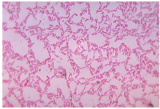
Figure \(\PageIndex{1}\) shows some of the cells of what has been called “the last human organ to be discovered.” This “organ” weighs about 200 grams (0.44 lb.) and consists of a hundred trillion cells, yet scientists are only now beginning to learn everything it does and how it varies among individuals. What is it? It’s the mass of bacteria that live in our large intestine.
Large Intestine
The large intestine, also called the large bowel, is the last organ of the GI tract. In adults, it averages about 1.5 m (5 ft) in length. It is shorter than the small intestine but at least twice as wide, averaging about 6.5 cm (2.5 in.) in diameter. Water is absorbed from the chyme as it passes through the large intestine, turning the chyme into solid feces. Feces is stored in the large intestine until it leaves the body during defecation.
Parts of the Large Intestine
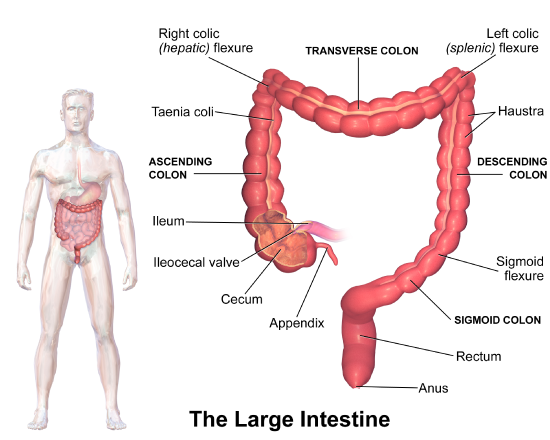
The large intestine begins at the end of the small intestine, where a valve separates the small and large intestines and regulates the movement of chyme into the large intestine Figure \(\PageIndex{2}\). The first part of the large intestine, where chyme enters from the small intestine, is called the cecum. From the cecum, the large intestine continues upward, travels across the upper abdomen, and then continues downward. It then becomes a V-shaped region, which is attached to the rectum. The rectum stores feces until elimination occurs. It transitions to the final part of the large intestine, called the anus, which has an opening to the outside of the body for feces to pass through.
A projection from the cecum of the colon is known as the appendix. The function of the appendix is uncertain, but it does not seem to be involved in digestion or absorption. It may play a role in immunity, and in the fetus, it seems to have an endocrine function, releasing hormones needed for homeostasis. Some biologists speculate that the appendix may also store a sample of the colon’s normal bacteria. If so, it may be able to repopulate the colon with the bacteria if illness or antibiotic medications deplete these microorganisms. Appendicitis, or infection and inflammation of the appendix, is a fairly common medical problem, typically resolved by surgical removal of the appendix (appendectomy). People who have had their appendix surgically removed do not seem to suffer any ill effects, so the organ is considered to be dispensable. As such, it is often referred to as a vestigial organ, which is a previously useful organ that has been retained over evolutionary time as part of the anatomy, even though it no longer has a function in the body.
Functions of the Large Intestine
The removal of water from chyme to form feces starts in the ascending colon and continues throughout much of the length of the organ. Salts such as sodium are also removed from food wastes in the large intestine before the wastes are eliminated from the body. This allows salts as well as water to be recycled in the body.
The large intestine is also the site where huge numbers of beneficial bacteria ferment many unabsorbed materials in food waste. The bacterial breakdown of undigested polysaccharides produces nitrogen, carbon dioxide, methane, and other gases that are responsible for intestinal gas, or flatulence. These bacteria are particularly prevalent in the descending colon. Some of the bacteria also produce vitamins that are absorbed from the colon. The vitamins include vitamins B1 (thiamine), B2 (riboflavin), B7 (biotin), B12, and K. Another role of bacteria in the colon is immune function. The bacteria may stimulate the immune system to produce antibodies that are effective against similar, but pathogenic, bacteria, thereby preventing infections. Still, other roles played by bacteria in the large intestine include breaking down toxins before they can poison the body, producing substances that help prevent colon cancer, and inhibiting the growth of harmful bacteria.
Colorectal cancer, or cancer of the colon or rectum, is the fourth most common cancer in the United States. It is also the second most common cause of cancer deaths in this country. Widespread screening of patients for signs of colorectal cancer has significantly lowered the death rate in recent years. Because early-stage colorectal cancer is usually asymptomatic, routine screening is important for identifying cancer early when chances of a cure are still high.
Screening for colorectal cancer has also become easier and less invasive in recent years. One way to test for colorectal cancer is to examine a sample of stool and look for occult (hidden from the unaided eye) blood in the stool. This test is based on the assumption that blood vessels in cancer are fragile and may be easily damaged by the passage of feces through the colon or rectum. The damaged vessels may bleed into the feces but rarely bleed enough for blood to be visible in the stool. Stool for the occult blood test can be collected by the patient at home with a test kit provided by a doctor. If occult blood is detected in the stool, a different type of follow-up test is generally needed to determine whether cancer is the cause of the bleeding.
A similarly simple and noninvasive but more definitive test for colorectal cancer looks for DNA from cancer cells in the stool. Again, the patient can collect the stool sample at home using a simple test kit and mail the specimen to a lab, which does the analysis. If the test comes back positive, then a direct visual examination of the colon and rectum by colonoscopy is required.
Colonoscopy is the gold standard for the diagnosis of colorectal cancer. Using a tiny camera at the end of a long tube inserted up into the colon, a doctor can directly visualize the lining of the large intestine and spot any suspicious areas that may be cancerous. While a colonoscopy is invasive and requires the patient to prepare for the test for a couple of days by changing his or her diet and drinking special fluids, it reveals more than just cancer. A colonoscopy also reveals any growths called polyps in the colon. Colon polyps are not cancer but often develop into cancerous lesions, so if they are found during a colonoscopy, a surgical instrument inserted with the scope is usually used to remove them. Therefore, a colonoscopy can not only detect cancer in its early stages, but it can even help prevent cancer by enabling the removal of potentially pre-cancerous polyps.
A test similar to colonoscopy may be done in some patients. Called a flexible sigmoidoscopy, it allows a doctor to use a small camera to inspect the rectum and lower third of the colon, where the majority of cases of colorectal cancer occur. However, the rest of the colon cannot be examined with a sigmoidoscopy. Another alternative to a full-blown colonoscopy is a virtual colonoscopy, in which a CT scan of the rectum and colon is used to make detailed cross-sectional images of the organs. The images can then be studied by a specialist to detect cancers or polyps. For both of these colonoscopy alternatives, a follow-up colonoscopy is required if polyps or potentially cancerous lesions are detected.
Unless you have a family history of colorectal cancer or certain other risk factors, you probably do not need to start routine screening for the disease until middle age. Your doctor can tell you the most appropriate starting age for your particular case, given your risk factors and current cancer guidelines. You may be able to be screened with one of the less invasive methods rather than colonoscopy until you are somewhat older. Again, check with your doctor for specific recommendations. All of the testing methods have pros and cons that should be taken into consideration by a given patient and medical provider.
Explore More
New research shows that babies born through vaginal birth actually have healthier gut flora, learn more here:
- Identify the main functions of the large intestine.
- How do beneficial bacteria in the large intestine help the human organism?
- True or False. The first part of the large intestine is where most chemical digestion takes place.
- When diarrhea occurs, feces leaves the body in a more liquid state than normal. What part of the digestive system do you think is involved in diarrhea? Explain your answer.
Attributions
- Bacteroides biacutis by US government, Public Domain via Wikimedia Commons
- Large intestine by Blausen.com staff (2014). "Medical gallery of Blausen Medical 2014". WikiJournal of Medicine 1 (2). DOI:10.15347/wjm/2014.010. ISSN 2002-4436. CC BY 3.0 via Wikimedia Commons
- Text adapted from Human Biology by CK-12 licensed CC BY-NC 3.0