

8.2: Lymphatic System
- Page ID
- 191666

\( \newcommand{\vecs}[1]{\overset { \scriptstyle \rightharpoonup} {\mathbf{#1}} } \)
\( \newcommand{\vecd}[1]{\overset{-\!-\!\rightharpoonup}{\vphantom{a}\smash {#1}}} \)
\( \newcommand{\dsum}{\displaystyle\sum\limits} \)
\( \newcommand{\dint}{\displaystyle\int\limits} \)
\( \newcommand{\dlim}{\displaystyle\lim\limits} \)
\( \newcommand{\id}{\mathrm{id}}\) \( \newcommand{\Span}{\mathrm{span}}\)
( \newcommand{\kernel}{\mathrm{null}\,}\) \( \newcommand{\range}{\mathrm{range}\,}\)
\( \newcommand{\RealPart}{\mathrm{Re}}\) \( \newcommand{\ImaginaryPart}{\mathrm{Im}}\)
\( \newcommand{\Argument}{\mathrm{Arg}}\) \( \newcommand{\norm}[1]{\| #1 \|}\)
\( \newcommand{\inner}[2]{\langle #1, #2 \rangle}\)
\( \newcommand{\Span}{\mathrm{span}}\)
\( \newcommand{\id}{\mathrm{id}}\)
\( \newcommand{\Span}{\mathrm{span}}\)
\( \newcommand{\kernel}{\mathrm{null}\,}\)
\( \newcommand{\range}{\mathrm{range}\,}\)
\( \newcommand{\RealPart}{\mathrm{Re}}\)
\( \newcommand{\ImaginaryPart}{\mathrm{Im}}\)
\( \newcommand{\Argument}{\mathrm{Arg}}\)
\( \newcommand{\norm}[1]{\| #1 \|}\)
\( \newcommand{\inner}[2]{\langle #1, #2 \rangle}\)
\( \newcommand{\Span}{\mathrm{span}}\) \( \newcommand{\AA}{\unicode[.8,0]{x212B}}\)
\( \newcommand{\vectorA}[1]{\vec{#1}} % arrow\)
\( \newcommand{\vectorAt}[1]{\vec{\text{#1}}} % arrow\)
\( \newcommand{\vectorB}[1]{\overset { \scriptstyle \rightharpoonup} {\mathbf{#1}} } \)
\( \newcommand{\vectorC}[1]{\textbf{#1}} \)
\( \newcommand{\vectorD}[1]{\overrightarrow{#1}} \)
\( \newcommand{\vectorDt}[1]{\overrightarrow{\text{#1}}} \)
\( \newcommand{\vectE}[1]{\overset{-\!-\!\rightharpoonup}{\vphantom{a}\smash{\mathbf {#1}}}} \)
\( \newcommand{\vecs}[1]{\overset { \scriptstyle \rightharpoonup} {\mathbf{#1}} } \)
\(\newcommand{\longvect}{\overrightarrow}\)
\( \newcommand{\vecd}[1]{\overset{-\!-\!\rightharpoonup}{\vphantom{a}\smash {#1}}} \)
\(\newcommand{\avec}{\mathbf a}\) \(\newcommand{\bvec}{\mathbf b}\) \(\newcommand{\cvec}{\mathbf c}\) \(\newcommand{\dvec}{\mathbf d}\) \(\newcommand{\dtil}{\widetilde{\mathbf d}}\) \(\newcommand{\evec}{\mathbf e}\) \(\newcommand{\fvec}{\mathbf f}\) \(\newcommand{\nvec}{\mathbf n}\) \(\newcommand{\pvec}{\mathbf p}\) \(\newcommand{\qvec}{\mathbf q}\) \(\newcommand{\svec}{\mathbf s}\) \(\newcommand{\tvec}{\mathbf t}\) \(\newcommand{\uvec}{\mathbf u}\) \(\newcommand{\vvec}{\mathbf v}\) \(\newcommand{\wvec}{\mathbf w}\) \(\newcommand{\xvec}{\mathbf x}\) \(\newcommand{\yvec}{\mathbf y}\) \(\newcommand{\zvec}{\mathbf z}\) \(\newcommand{\rvec}{\mathbf r}\) \(\newcommand{\mvec}{\mathbf m}\) \(\newcommand{\zerovec}{\mathbf 0}\) \(\newcommand{\onevec}{\mathbf 1}\) \(\newcommand{\real}{\mathbb R}\) \(\newcommand{\twovec}[2]{\left[\begin{array}{r}#1 \\ #2 \end{array}\right]}\) \(\newcommand{\ctwovec}[2]{\left[\begin{array}{c}#1 \\ #2 \end{array}\right]}\) \(\newcommand{\threevec}[3]{\left[\begin{array}{r}#1 \\ #2 \\ #3 \end{array}\right]}\) \(\newcommand{\cthreevec}[3]{\left[\begin{array}{c}#1 \\ #2 \\ #3 \end{array}\right]}\) \(\newcommand{\fourvec}[4]{\left[\begin{array}{r}#1 \\ #2 \\ #3 \\ #4 \end{array}\right]}\) \(\newcommand{\cfourvec}[4]{\left[\begin{array}{c}#1 \\ #2 \\ #3 \\ #4 \end{array}\right]}\) \(\newcommand{\fivevec}[5]{\left[\begin{array}{r}#1 \\ #2 \\ #3 \\ #4 \\ #5 \\ \end{array}\right]}\) \(\newcommand{\cfivevec}[5]{\left[\begin{array}{c}#1 \\ #2 \\ #3 \\ #4 \\ #5 \\ \end{array}\right]}\) \(\newcommand{\mattwo}[4]{\left[\begin{array}{rr}#1 \amp #2 \\ #3 \amp #4 \\ \end{array}\right]}\) \(\newcommand{\laspan}[1]{\text{Span}\{#1\}}\) \(\newcommand{\bcal}{\cal B}\) \(\newcommand{\ccal}{\cal C}\) \(\newcommand{\scal}{\cal S}\) \(\newcommand{\wcal}{\cal W}\) \(\newcommand{\ecal}{\cal E}\) \(\newcommand{\coords}[2]{\left\{#1\right\}_{#2}}\) \(\newcommand{\gray}[1]{\color{gray}{#1}}\) \(\newcommand{\lgray}[1]{\color{lightgray}{#1}}\) \(\newcommand{\rank}{\operatorname{rank}}\) \(\newcommand{\row}{\text{Row}}\) \(\newcommand{\col}{\text{Col}}\) \(\renewcommand{\row}{\text{Row}}\) \(\newcommand{\nul}{\text{Nul}}\) \(\newcommand{\var}{\text{Var}}\) \(\newcommand{\corr}{\text{corr}}\) \(\newcommand{\len}[1]{\left|#1\right|}\) \(\newcommand{\bbar}{\overline{\bvec}}\) \(\newcommand{\bhat}{\widehat{\bvec}}\) \(\newcommand{\bperp}{\bvec^\perp}\) \(\newcommand{\xhat}{\widehat{\xvec}}\) \(\newcommand{\vhat}{\widehat{\vvec}}\) \(\newcommand{\uhat}{\widehat{\uvec}}\) \(\newcommand{\what}{\widehat{\wvec}}\) \(\newcommand{\Sighat}{\widehat{\Sigma}}\) \(\newcommand{\lt}{<}\) \(\newcommand{\gt}{>}\) \(\newcommand{\amp}{&}\) \(\definecolor{fillinmathshade}{gray}{0.9}\)The white patches on either side of the throat in this picture are signs of tonsillitis. The tonsils are small structures in the throat that are very common sites of infection. The white spots on the tonsils pictured here are evidence of infection. The patches consist of large amounts of dead bacteria, cellular debris, and white blood cells; in a word, pus. Children with recurrent tonsillitis may have their tonsils removed surgically to eliminate this type of infection. The tonsils are organs of the lymphatic system.

Like our blood circulation, the lymphatic system consists of millions of small vessels that branch throughout our bodies. But whereas arteries and veins carry blood, the lymphatic vessels are much, much finer and carry a colorless fluid called lymph.
What Is the Lymphatic System?
The lymphatic system is a collection of organs involved in the production, maturation, and harboring of white blood cells called lymphocytes. It also includes a network of vessels that transport or filter the fluid known as lymph, in which lymphocytes circulate (Figure \(\PageIndex{2}\)).
Organs of the lymphatic system include the tonsils, thymus, and spleen, as well as hundreds of lymph nodes distributed along the lymphatic vessels.
The lymphatic vessels form a transportation network similar in many respects to the blood vessels of the cardiovascular system. However, unlike the cardiovascular system, the lymphatic system is not a closed system. Instead, lymphatic vessels carry lymph in a single direction, always toward the upper chest, where it empties into blood vessels.
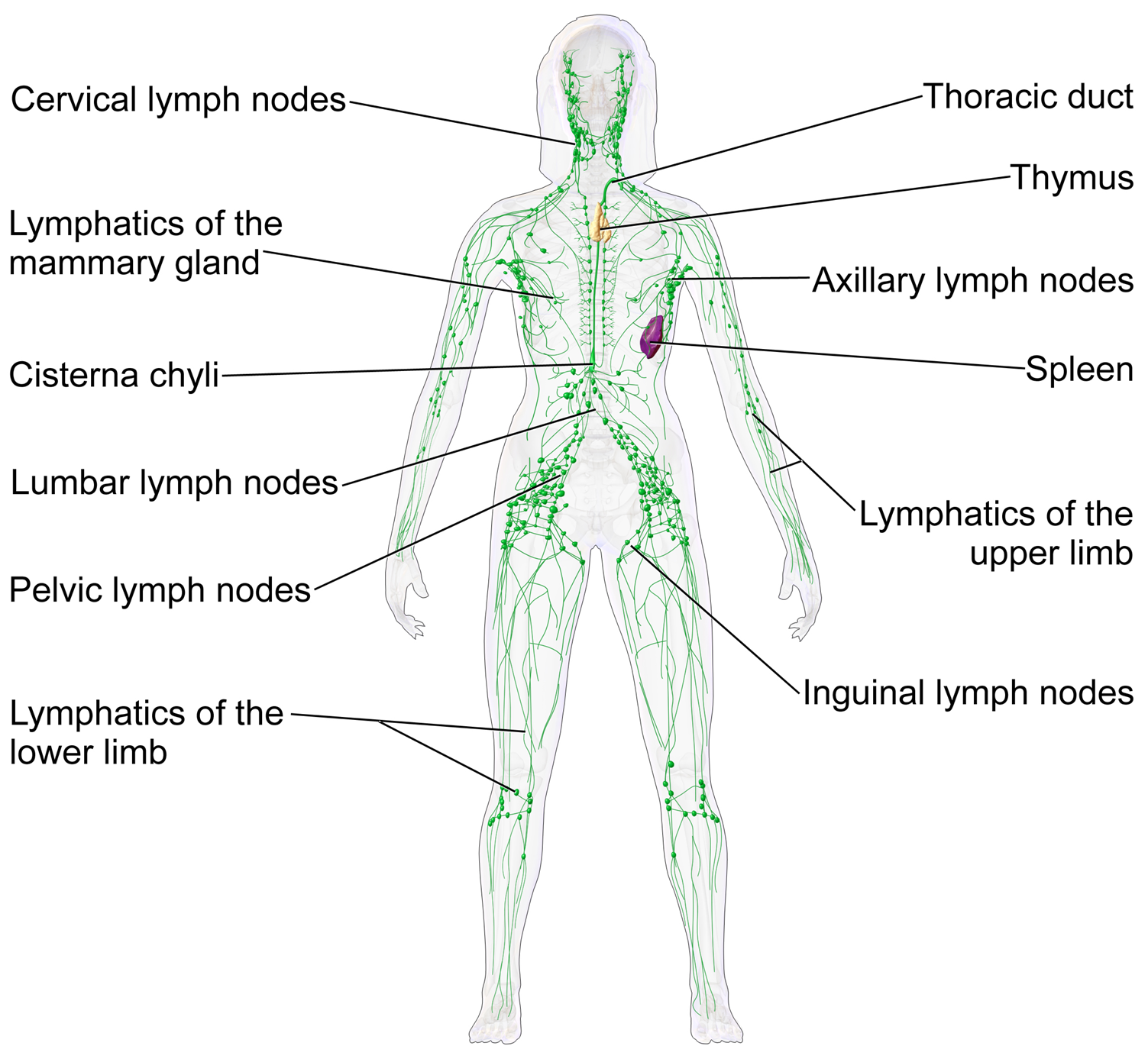 Figure \(\PageIndex{2}\): The lymphatic system includes the thymus, spleen, lymph vessels, and nodes. Lymphatic System, Blausen Staff CC-BY 3.0
Immune Function of the Lymphatic System
The lymphatic system primarily serves as host defense within the immune system, centered on the production, maturation, and circulation of lymphocytes.
Lymphocytes are leukocytes within the adaptive immune system. Responsible for recognizing and tailoring a defense against specific pathogens or tumor cells, lymphocytes may also create long-lasting memory, allowing for quick, strong attacks against that same pathogen in the future. In other words, lymphocytes confer long-lasting immunity against specific pathogens.
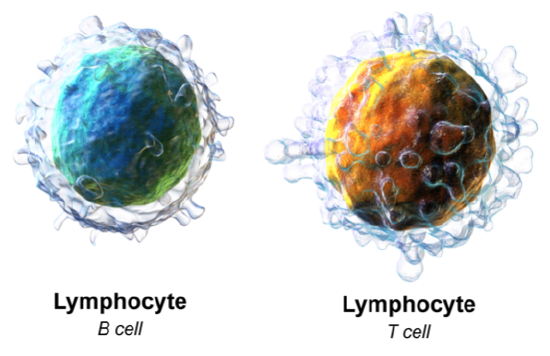
There are two major types of lymphocytes, called B cells and T cells (Figure \(\PageIndex{3}\)). Both B cells and T cells are involved in the adaptive immune response, but they play different roles.
Production and Maturation of Lymphocytes
Both B cells and T cells are produced from stem cells in the red bone marrow, as are all other blood cells.
After lymphocytes form, they undergo a complex maturation process before they are ready to search for pathogens. In this process, they “learn” to distinguish self from non-self. Only lymphocytes that successfully complete this process go on to actually fight infections.
- B cells mature in the bone marrow, which is why they are called B cells. After they mature and leave the bone marrow, they travel first to the circulatory system and then enter the lymphatic system to search for pathogens.
- T cells mature in the thymus, which is why they are called T cells (Figure \(\PageIndex{4}\)). After maturation, T cells join B cells in the lymphatic system in the hunt for pathogens.
Bone marrow and the thymus are called primary lymphoid organs because they play a role in the production and/or maturation of lymphocytes.

Lymphocytes in Secondary Lymphoid Organs
The tonsils, spleen, and lymph nodes are referred to as secondary lymphoid organs because they do not produce or mature lymphocytes. Instead, they filter lymph and store lymphocytes.
Lymphocytes and adaptive immune responses are activated in these secondary lymphoid organs in response to pathogens (or their antigens).
Activation leads to the cloning of pathogen-specific lymphocytes, which then circulate between the lymphatic system and the blood, searching for and destroying their specific pathogens by producing antibodies.
Tonsils
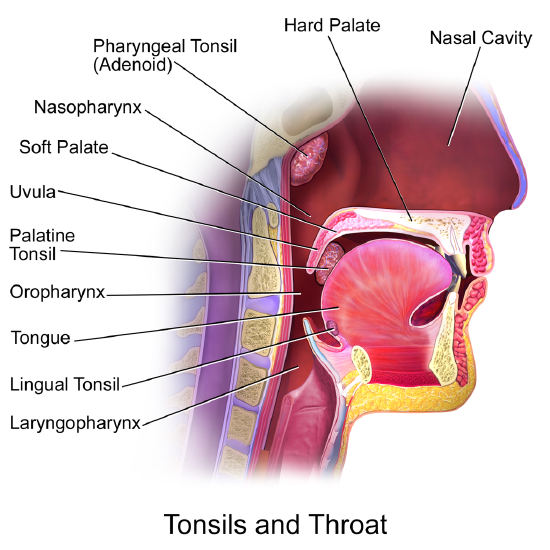
Three of the four pairs of tonsils are illustrated in Figure \(\PageIndex{5}\). The palatine tonsils are most familiar, visible on either side of the throat. The fourth pair, tubal tonsils, are located at the back of the nasopharynx.
All four pairs of tonsils encircle a region where the respiratory and gastrointestinal tracts intersect and where pathogens often enter the body.
Spleen
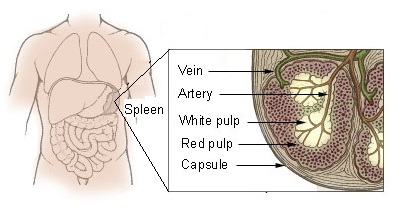
The spleen is the largest of the secondary lymphoid organs (Figure \(\PageIndex{6}\)). It stores lymphocytes and filters lymph and blood (dead or aged red blood cells)
In a fetus, the spleen also produces red blood cells. After birth, red blood cells are produced largely in the bone marrow.
Lymph Nodes
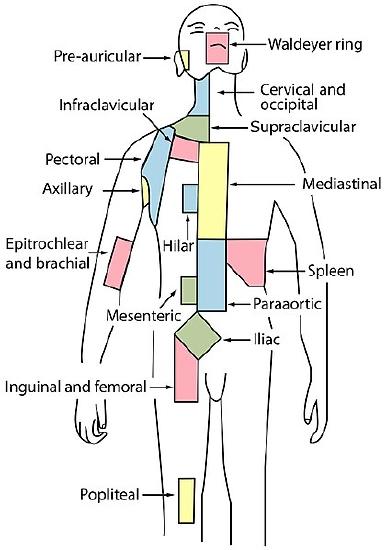
Each of the over 500 lymph nodes is a small but organized collection of lymphoid tissue containing many lymphocytes and located at intervals along the lymphatic vessels. Lymph passes through these nodes on its way back to the blood.
Many of them are clustered at the base of the limbs and in the neck (Figure \(\PageIndex{7}\)).
Cardiovascular Function of the Lymphatic System
Returning lymph to the bloodstream is one of the major functions of the lymphatic system.
As blood travels through capillaries of the cardiovascular system, it is under pressure, forcing some blood components (e.g., water, oxygen, and nutrients) through the walls of the capillaries and into the tissue spaces between cells, forming interstitial fluid (Figure \(\PageIndex{8\)).
Interstitial fluid bathes and nourishes cells and also absorbs their waste products. Much of the water from the interstitial fluid is reabsorbed via osmosis into the capillary blood.
The remaining fluid is absorbed by tiny lymphatic vessels called lymph capillaries, which then becomes lymph. Lymph is very similar to blood plasma. Besides water, lymph may contain proteins, waste products, cellular debris, and pathogens. It also contains numerous white blood cells, especially lymphocytes, the main cell type of the lymphatic system.
Lymph is transported via lymphatic vessels to two large lymphatic ducts in the upper chest. Then the lymph flows into the subclavian veins of the cardiovascular system.
Unlike blood, lymph is not actively pumped through its vessels. Instead, lymph moves through lymphatic vessels via contractions of the lymph vessels and skeletal muscles. Lymphatic vessels also contain numerous valves that keep lymph flowing in just one direction, thereby preventing backflow.
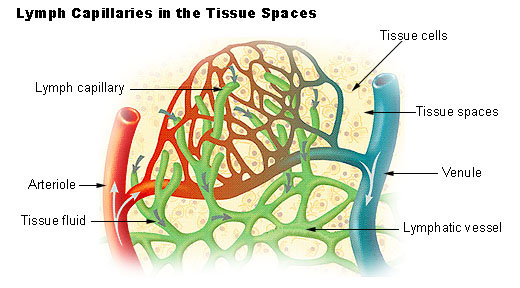
Figure \(\PageIndex{8}\): Fluid and other substances in the blood are forced by blood pressure through the walls of capillaries and into the surrounding tissue spaces. Some of the tissue fluid is absorbed by tiny lymphatic vessels, forming lymph. The arrows indicate the direction of blood and lymph through the blood and lymphatic vessels. Lymph Capillaries, NCI CC0
Your guide to what the lymphatic drainage system is, where it is in the body, and how it helps our bodies get rid of toxins, waste, and other unwanted materials, including infections and cancer cells.
Digestive Function of the Lymphatic System
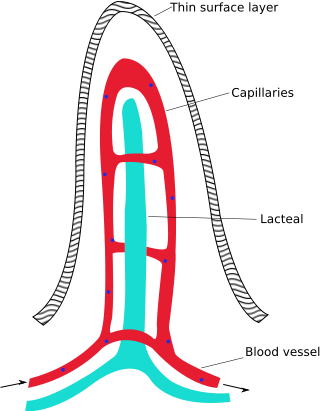
Lymphatic vessels (lacteals) are present in the lining of the gastrointestinal tract, mainly in the small intestine (Figure \(\PageIndex{9}\)). Each tiny villus in the lining of the small intestine has an internal bed of capillaries and lacteals. The capillaries absorb most nutrients from digested food into the blood. The lacteals absorb mainly fatty acids from lipid digestion into the lymph, forming a fatty-acid-enriched fluid called chyle.
Vessels of the lymphatic network then transport chyle from the small intestine to the main lymphatic ducts in the chest, from which it drains into the blood circulation. The nutrients in chyle then circulate in the blood to the liver, where they are processed along with the other nutrients that reach the liver directly via the bloodstream.
Lymph nodes near the surface of the body are obvious signs of immune system activity when they become enlarged and sometimes tender to the touch. Because swollen lymph nodes are easy to see and feel, an individual can monitor his or her own health. It is important to understand the myths and realities of swollen lymph nodes.
Myth: You should see a doctor immediately whenever you have swollen lymph nodes.
Reality: Lymph nodes constantly filter lymph, so they are expected to change in size depending on the amount of debris or pathogens present. A minor, unnoticed infection may cause swollen lymph nodes that may last for a few weeks. Generally, lymph nodes that return to their normal size within three weeks are not a cause for concern.
Myth: Swollen lymph nodes mean you have a bacterial infection.
Reality: Although infection is the most common cause of swollen lymph nodes, not all infections are caused by bacteria. For example, mononucleosis commonly causes swollen lymph nodes, and it is caused by viruses. There are also other causes of swollen lymph nodes besides infections, such as cancer and certain medications.
Myth: A swollen lymph node means you have cancer.
Reality: Cancer is far less likely to be the cause of a swollen lymph node than is an infection.
Myth: Cancer in a lymph node always originates somewhere else. There is no cancer of the lymph nodes.
Reality: Cancers do commonly spread from their site of origin to nearby lymph nodes and then to other organs, but cancer may also originate in the lymph nodes. This type of cancer is called lymphoma.