

2.6: Case Study Conclusion- Our Invisible Inhabitants and Chapter Summary
- Page ID
- 92652

\( \newcommand{\vecs}[1]{\overset { \scriptstyle \rightharpoonup} {\mathbf{#1}} } \)
\( \newcommand{\vecd}[1]{\overset{-\!-\!\rightharpoonup}{\vphantom{a}\smash {#1}}} \)
\( \newcommand{\dsum}{\displaystyle\sum\limits} \)
\( \newcommand{\dint}{\displaystyle\int\limits} \)
\( \newcommand{\dlim}{\displaystyle\lim\limits} \)
\( \newcommand{\id}{\mathrm{id}}\) \( \newcommand{\Span}{\mathrm{span}}\)
( \newcommand{\kernel}{\mathrm{null}\,}\) \( \newcommand{\range}{\mathrm{range}\,}\)
\( \newcommand{\RealPart}{\mathrm{Re}}\) \( \newcommand{\ImaginaryPart}{\mathrm{Im}}\)
\( \newcommand{\Argument}{\mathrm{Arg}}\) \( \newcommand{\norm}[1]{\| #1 \|}\)
\( \newcommand{\inner}[2]{\langle #1, #2 \rangle}\)
\( \newcommand{\Span}{\mathrm{span}}\)
\( \newcommand{\id}{\mathrm{id}}\)
\( \newcommand{\Span}{\mathrm{span}}\)
\( \newcommand{\kernel}{\mathrm{null}\,}\)
\( \newcommand{\range}{\mathrm{range}\,}\)
\( \newcommand{\RealPart}{\mathrm{Re}}\)
\( \newcommand{\ImaginaryPart}{\mathrm{Im}}\)
\( \newcommand{\Argument}{\mathrm{Arg}}\)
\( \newcommand{\norm}[1]{\| #1 \|}\)
\( \newcommand{\inner}[2]{\langle #1, #2 \rangle}\)
\( \newcommand{\Span}{\mathrm{span}}\) \( \newcommand{\AA}{\unicode[.8,0]{x212B}}\)
\( \newcommand{\vectorA}[1]{\vec{#1}} % arrow\)
\( \newcommand{\vectorAt}[1]{\vec{\text{#1}}} % arrow\)
\( \newcommand{\vectorB}[1]{\overset { \scriptstyle \rightharpoonup} {\mathbf{#1}} } \)
\( \newcommand{\vectorC}[1]{\textbf{#1}} \)
\( \newcommand{\vectorD}[1]{\overrightarrow{#1}} \)
\( \newcommand{\vectorDt}[1]{\overrightarrow{\text{#1}}} \)
\( \newcommand{\vectE}[1]{\overset{-\!-\!\rightharpoonup}{\vphantom{a}\smash{\mathbf {#1}}}} \)
\( \newcommand{\vecs}[1]{\overset { \scriptstyle \rightharpoonup} {\mathbf{#1}} } \)
\(\newcommand{\longvect}{\overrightarrow}\)
\( \newcommand{\vecd}[1]{\overset{-\!-\!\rightharpoonup}{\vphantom{a}\smash {#1}}} \)
\(\newcommand{\avec}{\mathbf a}\) \(\newcommand{\bvec}{\mathbf b}\) \(\newcommand{\cvec}{\mathbf c}\) \(\newcommand{\dvec}{\mathbf d}\) \(\newcommand{\dtil}{\widetilde{\mathbf d}}\) \(\newcommand{\evec}{\mathbf e}\) \(\newcommand{\fvec}{\mathbf f}\) \(\newcommand{\nvec}{\mathbf n}\) \(\newcommand{\pvec}{\mathbf p}\) \(\newcommand{\qvec}{\mathbf q}\) \(\newcommand{\svec}{\mathbf s}\) \(\newcommand{\tvec}{\mathbf t}\) \(\newcommand{\uvec}{\mathbf u}\) \(\newcommand{\vvec}{\mathbf v}\) \(\newcommand{\wvec}{\mathbf w}\) \(\newcommand{\xvec}{\mathbf x}\) \(\newcommand{\yvec}{\mathbf y}\) \(\newcommand{\zvec}{\mathbf z}\) \(\newcommand{\rvec}{\mathbf r}\) \(\newcommand{\mvec}{\mathbf m}\) \(\newcommand{\zerovec}{\mathbf 0}\) \(\newcommand{\onevec}{\mathbf 1}\) \(\newcommand{\real}{\mathbb R}\) \(\newcommand{\twovec}[2]{\left[\begin{array}{r}#1 \\ #2 \end{array}\right]}\) \(\newcommand{\ctwovec}[2]{\left[\begin{array}{c}#1 \\ #2 \end{array}\right]}\) \(\newcommand{\threevec}[3]{\left[\begin{array}{r}#1 \\ #2 \\ #3 \end{array}\right]}\) \(\newcommand{\cthreevec}[3]{\left[\begin{array}{c}#1 \\ #2 \\ #3 \end{array}\right]}\) \(\newcommand{\fourvec}[4]{\left[\begin{array}{r}#1 \\ #2 \\ #3 \\ #4 \end{array}\right]}\) \(\newcommand{\cfourvec}[4]{\left[\begin{array}{c}#1 \\ #2 \\ #3 \\ #4 \end{array}\right]}\) \(\newcommand{\fivevec}[5]{\left[\begin{array}{r}#1 \\ #2 \\ #3 \\ #4 \\ #5 \\ \end{array}\right]}\) \(\newcommand{\cfivevec}[5]{\left[\begin{array}{c}#1 \\ #2 \\ #3 \\ #4 \\ #5 \\ \end{array}\right]}\) \(\newcommand{\mattwo}[4]{\left[\begin{array}{rr}#1 \amp #2 \\ #3 \amp #4 \\ \end{array}\right]}\) \(\newcommand{\laspan}[1]{\text{Span}\{#1\}}\) \(\newcommand{\bcal}{\cal B}\) \(\newcommand{\ccal}{\cal C}\) \(\newcommand{\scal}{\cal S}\) \(\newcommand{\wcal}{\cal W}\) \(\newcommand{\ecal}{\cal E}\) \(\newcommand{\coords}[2]{\left\{#1\right\}_{#2}}\) \(\newcommand{\gray}[1]{\color{gray}{#1}}\) \(\newcommand{\lgray}[1]{\color{lightgray}{#1}}\) \(\newcommand{\rank}{\operatorname{rank}}\) \(\newcommand{\row}{\text{Row}}\) \(\newcommand{\col}{\text{Col}}\) \(\renewcommand{\row}{\text{Row}}\) \(\newcommand{\nul}{\text{Nul}}\) \(\newcommand{\var}{\text{Var}}\) \(\newcommand{\corr}{\text{corr}}\) \(\newcommand{\len}[1]{\left|#1\right|}\) \(\newcommand{\bbar}{\overline{\bvec}}\) \(\newcommand{\bhat}{\widehat{\bvec}}\) \(\newcommand{\bperp}{\bvec^\perp}\) \(\newcommand{\xhat}{\widehat{\xvec}}\) \(\newcommand{\vhat}{\widehat{\vvec}}\) \(\newcommand{\uhat}{\widehat{\uvec}}\) \(\newcommand{\what}{\widehat{\wvec}}\) \(\newcommand{\Sighat}{\widehat{\Sigma}}\) \(\newcommand{\lt}{<}\) \(\newcommand{\gt}{>}\) \(\newcommand{\amp}{&}\) \(\definecolor{fillinmathshade}{gray}{0.9}\)Case Study Conclusion: Our Invisible Inhabitants
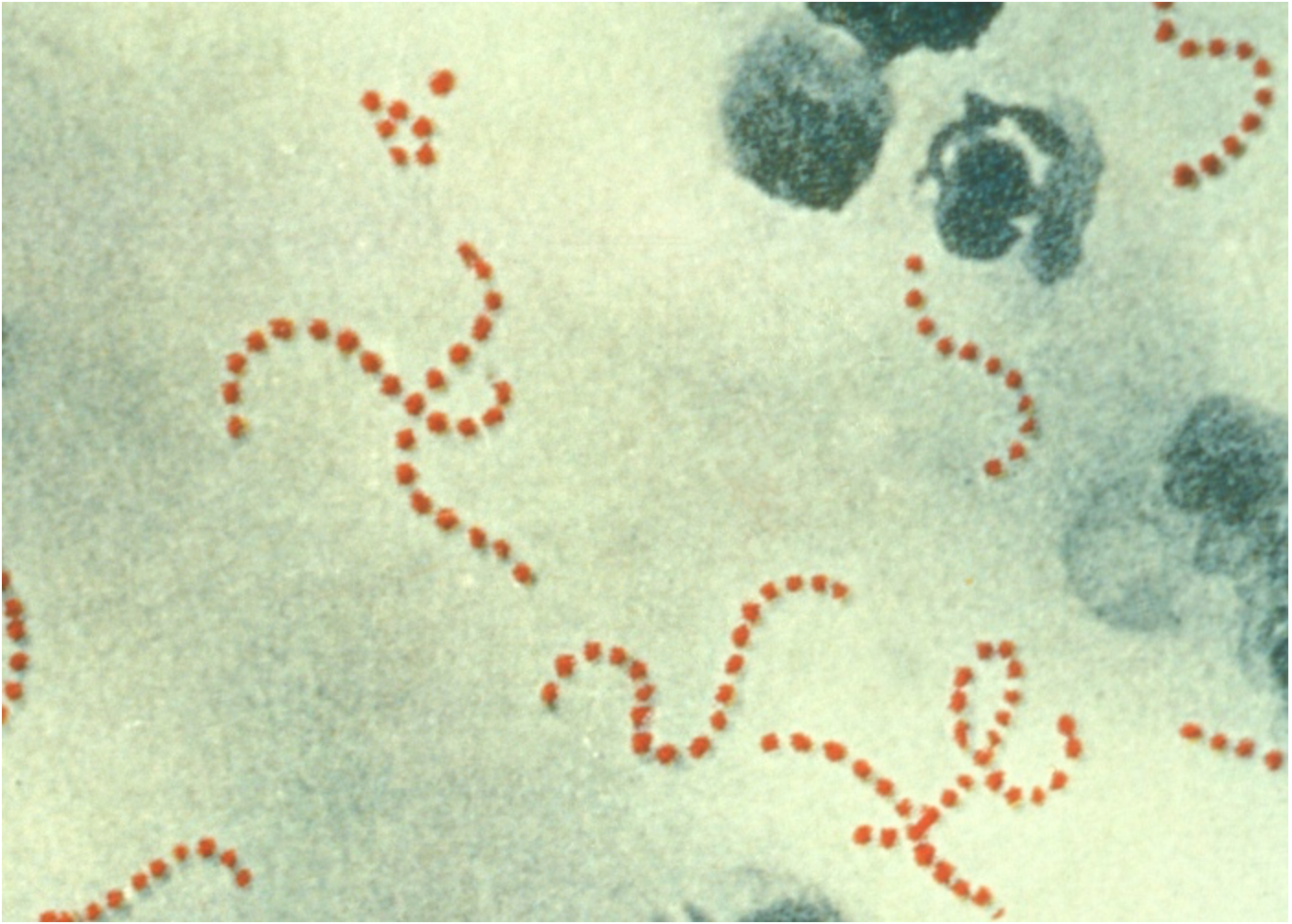
As you may recall, Wajiha’s strep throat was caused by Streptococcus pyogenes bacteria, the species shown in the photomicrograph above. Wajiha took antibiotics to kill the S. pyogenes, but this also killed her “good” bacteria, throwing off the balance of microorganisms living inside of her, which resulted in diarrhea and a yeast infection.
After reading this chapter, you should now know that microorganisms such as bacteria and yeast that live in humans are also similar to us in many ways. They are living organisms and therefore share traits such as homeostasis, organization, metabolism, growth, adaptation, response to stimuli, and reproduction with us. They, like us, contain genes, consist of cells, and have the ability to evolve. Wajiha’s beneficial gut bacteria help digest her food as part of her metabolic processes. Wajiha got a yeast infection, likely because the growth and reproductive rates of the yeast living on her body were not held in check by beneficial bacteria after she took antibiotics. You can see that there are many ways in which an understanding of the basic characteristics of life can directly apply to your own.
You also learned how living organisms are classified, from bacteria in the Bacteria domain to yeast (fungus kingdom) and humans (animal kingdom), both in the Eukarya domain. You probably now recognize that Streptococcus pyogenes is the binomial nomenclature for this species, and that Streptococcus refers to the genus name.
As Wajiha’s doctor told her, there are many different species of microorganisms living in the human digestive system. You should recognize this as a type of biodiversity called species diversity. This diversity is maintained in a balance, or homeostasis, that can be upset when one type of organism is killed, for instance, by antibiotics.
Wajiha’s doctor advised her to complete the entire course of antibiotics because stopping too early would kill the bacteria most susceptible to the antibiotic, while leaving those more resistant alive. This difference in susceptibility to antibiotics is an example of genetic diversity. Over time, the surviving antibiotic-resistant bacteria will have higher survival and reproductive rates than the more susceptible bacteria, and the trait of antibiotic resistance will become more common in the population. In this way, bacteria can evolve and become better adapted to their environment, at a major cost to our health, as our antibiotics will no longer be effective. This issue of improper use of antibiotics leading to increased antibiotic resistance is a major concern for public health experts.
After reading this chapter, you now know how humans are classified and some of their characteristics, as well as those of their near relatives. Beyond our more obvious features of big brains, intelligence, and the ability to walk upright, we also serve as a home to many different organisms that may be invisible to the naked eye but play a big role in maintaining our health.
Chapter Summary
In this chapter, you learned about the basic principles of biology and how humans are situated among other living organisms. Specifically, you learned:
- To be classified as a living thing, most scientists agree that an object must exhibit seven characteristics, including:
- Maintaining a more-or-less constant internal environment, which is called homeostasis.
- Having multiple levels of the organization and consisting of one or more cells.
- Using energy and being capable of metabolism.
- The ability to grow and develop.
- The ability to evolve adaptations to the environment.
- The ability to detect and respond to environmental stimuli.
- The ability to reproduce.
- Biodiversity refers to the variety of life that exists on Earth. It includes species diversity, genetic diversity within species, and ecosystem diversity.
- The formal biological definition of a species is a group of organisms that are actually or potentially interbreeding. In reality, organisms are often classified into species based on morphology.
- A system for classifying living things was introduced by Linnaeus in the 1700s. It includes taxa from the species (least inclusive) to the kingdom (most inclusive). Linnaeus also introduced a system of naming species, called binomial nomenclature.
- The domain, a taxonomic rank above the kingdom, was later added to the Linnaean system. Living things are generally grouped into three domains: Bacteria, Archaea, and Eukarya. Humans and other animal species belong to the Eukarya domain.
- Modern systems of classification take into account phylogenies, or evolutionary histories of related organisms, rather than just morphological similarities and differences. These relationships are often represented by phylogenetic trees or other tree-like diagrams.
- The human species, Homo sapiens, is placed in the primate order of the class Mammalia, which is a chordate in the animal kingdom.
- Traits humans share with other primates include five digits with nails and opposable thumbs; an excellent sense of vision, including the ability to see in color and to perceive depth (stereopsis); a large brain, a high degree of intelligence, and complex behaviors. Like most other primates, we also live in social groups. Many of our primate traits are adaptations to life in the trees.
- Within the primate order, our species is placed in the hominid family, which also includes chimpanzees, gorillas, and orangutans.
- The genus Homo first evolved about 2.8 million years ago. Early Homo species were fully bipedal but had small brains. All are now extinct.
- Over the last 800,000 years, Homo sapiens evolved with smaller faces, jaws, and front teeth, but with much larger brains than those of earlier Homo species.
- The human body consists of multiple parts that function together to maintain life. The biology of the human body incorporates the body’s structure, or anatomy, and the body’s functioning, or physiology.
- The organization of the human body is a hierarchy of increasing size and complexity, from atoms and molecules to the entire organism.
- Cells are the level of organization above atoms and molecules, and they are the basic units of structure and function of the human body. Each cell performs basic life functions and other specific roles. Cells of the human body exhibit significant variation.
- Variations in cell function are generally reflected in variations in cell structure.
- Some cells are unattached to other cells and can move freely; others are attached to each other and cannot move freely. Some cells can divide readily and form new cells; others can divide only under exceptional circumstances. Many cells are specialized to produce and secrete particular substances.
- All the different cell types within an individual have the same genes. Cells can vary because different genes are expressed in different cell types.
- Many common types of human cells have several subtypes, each with distinct structure and function. For example, bone cell subtypes include osteocytes, osteoblasts, osteogenic cells, and osteoclasts.
- A tissue is a group of cells that are connected and have a similar function. There are four basic types of human tissues that make up all the organs of the human body: epithelial, muscle, nervous, and connective tissues.
- Connective tissues, such as bone and blood, are composed of cells separated by a non-living extracellular matrix.
- Epithelial tissues, such as skin and mucous membranes, protect the body and its internal organs and secrete or absorb substances.
- Muscle tissues are made up of cells that have the unique ability to contract. They include skeletal, smooth, and cardiac muscle tissues.
- Nervous tissues are composed of neurons, which transmit electrical signals, and various types of glial cells, which play supporting roles. Types of nervous tissues include gray matter, white matter, nerves, and ganglia.
- An organ is a structure that consists of two or more types of tissues that work together to do the same job. Examples include the brain and heart.
- Many organs are composed of a major tissue that performs the organ’s main function, as well as other tissues that play supporting roles.
- The human body contains five organs considered vital to survival. They are the heart, brain, kidneys, liver, and lungs. If any of these five organs stops functioning, the death of the organism is imminent without medical intervention.
- An organ system is a group of organs that work together to carry out a complex overall function. For example, the skeletal system provides the body with structure and protects internal organs.
- There are 11 major organ systems in the human organism. They are the integumentary, skeletal, muscular, nervous, endocrine, cardiovascular, lymphatic, respiratory, digestive, urinary, and reproductive systems. Only the reproductive system varies significantly between males and females.
- The human body is divided into several body cavities. A body cavity is a fluid-filled space in the body that holds and protects internal organs. The two largest cavities in the human body are the ventral and dorsal cavities.
- The ventral cavity is at the anterior, or front, of the trunk. It is subdivided into the thoracic cavity and the abdominopelvic cavity.
- The dorsal cavity is at the posterior, or back, of the body, and includes the head and the back of the trunk. It is subdivided into the cranial cavity and the spinal cavity.
- Organ systems of the human body must work together to keep the body alive and functioning normally. This requires communication among organ systems. This is controlled by the autonomic and endocrine systems. The autonomic nervous system controls involuntary body functions, such as heart rate and digestion. The endocrine system secretes hormones into the blood that travel to body cells and influence their activities.
- Cellular respiration is a good example of organ system interactions because it is a basic life process that occurs in all living cells. It is the intracellular process that breaks down glucose with oxygen to produce carbon dioxide and energy. Cellular respiration requires the interaction of the digestive, cardiovascular, and respiratory systems.
- The fight-or-flight response is a good example of how the nervous and endocrine systems control responses of other organ systems. It is triggered by a message from the brain to the endocrine system, preparing the body for fight-or-flight. Many organ systems are stimulated to respond, including the cardiovascular, respiratory, and digestive systems.
- Digesting food requires teamwork between the digestive system and several other organ systems, including the nervous, cardiovascular, and muscular systems.
- Playing softball or engaging in other voluntary physical activities may involve interactions among the nervous, muscular, skeletal, respiratory, and cardiovascular systems.
- Homeostasis is the condition in which a system, such as the human body, is maintained in a more-or-less steady state. It is the job of cells, tissues, organs, and organ systems throughout the body to maintain homeostasis.
- For any given variable, such as body temperature, there is a particular set point, the physiological optimum value. The spread of values around the setpoint that is considered insignificant is called the normal range.
- Homeostasis is generally maintained by a negative feedback loop that includes a stimulus, a sensor, a control center, and an effector. Negative feedback serves to reduce an excessive response and to keep a variable within the normal range. Negative feedback loops control body temperature and blood glucose level.
- Sometimes homeostatic mechanisms fail, leading to imbalance. Diabetes is an example of a disease caused by a homeostatic imbalance. Aging can reduce the efficiency of the body’s control system, making the elderly more susceptible to disease.
- Positive feedback loops are not common in biological systems. Positive feedback intensifies a response until an endpoint is reached. Positive feedback loops control blood clotting and childbirth.