

18.4: Innate Immune System
- Page ID
- 92731

\( \newcommand{\vecs}[1]{\overset { \scriptstyle \rightharpoonup} {\mathbf{#1}} } \)
\( \newcommand{\vecd}[1]{\overset{-\!-\!\rightharpoonup}{\vphantom{a}\smash {#1}}} \)
\( \newcommand{\dsum}{\displaystyle\sum\limits} \)
\( \newcommand{\dint}{\displaystyle\int\limits} \)
\( \newcommand{\dlim}{\displaystyle\lim\limits} \)
\( \newcommand{\id}{\mathrm{id}}\) \( \newcommand{\Span}{\mathrm{span}}\)
( \newcommand{\kernel}{\mathrm{null}\,}\) \( \newcommand{\range}{\mathrm{range}\,}\)
\( \newcommand{\RealPart}{\mathrm{Re}}\) \( \newcommand{\ImaginaryPart}{\mathrm{Im}}\)
\( \newcommand{\Argument}{\mathrm{Arg}}\) \( \newcommand{\norm}[1]{\| #1 \|}\)
\( \newcommand{\inner}[2]{\langle #1, #2 \rangle}\)
\( \newcommand{\Span}{\mathrm{span}}\)
\( \newcommand{\id}{\mathrm{id}}\)
\( \newcommand{\Span}{\mathrm{span}}\)
\( \newcommand{\kernel}{\mathrm{null}\,}\)
\( \newcommand{\range}{\mathrm{range}\,}\)
\( \newcommand{\RealPart}{\mathrm{Re}}\)
\( \newcommand{\ImaginaryPart}{\mathrm{Im}}\)
\( \newcommand{\Argument}{\mathrm{Arg}}\)
\( \newcommand{\norm}[1]{\| #1 \|}\)
\( \newcommand{\inner}[2]{\langle #1, #2 \rangle}\)
\( \newcommand{\Span}{\mathrm{span}}\) \( \newcommand{\AA}{\unicode[.8,0]{x212B}}\)
\( \newcommand{\vectorA}[1]{\vec{#1}} % arrow\)
\( \newcommand{\vectorAt}[1]{\vec{\text{#1}}} % arrow\)
\( \newcommand{\vectorB}[1]{\overset { \scriptstyle \rightharpoonup} {\mathbf{#1}} } \)
\( \newcommand{\vectorC}[1]{\textbf{#1}} \)
\( \newcommand{\vectorD}[1]{\overrightarrow{#1}} \)
\( \newcommand{\vectorDt}[1]{\overrightarrow{\text{#1}}} \)
\( \newcommand{\vectE}[1]{\overset{-\!-\!\rightharpoonup}{\vphantom{a}\smash{\mathbf {#1}}}} \)
\( \newcommand{\vecs}[1]{\overset { \scriptstyle \rightharpoonup} {\mathbf{#1}} } \)
\(\newcommand{\longvect}{\overrightarrow}\)
\( \newcommand{\vecd}[1]{\overset{-\!-\!\rightharpoonup}{\vphantom{a}\smash {#1}}} \)
\(\newcommand{\ket}[1]{\left| #1 \right>}\)
\(\newcommand{\bra}[1]{\left< #1 \right|}\)
\(\newcommand{\braket}[2]{\left< #1 \vphantom{#2} \right| \left. #2 \vphantom{#1} \right>}\)
\(\newcommand{\braopket}[3]{\left< #1 \vphantom{#2}\vphantom{#3} \right| #2 \vphantom{#1}\vphantom{#3} \left| #3 \vphantom{#1}\vphantom{#2} \right>}\)
\(\newcommand{\qmvec}[1]{\mathbf{\vec{#1}}}\)
\(\newcommand{\op}[1]{\hat{\mathbf{#1}}}\)
\(\newcommand{\expect}[1]{\langle #1 \rangle}\)
\(\newcommand{\dfn}[1]{\emph{\textbf{#1}}}\)
It’s just a paper cut, but the break in your skin could provide an easy way for pathogens to enter your body. If bacteria were to enter through the cut and infect the wound, your innate immune system would quickly respond with a dizzying array of general defenses.
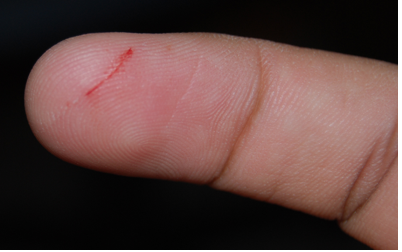
The innate immune system is a subset of the human immune system that produces rapid but nonspecific responses to pathogens. Innate responses are generic rather than tailored to specific pathogens. Every pathogen that is encountered is responded to in the same general ways by the innate system. Although the innate immune system provides rapid defenses against pathogens, it does not confer long-lasting immunity. In most organisms, the innate immune system is the primary host defense system. In most vertebrates, including humans, the innate immune system is the only host defense system.
In humans, the innate immune system includes surface barriers, inflammation, the complement system, and a variety of cellular responses. Surface barriers of various types generally keep most pathogens out of the body. If these barriers fail, then other innate defenses are triggered. The triggering event is usually the identification of pathogens by pattern-recognition receptors on cells of the innate immune system. These receptors recognize molecules that are broadly shared by pathogens but distinguishable from host molecules. Alternatively, other innate defenses may be triggered when damaged, injured, or stressed cells send out alarm signals, many of which are recognized by the same receptors that recognize pathogens.
Barriers to Pathogens
The body’s first line of defense consists of three different types of barriers that keep most pathogens out of body tissues. The types of barriers are mechanical, chemical, and biological barriers.
Mechanical Barriers
Mechanical barriers are the first line of defense against pathogens, physically blocking them from entering the body. The skin is the most important mechanical barrier. In fact, it is the body's single most important defense. The outer layer of skin, the epidermis, is tough and very difficult for pathogens to penetrate. It consists of dead cells that are constantly being shed from the body surface. This helps remove bacteria and other infectious agents that have adhered to the skin. The epidermis also lacks blood vessels and is usually lacking moisture, so it does not provide a suitable environment for most pathogens. Hair, an accessory organ of the skin, also helps keep out pathogens. Hair in the nose may trap larger particles and other airborne particles before they can enter the respiratory system.
Watch this short video to see how important proper handwashing techniques are to your health.
Mucous membranes provide a mechanical barrier to pathogens and other particles at body openings. These membranes also line the respiratory, gastrointestinal, urinary, and reproductive tracts. Mucous membranes secrete mucus, a slimy, somewhat sticky substance that traps pathogens. Many mucous membranes also have hair-like cilia that sweep mucus and trapped pathogens toward body openings where they can be removed from the body. When you sneeze or cough, mucus and pathogens are mechanically ejected from the nose and throat, as you can see in the photo below. Other mechanical defenses include tears, which wash pathogens from the eyes, and urine, which flushes them from the urinary tract.
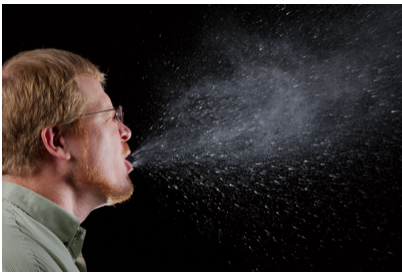
Figure \(\PageIndex{2}\): A sneeze can expel many pathogens from the respiratory tract. That’s why you should always cover your mouth and nose when you sneeze. Sneeze, James Gathany/CDC ID 11162 CC0
Chemical Barriers
Chemical barriers also protect against pathogen infections. They destroy pathogens on the outer body surface, at body openings, and on inner body linings. Sweat, mucus, tears, saliva, and breast milk all contain antimicrobial substances, such as the enzyme lysozyme, that kill pathogens, especially bacteria. Sebaceous glands in the dermis of the skin secrete acids that form a very fine, slightly acidic film on the surface of the skin that acts as a barrier to bacteria, viruses, and other potential contaminants that might penetrate the skin. Urine and vaginal secretions are also too acidic for many pathogens to endure. Semen contains zinc, which most pathogens cannot tolerate, as well as defensins, antimicrobial proteins that primarily disrupt bacterial cell membranes. In the stomach, stomach acid and digestive enzymes called proteases, which break down proteins, kill most pathogens that enter the gastrointestinal tract in food or water.
Biological Barriers
Biological barriers are living organisms that help protect the body from pathogens. Trillions of harmless bacteria normally live on the human skin and in the urinary, reproductive, and gastrointestinal tracts. These bacteria use up food and surface space, helping prevent pathogenic bacteria from colonizing the body. Some of these harmless bacteria also secrete substances that alter their environment, making it less hospitable to potentially harmful bacteria. For example, they may release toxins or change the pH. All of these effects of harmless bacteria reduce the likelihood that pathogenic microorganisms will reach sufficient numbers to cause illness.
Inflammation
If pathogens breach the barriers that protect the body, one of the innate immune system's first active responses kicks in. This response is inflammation. The main function of inflammation is to establish a physical barrier against the spread of infection. It also eliminates the initial cause of cell injury, clears out dead cells and tissues damaged from the original insult and the inflammatory process, and initiates tissue repair. Inflammation is often a response to infection by pathogens, but it can also result from burns, frostbite, or exposure to toxins.
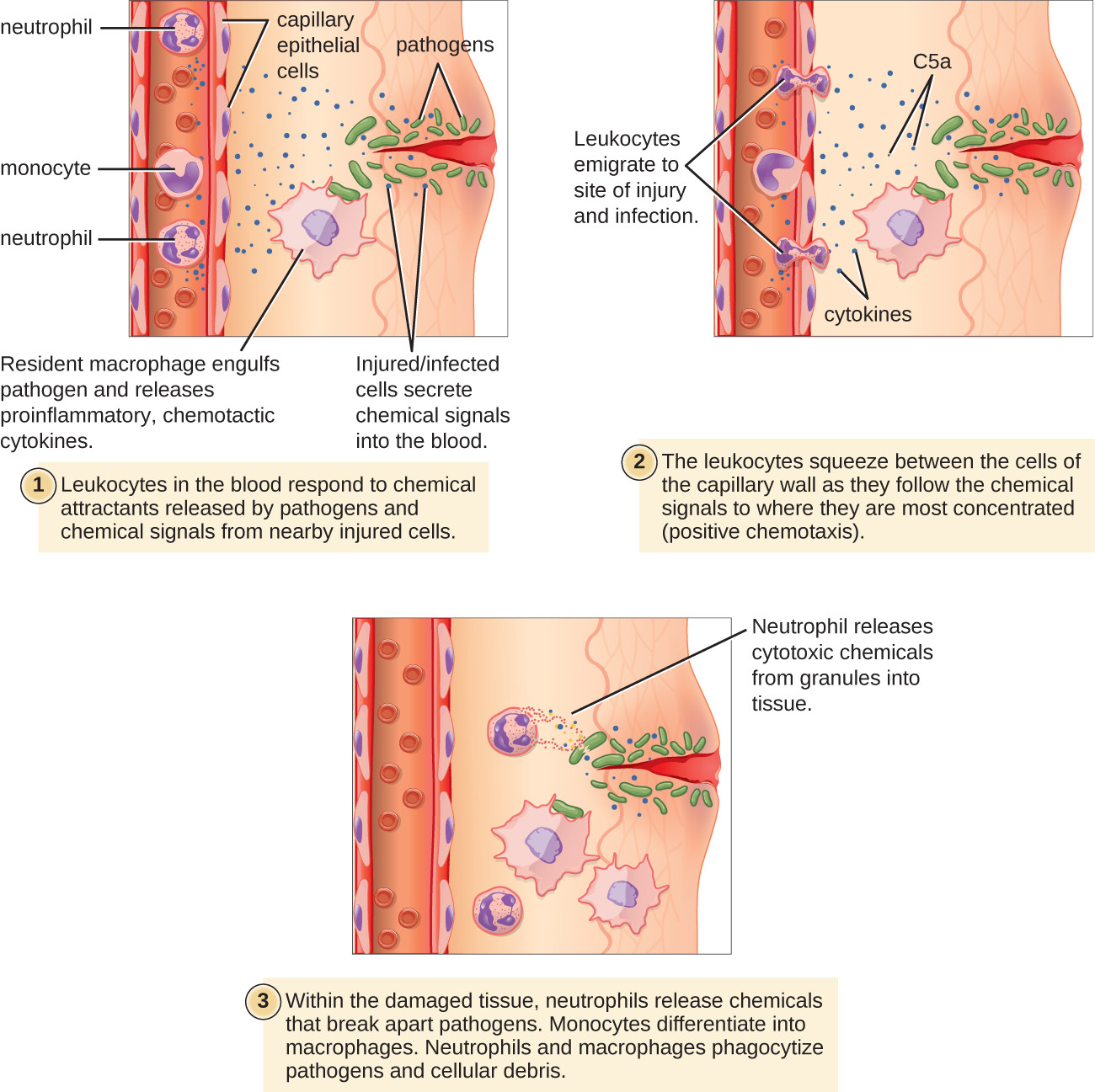
The signs and symptoms of inflammation include redness, swelling, warmth, pain, and frequently some loss of function. These symptoms are caused by increased blood flow into infected tissue and a number of other processes (Figure \(\PageIndex{3}\)).
Inflammation is triggered by chemicals such as cytokines and histamines, which are released by injured or infected cells or by immune system cells such as macrophages (described in Figure \(\PageIndex{5}\)) that are already present in tissues. These chemicals cause capillaries to dilate and become leaky, increasing blood flow to the infected area and allowing blood to enter the tissues. Pathogen-destroying leukocytes, complement proteins, and tissue-repairing proteins migrate from the bloodstream into tissue spaces to attack pathogens and repair tissue damage. Cytokines also promote chemotaxis, the migration of leukocytes to the site of infection to destroy pathogens. Some cytokines have antiviral, antifungal, and antibacterial effects, such as shutting down protein synthesis in host cells, which viruses need to survive and replicate.
It starts with a tickle in your throat that becomes a cough. Your muscles begin to ache, you grow irritable, and you lose your appetite. It’s official: you’ve got the flu. It’s logical to assume that this miserable medley of symptoms is the result of the infection coursing through your body — but is that really the case? Marco A. Sotomayor explains what’s actually making you feel sick.
Complement System
The complement system is a complex biochemical mechanism named for its ability to “complement” the killing of pathogens, directly creating holes in the pathogen's cell wall and assisting antibodies in killing them. Antibodies are produced during an adaptive immune response. The complement system consists of more than two dozen proteins that are normally found in the blood and synthesized in the liver. Proteins usually circulate as nonfunctional precursor molecules until activated.
Cellular Responses
Cellular responses of the innate immune system involve a variety of leukocyte types. Many of these leukocytes circulate in the blood and act like independent, single-celled organisms, searching out and destroying pathogens in the human host. These and other innate immune cells identify pathogens or debris and help eliminate them. One way is phagocytosis.
Phagocytosis
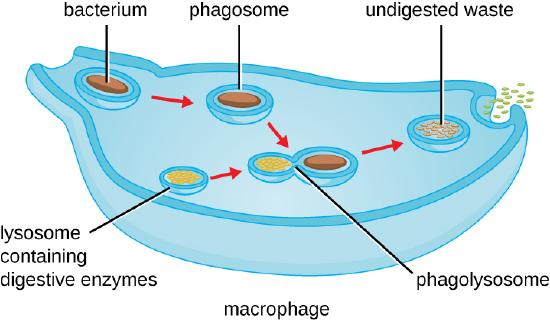
Phagocytosis is an important innate immune function performed by phagocytes. During phagocytosis, phagocytes engulf and digest pathogens and other harmful particles. Phagocytes generally patrol the body, searching for pathogens, but they can also be recruited to specific locations by cytokine release during inflammation. Some phagocytes reside permanently in certain tissues.
As shown in Figure \(\PageIndex{4}\), when a pathogen such as a bacterium is encountered by a phagocyte, the phagocyte extends a portion of its plasma membrane, wrapping the membrane around the pathogen until it is enveloped. Once inside the phagocyte, the pathogen becomes enclosed within an intracellular vesicle called a phagosome. The phagosome then fuses with another vesicle, the lysosome, forming a phagolysosome. Digestive enzymes and acids from the lysosome kill and digest the pathogen in the phagolysosome. The final step of phagocytosis is the excretion of soluble debris from the destroyed pathogen through exocytosis.
Leukocytes
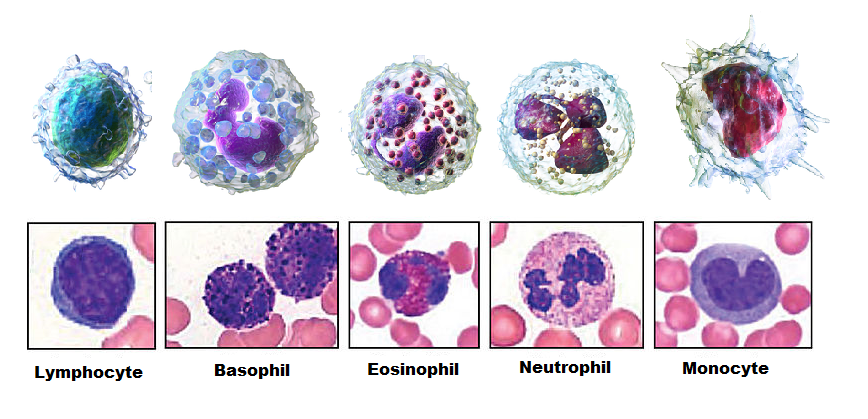
Types of leukocytes that kill pathogens by phagocytosis include neutrophils, macrophages, and dendritic cells. Macrophages and dendritic cells are derived from monocytes. Figure \(\PageIndex{5}\) shows five major types of leukocytes: lymphocytes, basophils, eosinophils, neutrophils, and monocytes. Lymphocytes are mainly involved in the adaptive immune system and are described in that section.
Neutrophils
Neutrophils are leukocytes that circulate in the blood and are usually the first immune cells to arrive at the site of an infection. These cells contain granules and carry a multilobed nucleus (Figure \(\PageIndex{5}\)). They are the most numerous phagocytes and normally account for at least half of the total circulating leukocytes. The bone marrow of a normal healthy adult produces more than 100 billion neutrophils per day. During acute inflammation, more than 10 times that many neutrophils may be produced each day. Many neutrophils are needed to fight infections because after a neutrophil phagocytizes just a few pathogens, it generally dies.
Macrophages
Macrophages are large phagocytic leukocytes that develop from monocytes. Macrophages spend much of their time in the interstitial fluid of tissues throughout the body. Monocytes lack granules and have a large, kidney-shaped nucleus (Figure \(\PageIndex{5}\)). They are the most efficient phagocytes and can phagocytize a substantial number of pathogens or other cells. Macrophages are also versatile cells that produce a wide array of chemicals — including enzymes, complement proteins, and cytokines — in addition to their phagocytic action. As phagocytes, macrophages act as scavengers, removing worn-out cells, other debris, and pathogens. In addition, macrophages act as antigen-presenting cells, activating the adaptive immune system. (To learn more about antigen-presenting cells, see the concept Adaptive Immune System.)
Eosinophils
Eosinophils are non-phagocytic leukocytes that are related to neutrophils. They specialize in defending against parasites. These cells contain granules and carry a bilobed, earmuff-shaped nucleus (Figure \(\PageIndex{5}\). These leukocytes are highly effective at killing large parasites, such as worms, by secreting a range of highly toxic substances when activated. Eosinophils may become overactive, leading to allergies or asthma.
Basophils
Basophils are nonphagocytic leukocytes that are also related to neutrophils. They are the least numerous of all white blood cells. These cells contain granules and carry a bilobed nucleus (Figure \(\PageIndex{5}\)). Basophils secrete two types of chemicals that support the body's defense system: histamine and heparin. Histamines are responsible for dilating blood vessels and increasing their permeability in inflammation. Heparin inhibits blood clotting and also promotes the movement of leukocytes into an area of infection.
Dendritic Cells
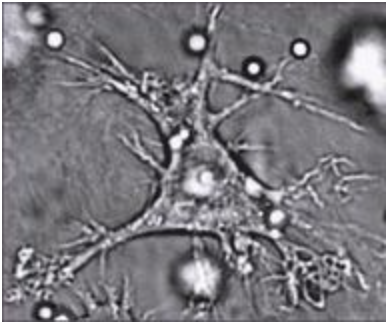
Like macrophages, dendritic cells develop from monocytes (Figure \(\PageIndex{5}\)). They reside in tissues that contact the external environment, so they are mainly found in the skin, nose, lungs, stomach, and intestines. Their plasma membrane has extensions (Figure \(\PageIndex{6}\)). Besides engulfing and digesting pathogens, dendritic cells also act as antigen-presenting cells that trigger adaptive immune responses.
Mast Cells
Mast cells are non-phagocytic leukocytes that help to initiate inflammation by secreting histamines. In some people, histamines trigger allergic reactions and inflammation. Mast cells may also secrete chemicals that help defend against parasites.
Natural Killer Cells
Natural killer cells are a subset of leukocytes, produced by the lymphatic system. Natural killer cells destroy cancerous or virus-infected host cells, although they do not directly attack invading pathogens. Natural killer cells recognize these host cells by a condition they exhibit called “missing self.” Cells with missing self have abnormally low levels of cell-surface proteins of the major histocompatibility complex (MHC), which normally identify body cells as self.
*Leukocytes Adapted from:
- White Blood Cells, Blausen Staff CC BY 3.0
- Leukocyte Key, OpenStax CC BY 3.0