

9: Global Climate Change
- Page ID
- 175884

\( \newcommand{\vecs}[1]{\overset { \scriptstyle \rightharpoonup} {\mathbf{#1}} } \)
\( \newcommand{\vecd}[1]{\overset{-\!-\!\rightharpoonup}{\vphantom{a}\smash {#1}}} \)
\( \newcommand{\dsum}{\displaystyle\sum\limits} \)
\( \newcommand{\dint}{\displaystyle\int\limits} \)
\( \newcommand{\dlim}{\displaystyle\lim\limits} \)
\( \newcommand{\id}{\mathrm{id}}\) \( \newcommand{\Span}{\mathrm{span}}\)
( \newcommand{\kernel}{\mathrm{null}\,}\) \( \newcommand{\range}{\mathrm{range}\,}\)
\( \newcommand{\RealPart}{\mathrm{Re}}\) \( \newcommand{\ImaginaryPart}{\mathrm{Im}}\)
\( \newcommand{\Argument}{\mathrm{Arg}}\) \( \newcommand{\norm}[1]{\| #1 \|}\)
\( \newcommand{\inner}[2]{\langle #1, #2 \rangle}\)
\( \newcommand{\Span}{\mathrm{span}}\)
\( \newcommand{\id}{\mathrm{id}}\)
\( \newcommand{\Span}{\mathrm{span}}\)
\( \newcommand{\kernel}{\mathrm{null}\,}\)
\( \newcommand{\range}{\mathrm{range}\,}\)
\( \newcommand{\RealPart}{\mathrm{Re}}\)
\( \newcommand{\ImaginaryPart}{\mathrm{Im}}\)
\( \newcommand{\Argument}{\mathrm{Arg}}\)
\( \newcommand{\norm}[1]{\| #1 \|}\)
\( \newcommand{\inner}[2]{\langle #1, #2 \rangle}\)
\( \newcommand{\Span}{\mathrm{span}}\) \( \newcommand{\AA}{\unicode[.8,0]{x212B}}\)
\( \newcommand{\vectorA}[1]{\vec{#1}} % arrow\)
\( \newcommand{\vectorAt}[1]{\vec{\text{#1}}} % arrow\)
\( \newcommand{\vectorB}[1]{\overset { \scriptstyle \rightharpoonup} {\mathbf{#1}} } \)
\( \newcommand{\vectorC}[1]{\textbf{#1}} \)
\( \newcommand{\vectorD}[1]{\overrightarrow{#1}} \)
\( \newcommand{\vectorDt}[1]{\overrightarrow{\text{#1}}} \)
\( \newcommand{\vectE}[1]{\overset{-\!-\!\rightharpoonup}{\vphantom{a}\smash{\mathbf {#1}}}} \)
\( \newcommand{\vecs}[1]{\overset { \scriptstyle \rightharpoonup} {\mathbf{#1}} } \)
\(\newcommand{\longvect}{\overrightarrow}\)
\( \newcommand{\vecd}[1]{\overset{-\!-\!\rightharpoonup}{\vphantom{a}\smash {#1}}} \)
\(\newcommand{\ket}[1]{\left| #1 \right>}\)
\(\newcommand{\bra}[1]{\left< #1 \right|}\)
\(\newcommand{\braket}[2]{\left< #1 \vphantom{#2} \right| \left. #2 \vphantom{#1} \right>}\)
\(\newcommand{\braopket}[3]{\left< #1 \vphantom{#2}\vphantom{#3} \right| #2 \vphantom{#1}\vphantom{#3} \left| #3 \vphantom{#1}\vphantom{#2} \right>}\)
\(\newcommand{\qmvec}[1]{\mathbf{\vec{#1}}}\)
\(\newcommand{\op}[1]{\hat{\mathbf{#1}}}\)
\(\newcommand{\expect}[1]{\langle #1 \rangle}\)
\(\newcommand{\dfn}[1]{\emph{\textbf{#1}}}\)
Chapter Hook: Rising Seas from Venice to San Diego
The iconic Grand Canal of Venice, Italy offers a visible reminder that Earth's climate is changing. For centuries, stone steps leading into the canal marked the boundary between land and water. Because the canal is directly connected to the surrounding sea, these steps also record changes in sea level. Today, water levels are significantly higher than when many of these structures were built, and flooding events have become increasingly common (figure \(\PageIndex{a}\)).
As global temperatures rise, melting glaciers and ice sheets, combined with the expansion of warming seawater, are causing sea levels around the world to rise.Venice is not alone in facing this challenge. Coastal communities on every continent are preparing for the impacts of rising seas, including more frequent flooding, erosion, damage to infrastructure, and the loss of coastal habitats. Scientists project that sea level will continue to rise throughout this century, threatening many low-lying cities and coastal ecosystems.
Closer to home, San Diego faces many of the same risks. Depending on future greenhouse gas emissions and the rate of ice-sheet melting, sea level along the San Diego coastline could rise by approximately 3.6 to 7 feet (1.1 to 2.1 meters) by 2100.
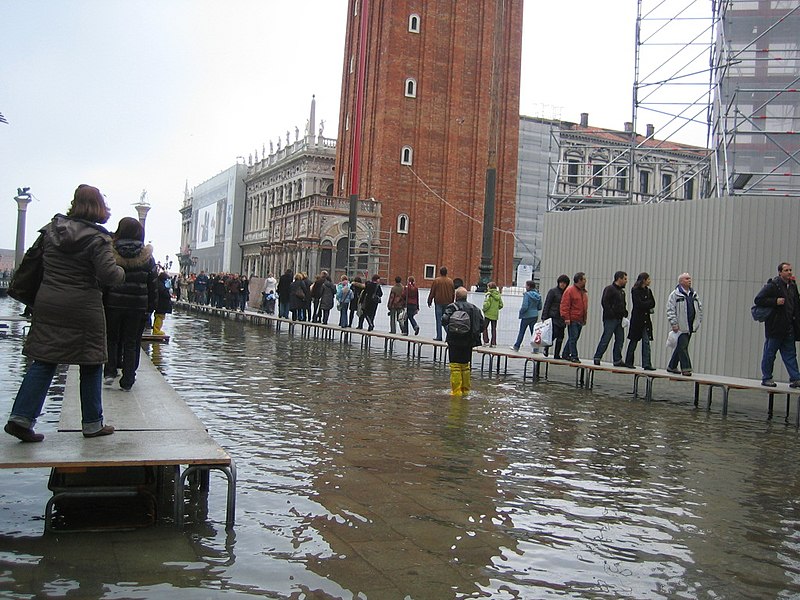
Figure \(\PageIndex{a}\): Flooding along the Grand Canal in Venice, Italy. Rising sea levels and more frequent high-tide flooding have increased challenges for this historic coastal city. Image by [WorldIslandInfo.com] in Wikimedia Commons (CC-BY2.0).

Figure \(\PageIndex{b}\): Screenshot of mid-range sea-level rise estimate for San Diego by 2100. Sea level rise predictions for San Diego are expected to be from 3.6 feet (1.09 m) - 7 feet (2.13 m). Using the NOAA sea level rise and viewer, 1.8 m mid-range estimate for San Diego has been mapped onto the coastline (figure \(\PageIndex{b}\)). Image source: National Oceanic and Atmospheric Administration Sea level Rise Viewer. [https://coast.noaa.gov/slr/#/layer/s...tion/NOS_Minor]
Venice and San Diego are separated by more than 6,000 miles and exist in very different cultural and environmental settings. Yet both communities illustrate the same reality: climate change is not a distant problem affecting only the future. Its effects are already being measured today. Rising sea level is just one of many consequences of global climate change that scientists, policymakers, and communities must confront in the coming decades.
Attributions
This page was heavily revised and rewritten by Erin Rempala and contains adapted content from content originally authored by Melissa Ha and Rachel Schleiger and is licensed CC BY-NC-SA 4.0 as well as from the following sources:
- City of San Diego. (n.d.). Sea level rise. Climate Resilient SD. San Diego.gov [www.sandiego.gov]
- National Oceanic and Atmospheric Administration. (n.d.). Sea Level Rise Viewer. NOAA Office for Coastal Management. NOAA.gov [coast.noaa.gov]
Modified by Melissa Ha and Rachel Schleiger from the following sources:
- Climate and the Effects of Global Climate Change from General Biology by OpenStax (licensed under CC-BY(opens in new window))
- Climate Change from Environmental Biology by Matthew R. Fisher (licensed under CC-BY(opens in new window))
- 9.1: Weather, Climate, and Climate Change
- This page explains the difference between "weather" and "climate." Weather refers to immediate atmospheric conditions such as temperature and precipitation, while climate is the long-term average of those weather patterns, including extremes. Daily choices may be influenced by weather, whereas climate affects broader purchasing decisions, as seen in tropical regions where winter clothing is unnecessary.
- 9.2: Earth's Energy Balance and Radiation
- This page covers the concept of radiation in atmospheric science, emphasizing its understanding as electromagnetic waves characterized by electric and magnetic fields. It details how different wavelengths correspond to various radiation types, such as radio waves and x-rays.
- 9.3: The Greenhouse Effect
- This page discusses the Greenhouse Effect, highlighting the balance of solar energy affecting Earth's temperature. It details how human activities, especially fossil fuel use, are increasing greenhouse gases (GHGs) and intensifying global warming, which cannot be solely attributed to natural causes. The page explains the function of GHGs in trapping heat, comparing them to a blanket, and underscores their critical role in sustaining life on Earth.
- 9.4: Evidence and Causes of Climate Change
- This page covers the critical issues surrounding global warming and climate change, emphasizing human-induced greenhouse gas emissions, particularly CO2 and methane. It highlights the urgent need for significant emissions reductions to limit warming and discusses the severe consequences of inaction, such as extreme weather and ecological disruptions. The importance of achieving net-zero by the early 2050s is stressed, along with the challenges in translating climate knowledge into action.
- 9.5: Impacts of Climate Change
- This page explores the evidence and impacts of modern climate change, including warming temperatures, sea-level rise, ecosystem disruption, and ocean acidification, as well as the risks these changes pose to both human and natural systems.
- 9.6: Ocean Acidification- The Other Carbon Problem
- This page explores ocean acidification, a lesser-known consequence of rising atmospheric carbon dioxide. It examines how changing ocean chemistry affects marine organisms, food webs, and coastal ecosystems.
- 9.8: Data Dive- Flooding in Venice Italy
- This page discusses the significant flooding issues in Venice, driven by natural events, human factors, and exacerbated by climate change and rising sea levels. It highlights the monitoring of flood occurrences exceeding 110cm over ten-year intervals, showing a notable increase in flooding frequency. The implications for Venice and lessons for other coastal cities dealing with similar challenges are also explored.