

8: Atmospheric Pollution
- Page ID
- 175874

\( \newcommand{\vecs}[1]{\overset { \scriptstyle \rightharpoonup} {\mathbf{#1}} } \)
\( \newcommand{\vecd}[1]{\overset{-\!-\!\rightharpoonup}{\vphantom{a}\smash {#1}}} \)
\( \newcommand{\dsum}{\displaystyle\sum\limits} \)
\( \newcommand{\dint}{\displaystyle\int\limits} \)
\( \newcommand{\dlim}{\displaystyle\lim\limits} \)
\( \newcommand{\id}{\mathrm{id}}\) \( \newcommand{\Span}{\mathrm{span}}\)
( \newcommand{\kernel}{\mathrm{null}\,}\) \( \newcommand{\range}{\mathrm{range}\,}\)
\( \newcommand{\RealPart}{\mathrm{Re}}\) \( \newcommand{\ImaginaryPart}{\mathrm{Im}}\)
\( \newcommand{\Argument}{\mathrm{Arg}}\) \( \newcommand{\norm}[1]{\| #1 \|}\)
\( \newcommand{\inner}[2]{\langle #1, #2 \rangle}\)
\( \newcommand{\Span}{\mathrm{span}}\)
\( \newcommand{\id}{\mathrm{id}}\)
\( \newcommand{\Span}{\mathrm{span}}\)
\( \newcommand{\kernel}{\mathrm{null}\,}\)
\( \newcommand{\range}{\mathrm{range}\,}\)
\( \newcommand{\RealPart}{\mathrm{Re}}\)
\( \newcommand{\ImaginaryPart}{\mathrm{Im}}\)
\( \newcommand{\Argument}{\mathrm{Arg}}\)
\( \newcommand{\norm}[1]{\| #1 \|}\)
\( \newcommand{\inner}[2]{\langle #1, #2 \rangle}\)
\( \newcommand{\Span}{\mathrm{span}}\) \( \newcommand{\AA}{\unicode[.8,0]{x212B}}\)
\( \newcommand{\vectorA}[1]{\vec{#1}} % arrow\)
\( \newcommand{\vectorAt}[1]{\vec{\text{#1}}} % arrow\)
\( \newcommand{\vectorB}[1]{\overset { \scriptstyle \rightharpoonup} {\mathbf{#1}} } \)
\( \newcommand{\vectorC}[1]{\textbf{#1}} \)
\( \newcommand{\vectorD}[1]{\overrightarrow{#1}} \)
\( \newcommand{\vectorDt}[1]{\overrightarrow{\text{#1}}} \)
\( \newcommand{\vectE}[1]{\overset{-\!-\!\rightharpoonup}{\vphantom{a}\smash{\mathbf {#1}}}} \)
\( \newcommand{\vecs}[1]{\overset { \scriptstyle \rightharpoonup} {\mathbf{#1}} } \)
\(\newcommand{\longvect}{\overrightarrow}\)
\( \newcommand{\vecd}[1]{\overset{-\!-\!\rightharpoonup}{\vphantom{a}\smash {#1}}} \)
\(\newcommand{\ket}[1]{\left| #1 \right>}\)
\(\newcommand{\bra}[1]{\left< #1 \right|}\)
\(\newcommand{\braket}[2]{\left< #1 \vphantom{#2} \right| \left. #2 \vphantom{#1} \right>}\)
\(\newcommand{\braopket}[3]{\left< #1 \vphantom{#2}\vphantom{#3} \right| #2 \vphantom{#1}\vphantom{#3} \left| #3 \vphantom{#1}\vphantom{#2} \right>}\)
\(\newcommand{\qmvec}[1]{\mathbf{\vec{#1}}}\)
\(\newcommand{\op}[1]{\hat{\mathbf{#1}}}\)
\(\newcommand{\expect}[1]{\langle #1 \rangle}\)
\(\newcommand{\dfn}[1]{\emph{\textbf{#1}}}\)
Introduction
During the COVID-19 pandemic, many people in the United States became accustomed to wearing face masks to reduce the spread of disease. For most Americans, however, masks are not normally worn in daily life except during events such as wildfire smoke episodes, severe allergy seasons, or outbreaks of respiratory illnesses. In contrast, residents of some highly polluted cities around the world have long used masks as a regular form of protection from poor air quality. In cities that experience frequent smog and high levels of airborne pollutants, people may wear masks during their daily commute or while working outdoors to reduce exposure. Although air quality has improved in many regions because of environmental regulations and pollution-control efforts, air pollution remains a significant challenge in many parts of the world.
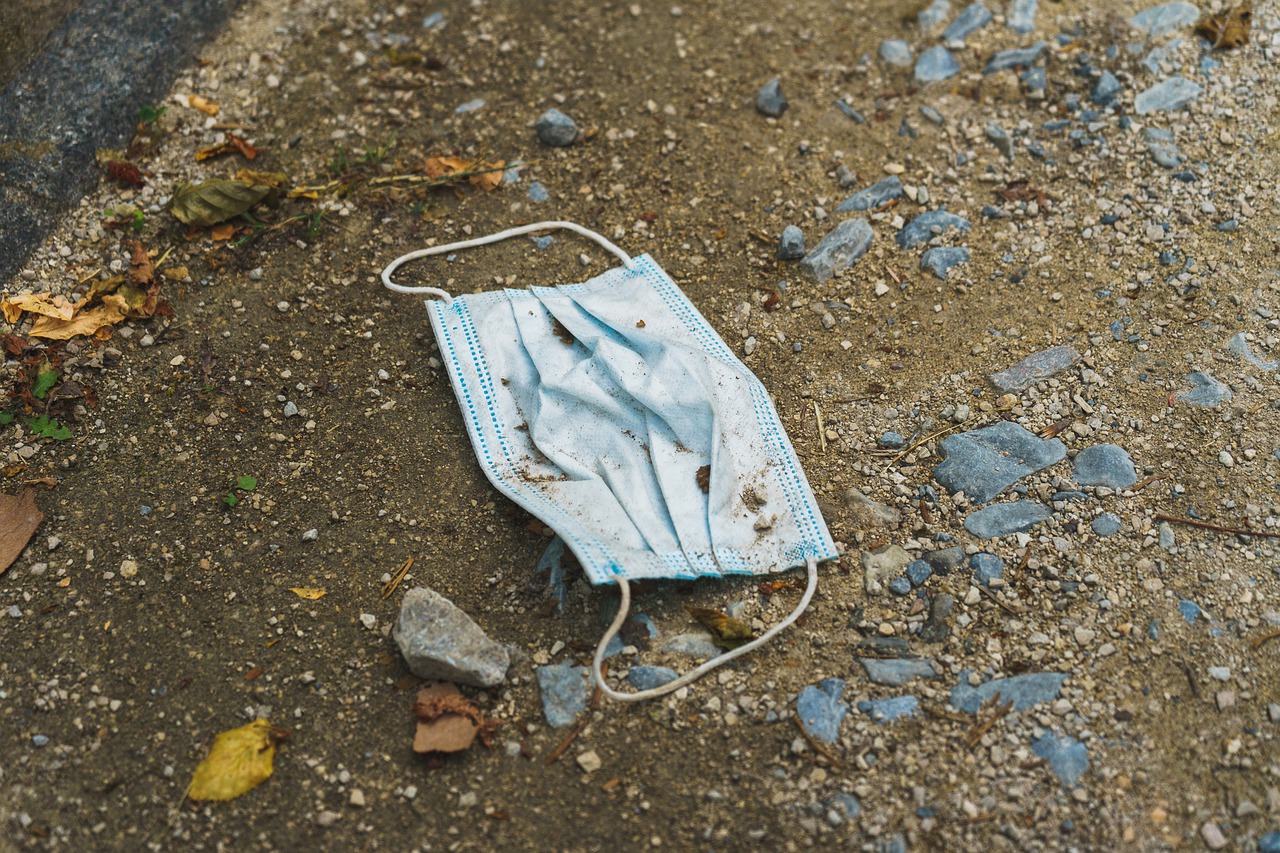
Air pollution is one of the most widespread environmental challenges facing the world today. Human activities such as transportation, fossil fuel-based energy production, industry, and agriculture release pollutants into the atmosphere that can affect human health, ecosystems, and Earth's climate. In this chapter, you will explore the sources and impacts of air pollution, examine how pollutants move through the atmosphere, and evaluate strategies that can improve air quality and protect environmental and public health.
- 8.1: Earth’s Atmosphere
- This page introduces the major layers of Earth's atmosphere and explains how air density, air pressure, and temperature change with altitude. It highlights the role of the troposphere in weather, the importance of the ozone layer in the stratosphere, and how the atmosphere helps regulate climate and protect life on Earth.
- 8.2: Air Pollution
- This page discusses air pollution, categorizing it into primary and secondary pollutants and distinguishing between outdoor and indoor sources. It emphasizes the health risks of six criteria pollutants identified by the EPA and highlights the dangers of secondhand smoke indoors. Strategies to combat air pollution include the Clean Air Act, economic incentives, and technological solutions like air filters and electric vehicles.
- 8.3: Acid Deposition
- This page discusses acid deposition, including wet and dry forms caused by natural and human activities, especially from fossil fuel combustion. It highlights the detrimental effects on ecosystems, particularly aquatic environments, and the release of toxic aluminum. Additionally, it addresses the damage to forests, materials, and public health. While there has been progress in reducing emissions, historically high acidity has created substantial environmental issues.
- 8.4: Ozone Depletion
- This page describes how chlorofluorocarbons (CFCs) and other ozone-depleting substances disrupt the ozone balance, leading to decreased levels and increased UV radiation, which poses health risks such as skin cancer and cataracts. It highlights international efforts like the Montreal Protocol to phase out harmful chemicals and reduce the ozone hole, stressing the need for protection against heightened UV exposure.
Attribution
This page was heavily revised and rewritten by Erin Rempala and contains adapted content originally authored by Melissa Ha and Rachel Schleiger and is licensed CC BY-NC-SA 4.0.
Modified by Rachel Schleiger (CC-BY-NC(opens in new window)).