

5.6: Extinction
- Page ID
- 185168

\( \newcommand{\vecs}[1]{\overset { \scriptstyle \rightharpoonup} {\mathbf{#1}} } \)
\( \newcommand{\vecd}[1]{\overset{-\!-\!\rightharpoonup}{\vphantom{a}\smash {#1}}} \)
\( \newcommand{\dsum}{\displaystyle\sum\limits} \)
\( \newcommand{\dint}{\displaystyle\int\limits} \)
\( \newcommand{\dlim}{\displaystyle\lim\limits} \)
\( \newcommand{\id}{\mathrm{id}}\) \( \newcommand{\Span}{\mathrm{span}}\)
( \newcommand{\kernel}{\mathrm{null}\,}\) \( \newcommand{\range}{\mathrm{range}\,}\)
\( \newcommand{\RealPart}{\mathrm{Re}}\) \( \newcommand{\ImaginaryPart}{\mathrm{Im}}\)
\( \newcommand{\Argument}{\mathrm{Arg}}\) \( \newcommand{\norm}[1]{\| #1 \|}\)
\( \newcommand{\inner}[2]{\langle #1, #2 \rangle}\)
\( \newcommand{\Span}{\mathrm{span}}\)
\( \newcommand{\id}{\mathrm{id}}\)
\( \newcommand{\Span}{\mathrm{span}}\)
\( \newcommand{\kernel}{\mathrm{null}\,}\)
\( \newcommand{\range}{\mathrm{range}\,}\)
\( \newcommand{\RealPart}{\mathrm{Re}}\)
\( \newcommand{\ImaginaryPart}{\mathrm{Im}}\)
\( \newcommand{\Argument}{\mathrm{Arg}}\)
\( \newcommand{\norm}[1]{\| #1 \|}\)
\( \newcommand{\inner}[2]{\langle #1, #2 \rangle}\)
\( \newcommand{\Span}{\mathrm{span}}\) \( \newcommand{\AA}{\unicode[.8,0]{x212B}}\)
\( \newcommand{\vectorA}[1]{\vec{#1}} % arrow\)
\( \newcommand{\vectorAt}[1]{\vec{\text{#1}}} % arrow\)
\( \newcommand{\vectorB}[1]{\overset { \scriptstyle \rightharpoonup} {\mathbf{#1}} } \)
\( \newcommand{\vectorC}[1]{\textbf{#1}} \)
\( \newcommand{\vectorD}[1]{\overrightarrow{#1}} \)
\( \newcommand{\vectorDt}[1]{\overrightarrow{\text{#1}}} \)
\( \newcommand{\vectE}[1]{\overset{-\!-\!\rightharpoonup}{\vphantom{a}\smash{\mathbf {#1}}}} \)
\( \newcommand{\vecs}[1]{\overset { \scriptstyle \rightharpoonup} {\mathbf{#1}} } \)
\(\newcommand{\longvect}{\overrightarrow}\)
\( \newcommand{\vecd}[1]{\overset{-\!-\!\rightharpoonup}{\vphantom{a}\smash {#1}}} \)
\(\newcommand{\ket}[1]{\left| #1 \right>}\)
\(\newcommand{\bra}[1]{\left< #1 \right|}\)
\(\newcommand{\braket}[2]{\left< #1 \vphantom{#2} \right| \left. #2 \vphantom{#1} \right>}\)
\(\newcommand{\braopket}[3]{\left< #1 \vphantom{#2}\vphantom{#3} \right| #2 \vphantom{#1}\vphantom{#3} \left| #3 \vphantom{#1}\vphantom{#2} \right>}\)
\(\newcommand{\qmvec}[1]{\mathbf{\vec{#1}}}\)
\(\newcommand{\op}[1]{\hat{\mathbf{#1}}}\)
\(\newcommand{\expect}[1]{\langle #1 \rangle}\)
\(\newcommand{\dfn}[1]{\emph{\textbf{#1}}}\)
Extinction and Biodiversity Loss
Biodiversity changes over time through two natural processes:
- Speciation – the formation of new species
- Extinction – the loss of a species
When new species form faster than species go extinct, biodiversity increases. When extinction occurs faster than speciation, biodiversity declines.
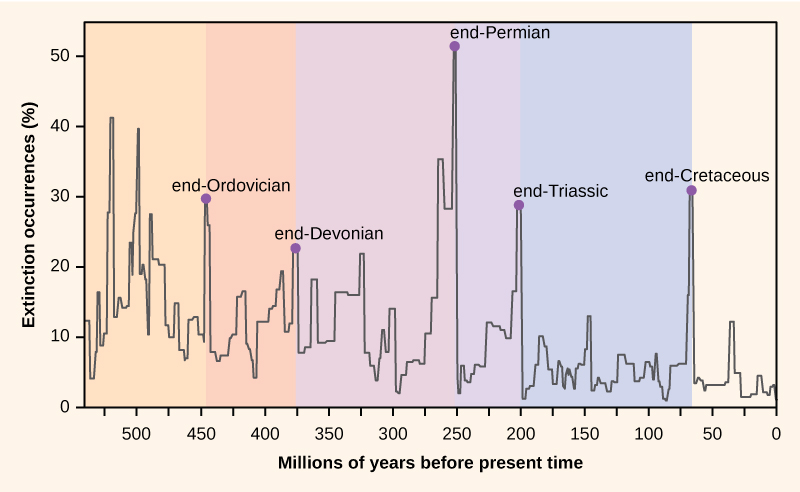
Throughout Earth's history, biodiversity has increased and decreased in response to environmental change. Scientists have identified five major mass extinctions, periods when a large percentage of Earth's species disappeared in a relatively short period of geological time.
The best-known mass extinction occurred about 66 million years ago when an asteroid impact contributed to the extinction of the non-avian dinosaurs and many other species.
(Figure \(\PageIndex{a}\)).
The Sixth Mass Extinction
Many scientists believe Earth is currently experiencing a sixth mass extinction. Unlike previous mass extinctions that were caused by natural events, the current biodiversity crisis is primarily driven by human activities. This has led some scientists to describe the present as the Anthropocene, a time when human activities have become the dominant influence on Earth's natural systems
Major causes of modern extinction include:
- Habitat loss
- Invasive species
- Pollution
- Climate change
- Overharvesting
According to the 2019 Intergovernmental Science-Policy Platform on Biodiversity and Ecosystem Services (IPBES) Global Assessment, about one million plant and animal species are at risk of extinction within the coming decades if current trends continue. Human activities such as habitat loss, pollution, climate change, overexploitation of resources, and invasive species are the main drivers of this biodiversity crisis. Recent UN- and IPBES-supported assessments indicate that global biodiversity loss continues and that extinction risks have increased in many regions, highlighting the need for rapid conservation and sustainability actions.
Why Extinction Matters
Extinction is a natural process, but today's extinction rates are much higher than natural background levels. Background extinction is the normal rate of species loss that occurs naturally over time, even without major human impacts or catastrophic events.
The loss of species can reduce ecosystem resilience and weaken ecosystem services that people depend on, including:
- Food production
- Water purification
- Pollination
- Climate regulation
Extirpation
Extinction occurs when a species disappears from Earth entirely. Extirpation occurs when a species disappears from a particular area but still survives elsewhere. Although extirpation does not eliminate a species globally, it can still affect ecosystem function. Conservation efforts often focus on preventing local extirpations and restoring species to habitats where they once occurred.
Yellowstone Wolves: A Case Study
The effects of extirpation can be seen in Yellowstone National Park. Wolves were eliminated from the park during the early twentieth century but survived elsewhere in North America. After wolves were reintroduced in the 1990s, scientists observed changes in elk populations, vegetation, and other parts of the ecosystem. This example shows how the loss or return of a single species can influence an entire ecosystem. The Yellowstone wolf example is often used to illustrate a top-down effect, where predators influence organisms at lower trophic levels.
Ecologists generally describe ecosystem interactions as:
- Top-down effects – Predators influence herbivores and other organisms lower in the food web. For example, wolves can affect elk populations, which in turn can influence vegetation.
- Bottom-up effects – The availability of resources such as sunlight, water, nutrients, or food influences populations at higher trophic levels.
In most ecosystems, both top-down and bottom-up factors interact to shape biodiversity, community structure, and ecosystem function.
Environmental Science Connection
Understanding extinction, extirpation, and species interactions helps scientists identify conservation priorities and develop strategies to protect biodiversity in a rapidly changing world.
References
UN Report: Nature’s Dangerous Decline ‘Unprecedented’; Species Extinction Rates ‘Accelerating’. 2019. United Nations. Accessed 2020-08-01.
Attributions
This page was heavily revised and rewritten by Erin Rempala and contains adapted content originally authored by Melissa Ha and Rachel Schleiger and is licensed CC BY-NC-SA 4.0.
Modified by Melissa Ha from the following sources:
- The Biodiversity Crisis from General Biology by OpenStax (licensed under CC-BY(opens in new window))
- Preserving Biodiversity and Importance of Biodiversity from Environmental Biology by Matthew R. Fisher (licensed under CC-BY(opens in new window))
- Biodiversity, Species Loss, and Ecosystem Function by Tom Theis and Jonathan Tomkin, Editors. Download for free at CNX. (licensed under CC-BY)