

5.3: Protecting Biodiveristy
- Page ID
- 185177

\( \newcommand{\vecs}[1]{\overset { \scriptstyle \rightharpoonup} {\mathbf{#1}} } \)
\( \newcommand{\vecd}[1]{\overset{-\!-\!\rightharpoonup}{\vphantom{a}\smash {#1}}} \)
\( \newcommand{\dsum}{\displaystyle\sum\limits} \)
\( \newcommand{\dint}{\displaystyle\int\limits} \)
\( \newcommand{\dlim}{\displaystyle\lim\limits} \)
\( \newcommand{\id}{\mathrm{id}}\) \( \newcommand{\Span}{\mathrm{span}}\)
( \newcommand{\kernel}{\mathrm{null}\,}\) \( \newcommand{\range}{\mathrm{range}\,}\)
\( \newcommand{\RealPart}{\mathrm{Re}}\) \( \newcommand{\ImaginaryPart}{\mathrm{Im}}\)
\( \newcommand{\Argument}{\mathrm{Arg}}\) \( \newcommand{\norm}[1]{\| #1 \|}\)
\( \newcommand{\inner}[2]{\langle #1, #2 \rangle}\)
\( \newcommand{\Span}{\mathrm{span}}\)
\( \newcommand{\id}{\mathrm{id}}\)
\( \newcommand{\Span}{\mathrm{span}}\)
\( \newcommand{\kernel}{\mathrm{null}\,}\)
\( \newcommand{\range}{\mathrm{range}\,}\)
\( \newcommand{\RealPart}{\mathrm{Re}}\)
\( \newcommand{\ImaginaryPart}{\mathrm{Im}}\)
\( \newcommand{\Argument}{\mathrm{Arg}}\)
\( \newcommand{\norm}[1]{\| #1 \|}\)
\( \newcommand{\inner}[2]{\langle #1, #2 \rangle}\)
\( \newcommand{\Span}{\mathrm{span}}\) \( \newcommand{\AA}{\unicode[.8,0]{x212B}}\)
\( \newcommand{\vectorA}[1]{\vec{#1}} % arrow\)
\( \newcommand{\vectorAt}[1]{\vec{\text{#1}}} % arrow\)
\( \newcommand{\vectorB}[1]{\overset { \scriptstyle \rightharpoonup} {\mathbf{#1}} } \)
\( \newcommand{\vectorC}[1]{\textbf{#1}} \)
\( \newcommand{\vectorD}[1]{\overrightarrow{#1}} \)
\( \newcommand{\vectorDt}[1]{\overrightarrow{\text{#1}}} \)
\( \newcommand{\vectE}[1]{\overset{-\!-\!\rightharpoonup}{\vphantom{a}\smash{\mathbf {#1}}}} \)
\( \newcommand{\vecs}[1]{\overset { \scriptstyle \rightharpoonup} {\mathbf{#1}} } \)
\(\newcommand{\longvect}{\overrightarrow}\)
\( \newcommand{\vecd}[1]{\overset{-\!-\!\rightharpoonup}{\vphantom{a}\smash {#1}}} \)
\(\newcommand{\avec}{\mathbf a}\) \(\newcommand{\bvec}{\mathbf b}\) \(\newcommand{\cvec}{\mathbf c}\) \(\newcommand{\dvec}{\mathbf d}\) \(\newcommand{\dtil}{\widetilde{\mathbf d}}\) \(\newcommand{\evec}{\mathbf e}\) \(\newcommand{\fvec}{\mathbf f}\) \(\newcommand{\nvec}{\mathbf n}\) \(\newcommand{\pvec}{\mathbf p}\) \(\newcommand{\qvec}{\mathbf q}\) \(\newcommand{\svec}{\mathbf s}\) \(\newcommand{\tvec}{\mathbf t}\) \(\newcommand{\uvec}{\mathbf u}\) \(\newcommand{\vvec}{\mathbf v}\) \(\newcommand{\wvec}{\mathbf w}\) \(\newcommand{\xvec}{\mathbf x}\) \(\newcommand{\yvec}{\mathbf y}\) \(\newcommand{\zvec}{\mathbf z}\) \(\newcommand{\rvec}{\mathbf r}\) \(\newcommand{\mvec}{\mathbf m}\) \(\newcommand{\zerovec}{\mathbf 0}\) \(\newcommand{\onevec}{\mathbf 1}\) \(\newcommand{\real}{\mathbb R}\) \(\newcommand{\twovec}[2]{\left[\begin{array}{r}#1 \\ #2 \end{array}\right]}\) \(\newcommand{\ctwovec}[2]{\left[\begin{array}{c}#1 \\ #2 \end{array}\right]}\) \(\newcommand{\threevec}[3]{\left[\begin{array}{r}#1 \\ #2 \\ #3 \end{array}\right]}\) \(\newcommand{\cthreevec}[3]{\left[\begin{array}{c}#1 \\ #2 \\ #3 \end{array}\right]}\) \(\newcommand{\fourvec}[4]{\left[\begin{array}{r}#1 \\ #2 \\ #3 \\ #4 \end{array}\right]}\) \(\newcommand{\cfourvec}[4]{\left[\begin{array}{c}#1 \\ #2 \\ #3 \\ #4 \end{array}\right]}\) \(\newcommand{\fivevec}[5]{\left[\begin{array}{r}#1 \\ #2 \\ #3 \\ #4 \\ #5 \\ \end{array}\right]}\) \(\newcommand{\cfivevec}[5]{\left[\begin{array}{c}#1 \\ #2 \\ #3 \\ #4 \\ #5 \\ \end{array}\right]}\) \(\newcommand{\mattwo}[4]{\left[\begin{array}{rr}#1 \amp #2 \\ #3 \amp #4 \\ \end{array}\right]}\) \(\newcommand{\laspan}[1]{\text{Span}\{#1\}}\) \(\newcommand{\bcal}{\cal B}\) \(\newcommand{\ccal}{\cal C}\) \(\newcommand{\scal}{\cal S}\) \(\newcommand{\wcal}{\cal W}\) \(\newcommand{\ecal}{\cal E}\) \(\newcommand{\coords}[2]{\left\{#1\right\}_{#2}}\) \(\newcommand{\gray}[1]{\color{gray}{#1}}\) \(\newcommand{\lgray}[1]{\color{lightgray}{#1}}\) \(\newcommand{\rank}{\operatorname{rank}}\) \(\newcommand{\row}{\text{Row}}\) \(\newcommand{\col}{\text{Col}}\) \(\renewcommand{\row}{\text{Row}}\) \(\newcommand{\nul}{\text{Nul}}\) \(\newcommand{\var}{\text{Var}}\) \(\newcommand{\corr}{\text{corr}}\) \(\newcommand{\len}[1]{\left|#1\right|}\) \(\newcommand{\bbar}{\overline{\bvec}}\) \(\newcommand{\bhat}{\widehat{\bvec}}\) \(\newcommand{\bperp}{\bvec^\perp}\) \(\newcommand{\xhat}{\widehat{\xvec}}\) \(\newcommand{\vhat}{\widehat{\vvec}}\) \(\newcommand{\uhat}{\widehat{\uvec}}\) \(\newcommand{\what}{\widehat{\wvec}}\) \(\newcommand{\Sighat}{\widehat{\Sigma}}\) \(\newcommand{\lt}{<}\) \(\newcommand{\gt}{>}\) \(\newcommand{\amp}{&}\) \(\definecolor{fillinmathshade}{gray}{0.9}\)Chapter Hook
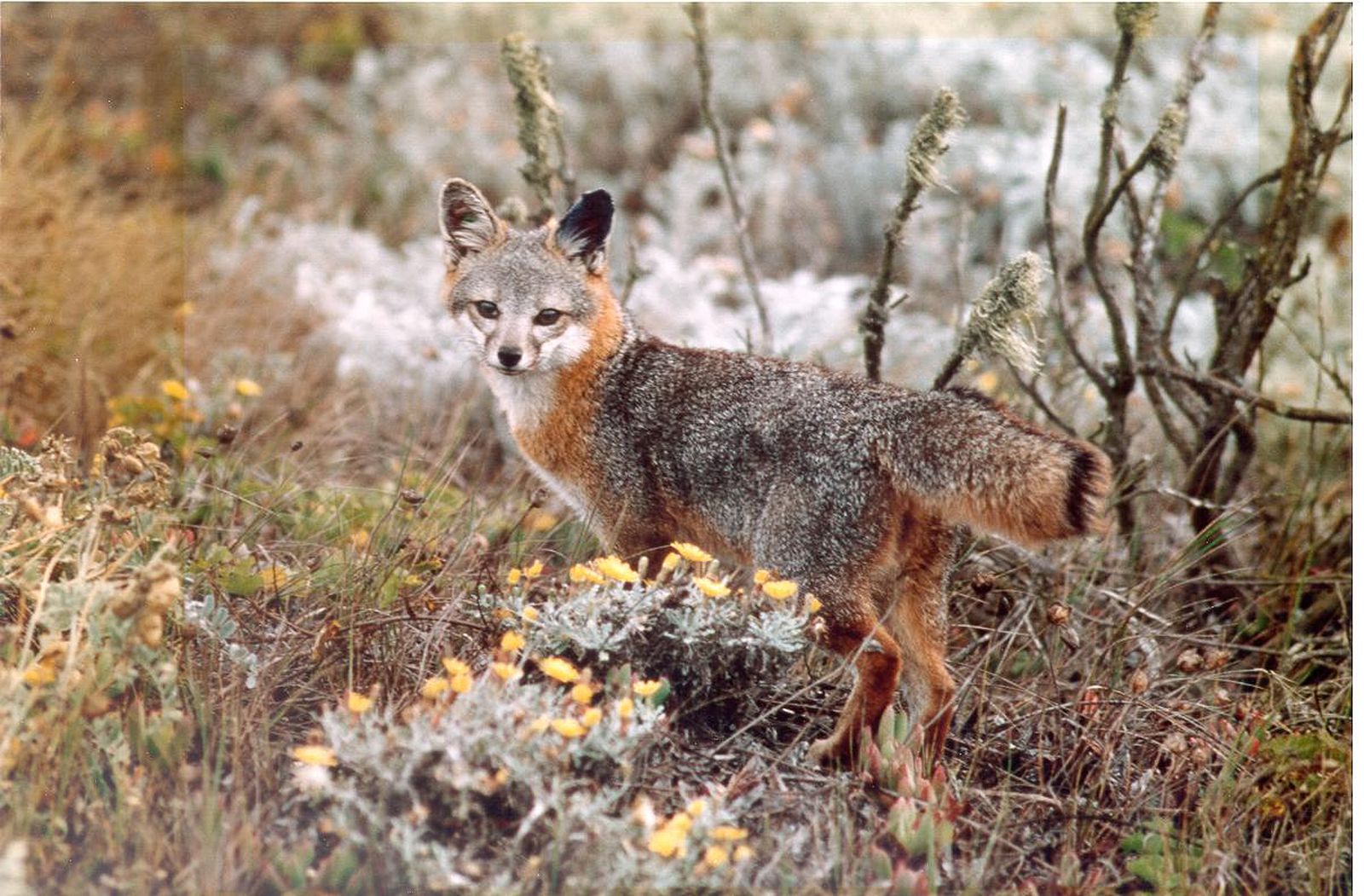
As of 2020, there were 41,415 species on the International Union for Conservation of Nature (IUCN) Red List, 16,306 of them being endangered and threatened with extinction. This is up from 16,118 from 2019. The Island Fox (Urocyon littoralis) is only found on six of the California Channel Islands off the coast of southern California. In the mid-1990’s four island fox subspecies experienced drastic population declines. Soon after, they were listed as critically endangered on the IUCN red list and endangered on the U.S Endangered Species Act. However, due to uncompromising recovery efforts (through supported funding from its endangered status), all four subspecies have almost completely recovered their populations. Regrettably, not all species that end up on the IUCN red list or endangered species list have trajectories that later hold such hope.
The field of conservation focuses on preserving biodiversity. Effective conservation depends on ecological knowledge. Today, the main efforts to preserve biodiversity involve legislative approaches to regulate human and corporate behavior, setting aside protected areas, and ecosystem restoration.
Attribution
Modified by Rachel Schleiger and Melissa Ha from Preserving Biodiversity from Environmental Biology by Matthew R. Fisher (licensed under CC-BY(opens in new window))
-
- 5.3.1: Policies
- This page outlines laws and treaties designed to protect endangered species, including the U.S. Endangered Species Act and Marine Mammals Protection Act, along with state counterparts like the California Endangered Species Act. Internationally, CITES addresses trade in endangered species, and the Migratory Bird Treaty Act safeguards numerous bird species. However, it highlights ongoing challenges in enforcement and species listing.
-
- 5.3.2: Non-profit Organizations
- This page discusses the vital role of the private non-profit sector in global conservation, highlighting organizations like the World Wildlife Fund, which raised over $300 million for endangered species in 2017-2018.
-
- 5.3.3: Species-level Conservation
- This page discusses conservation efforts targeting charismatic species like the California Condor and black-footed ferret, using methods such as captive breeding and vaccination. It highlights the importance of habitat protection, particularly for the Northern Spotted Owl, and the role of invasive species removal in ecosystem restoration. While some species, like delta smelt, are crucial indicators, many non-charismatic species remain overlooked.
-
- 5.3.4: Protected Areas
- This page highlights the importance of protecting natural areas for cultural, health, and economic benefits. It emphasizes nature preserves' role in conservation and biodiversity support. Wilderness areas are key habitats with minimal human impact, while the U.S. boasts extensive public recreational land, including national parks and wildlife refuges, each offering unique protections and recreational experiences that contribute to biodiversity conservation.
-
- 5.3.5: Ecosystem Restoration
- This page discusses ecosystem restoration, emphasizing its goal to return damaged areas to natural states to boost biodiversity and services. It highlights key examples like the wolf reintroduction in Yellowstone and large dam removals in the U.S. that improve ecological health. Environmental remediation efforts focus on cleaning up pollution at sites like Superfund areas, while reclamation and mitigation strategies aim to restore degraded habitats and reduce environmental damage.
-
- 5.3.6: Economic Influences on Conservation
- This page explores the impact of economics on conservation, highlighting how profit motives can lead to unsustainable practices, particularly in impoverished regions. It discusses debt-for-nature swaps as a viable solution, using Costa Rica's experience with U.S. debt relief as an example of fostering ecological preservation while supporting local economies through job creation and ecotourism.
-
- 5.3.7: Individual Choices
- This page explores how individual actions influence biodiversity, focusing on responsible consumer choices, resource conservation, and citizen science. It underscores the importance of selecting sustainable products, employing energy-efficient practices, and using native plants in gardening to protect local ecosystems.
-
- 5.3.8: Data Dive- Island Fox Populations
- This page discusses efforts by the Island Fox Conservation Working Group and Friends of the Island Fox to protect the endangered island fox through research and conservation. Annual meetings review population data of the six subspecies, showing varying statuses from stable to concerning. The 2019 meeting provided insights into these trends and included educational outreach to engage public support for conservation.