

3.2: Community Ecology
- Page ID
- 175758

\( \newcommand{\vecs}[1]{\overset { \scriptstyle \rightharpoonup} {\mathbf{#1}} } \)
\( \newcommand{\vecd}[1]{\overset{-\!-\!\rightharpoonup}{\vphantom{a}\smash {#1}}} \)
\( \newcommand{\dsum}{\displaystyle\sum\limits} \)
\( \newcommand{\dint}{\displaystyle\int\limits} \)
\( \newcommand{\dlim}{\displaystyle\lim\limits} \)
\( \newcommand{\id}{\mathrm{id}}\) \( \newcommand{\Span}{\mathrm{span}}\)
( \newcommand{\kernel}{\mathrm{null}\,}\) \( \newcommand{\range}{\mathrm{range}\,}\)
\( \newcommand{\RealPart}{\mathrm{Re}}\) \( \newcommand{\ImaginaryPart}{\mathrm{Im}}\)
\( \newcommand{\Argument}{\mathrm{Arg}}\) \( \newcommand{\norm}[1]{\| #1 \|}\)
\( \newcommand{\inner}[2]{\langle #1, #2 \rangle}\)
\( \newcommand{\Span}{\mathrm{span}}\)
\( \newcommand{\id}{\mathrm{id}}\)
\( \newcommand{\Span}{\mathrm{span}}\)
\( \newcommand{\kernel}{\mathrm{null}\,}\)
\( \newcommand{\range}{\mathrm{range}\,}\)
\( \newcommand{\RealPart}{\mathrm{Re}}\)
\( \newcommand{\ImaginaryPart}{\mathrm{Im}}\)
\( \newcommand{\Argument}{\mathrm{Arg}}\)
\( \newcommand{\norm}[1]{\| #1 \|}\)
\( \newcommand{\inner}[2]{\langle #1, #2 \rangle}\)
\( \newcommand{\Span}{\mathrm{span}}\) \( \newcommand{\AA}{\unicode[.8,0]{x212B}}\)
\( \newcommand{\vectorA}[1]{\vec{#1}} % arrow\)
\( \newcommand{\vectorAt}[1]{\vec{\text{#1}}} % arrow\)
\( \newcommand{\vectorB}[1]{\overset { \scriptstyle \rightharpoonup} {\mathbf{#1}} } \)
\( \newcommand{\vectorC}[1]{\textbf{#1}} \)
\( \newcommand{\vectorD}[1]{\overrightarrow{#1}} \)
\( \newcommand{\vectorDt}[1]{\overrightarrow{\text{#1}}} \)
\( \newcommand{\vectE}[1]{\overset{-\!-\!\rightharpoonup}{\vphantom{a}\smash{\mathbf {#1}}}} \)
\( \newcommand{\vecs}[1]{\overset { \scriptstyle \rightharpoonup} {\mathbf{#1}} } \)
\(\newcommand{\longvect}{\overrightarrow}\)
\( \newcommand{\vecd}[1]{\overset{-\!-\!\rightharpoonup}{\vphantom{a}\smash {#1}}} \)
\(\newcommand{\ket}[1]{\left| #1 \right>}\)
\(\newcommand{\bra}[1]{\left< #1 \right|}\)
\(\newcommand{\braket}[2]{\left< #1 \vphantom{#2} \right| \left. #2 \vphantom{#1} \right>}\)
\(\newcommand{\braopket}[3]{\left< #1 \vphantom{#2}\vphantom{#3} \right| #2 \vphantom{#1}\vphantom{#3} \left| #3 \vphantom{#1}\vphantom{#2} \right>}\)
\(\newcommand{\qmvec}[1]{\mathbf{\vec{#1}}}\)
\(\newcommand{\op}[1]{\hat{\mathbf{#1}}}\)
\(\newcommand{\expect}[1]{\langle #1 \rangle}\)
\(\newcommand{\dfn}[1]{\emph{\textbf{#1}}}\)
Community Ecology
Populations typically do not live in isolation from other species. Populations that live and interact within a given area form a community. The organisms that make up a community share a habitat, the physical environment in which they live. A community includes all of the biotic (living) components of an area, such as plants, animals, fungi, bacteria, and other organisms. Scientists study ecology at the community level to understand how species interact with one another and how these interactions influence the distribution and abundance of organisms.
Keystone Species
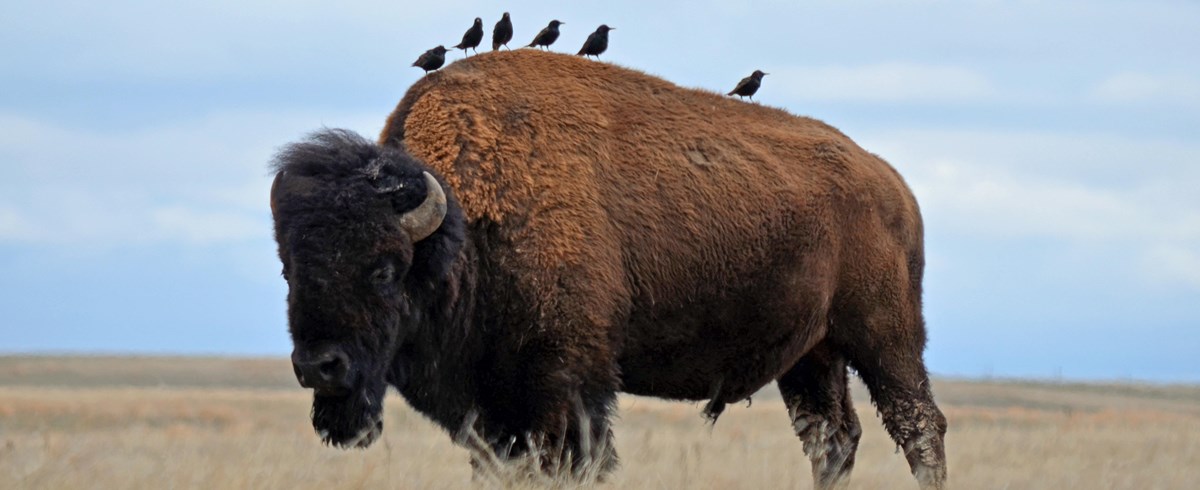
Until the late 1800s, American bison (Bison bison) numbered in the tens of millions across the Great Plains (figure \(\PageIndex{a}\)). By 1890, fewer than 1,000 remained due to overhunting, habitat loss, and U.S. government policies that contributed to the displacement of Indigenous peoples and the destruction of the resources they depended upon. Conservation efforts eventually helped bison populations recover, reaching roughly half a million individuals by the early 2000s.
As bison were reintroduced to parts of the Great Plains, ecologists observed major changes in the ecosystem. Bison grazing, wallowing, trampling, and movement across the landscape helped maintain plant diversity and created habitat conditions that benefited many other species. Because bison physically modify their environment and influence the availability of resources for other organisms, they are considered an ecosystem engineer. Bison are also considered a keystone species because their presence has a disproportionately large effect on the structure and function of Great Plains ecosystems. This example demonstrates how changes to a single species can affect an entire ecological community and highlights the importance of understanding community interactions when conserving and restoring ecosystems.
- 3.2.1: Biotic Interactions
- This page explains biotic interactions between organisms, including intraspecific and interspecific relationships. It differentiates between antagonistic interactions, where one species is harmed (e.g., competition and trophic interactions), and facilitation, involving beneficial relationships like commensalism and mutualism.
- 3.2.2: Community Structure and Dynamics
- This page explains the complexity of communities as ecosystems shaped by structure and dynamics. It highlights the role of keystone species in influencing biodiversity. The page details community dynamics and how they evolve through primary succession on bare rock and secondary succession after disturbances, emphasizing the role of pioneer species and existing soil in recolonization.
- 3.2.3: Data Dive- Beaver Impacts on Wetlands
- This page discusses ecosystem engineers, highlighting how beavers alter habitats and affect biodiversity. A 2017 study on beaver reintroduction showed an increase in wetland species diversity over time, particularly between 1-2 years and 10-12 years post-introduction. The findings suggest beavers' potential in habitat restoration, although certain data patterns remain ambiguous.
- 3.2.1: Biotic Interactions
- This page explains biotic interactions between organisms, including intraspecific and interspecific relationships. It differentiates between antagonistic interactions, where one species is harmed (e.g., competition and trophic interactions), and facilitation, involving beneficial relationships like commensalism and mutualism.
- 3.2.2: Community Structure and Dynamics
- This page explains the complexity of communities as ecosystems shaped by structure and dynamics. It highlights the role of keystone species in influencing biodiversity. The page details community dynamics and how they evolve through primary succession on bare rock and secondary succession after disturbances, emphasizing the role of pioneer species and existing soil in recolonization.
- 3.2.3: Data Dive- Beaver Impacts on Wetlands
- This page discusses ecosystem engineers, highlighting how beavers alter habitats and affect biodiversity. A 2017 study on beaver reintroduction showed an increase in wetland species diversity over time, particularly between 1-2 years and 10-12 years post-introduction. The findings suggest beavers' potential in habitat restoration, although certain data patterns remain ambiguous.
Attribution
This page was heavily revised and rewritten by Erin Rempala and contains content adapted from 6: Communities originally authored by Melissa Ha and Rachel Schleiger is licensed CC BY-NC-SA 4.0.
Modified by Rachel Schleiger and Melissa Ha from Community Ecology from Environmental Biology by Matthew R. Fisher (licensed under CC-BY(opens in new window))