
11.1: Weeds
- Page ID
- 232996

\( \newcommand{\vecs}[1]{\overset { \scriptstyle \rightharpoonup} {\mathbf{#1}} } \)
\( \newcommand{\vecd}[1]{\overset{-\!-\!\rightharpoonup}{\vphantom{a}\smash {#1}}} \)
\( \newcommand{\dsum}{\displaystyle\sum\limits} \)
\( \newcommand{\dint}{\displaystyle\int\limits} \)
\( \newcommand{\dlim}{\displaystyle\lim\limits} \)
\( \newcommand{\id}{\mathrm{id}}\) \( \newcommand{\Span}{\mathrm{span}}\)
( \newcommand{\kernel}{\mathrm{null}\,}\) \( \newcommand{\range}{\mathrm{range}\,}\)
\( \newcommand{\RealPart}{\mathrm{Re}}\) \( \newcommand{\ImaginaryPart}{\mathrm{Im}}\)
\( \newcommand{\Argument}{\mathrm{Arg}}\) \( \newcommand{\norm}[1]{\| #1 \|}\)
\( \newcommand{\inner}[2]{\langle #1, #2 \rangle}\)
\( \newcommand{\Span}{\mathrm{span}}\)
\( \newcommand{\id}{\mathrm{id}}\)
\( \newcommand{\Span}{\mathrm{span}}\)
\( \newcommand{\kernel}{\mathrm{null}\,}\)
\( \newcommand{\range}{\mathrm{range}\,}\)
\( \newcommand{\RealPart}{\mathrm{Re}}\)
\( \newcommand{\ImaginaryPart}{\mathrm{Im}}\)
\( \newcommand{\Argument}{\mathrm{Arg}}\)
\( \newcommand{\norm}[1]{\| #1 \|}\)
\( \newcommand{\inner}[2]{\langle #1, #2 \rangle}\)
\( \newcommand{\Span}{\mathrm{span}}\) \( \newcommand{\AA}{\unicode[.8,0]{x212B}}\)
\( \newcommand{\vectorA}[1]{\vec{#1}} % arrow\)
\( \newcommand{\vectorAt}[1]{\vec{\text{#1}}} % arrow\)
\( \newcommand{\vectorB}[1]{\overset { \scriptstyle \rightharpoonup} {\mathbf{#1}} } \)
\( \newcommand{\vectorC}[1]{\textbf{#1}} \)
\( \newcommand{\vectorD}[1]{\overrightarrow{#1}} \)
\( \newcommand{\vectorDt}[1]{\overrightarrow{\text{#1}}} \)
\( \newcommand{\vectE}[1]{\overset{-\!-\!\rightharpoonup}{\vphantom{a}\smash{\mathbf {#1}}}} \)
\( \newcommand{\vecs}[1]{\overset { \scriptstyle \rightharpoonup} {\mathbf{#1}} } \)
\(\newcommand{\longvect}{\overrightarrow}\)
\( \newcommand{\vecd}[1]{\overset{-\!-\!\rightharpoonup}{\vphantom{a}\smash {#1}}} \)
\(\newcommand{\ket}[1]{\left| #1 \right>}\)
\(\newcommand{\bra}[1]{\left< #1 \right|}\)
\(\newcommand{\braket}[2]{\left< #1 \vphantom{#2} \right| \left. #2 \vphantom{#1} \right>}\)
\(\newcommand{\braopket}[3]{\left< #1 \vphantom{#2}\vphantom{#3} \right| #2 \vphantom{#1}\vphantom{#3} \left| #3 \vphantom{#1}\vphantom{#2} \right>}\)
\(\newcommand{\qmvec}[1]{\mathbf{\vec{#1}}}\)
\(\newcommand{\op}[1]{\hat{\mathbf{#1}}}\)
\(\newcommand{\expect}[1]{\langle #1 \rangle}\)
\(\newcommand{\dfn}[1]{\emph{\textbf{#1}}}\)
As horticulturalists our goal is to encourage plant growth. We fertilize and water to nurture plants from seedlings to maturity, to fruit and seed production. The conditions that support crop growth are the same conditions that support non-crop growth. This makes control of weeds (unwanted plants) difficult.
The term weed is loosely defined as a plant growing where it is not wanted. Botanically, the term does not have a concrete definition that allows us to separate weed from non-weed. One might attribute “weed” as a state of mind since depends on the observer's standpoint. There are groups of non-cultivated plants that have characteristics that tend to make them a problem to control. These groups fall under the more concrete application of the term. For a wheat grower with a couple of hundred corn plants popping up across their wheat field, the corn is just as much a problem as the more traditional weeds.
Weeds can significantly impact a crop’s yield. One reason for this is that weeds compete with the cultivated plants for resources. There is a finite supply of nutrients in the soil and weed seeds often germinate and grow faster than the cultivated crop. They can establish root systems that deplete the soil’s nutrient reserves before the cultivated plant’s roots can get there. The same is true of water. There is only so much available and if it is divided between the plants and the weeds then the crop is going to potentially suffer from insufficient resources.

Weeds can block sunlight from striking the plant (Figure 11-2). Even if the crop and weed are about the same height, it will impact solar incidence on the sides of the plants and thus lower productivity. Dense weeds can crowd around the cultivated plants and prevent adequate air circulation. While it might be possible to have a small impact on photosynthesis due to lower CO2 levels, the real issue is with disease. Lack of air circulation amongst leaf canopies can lead to fungal pathogens and issues with some insect pest as well.
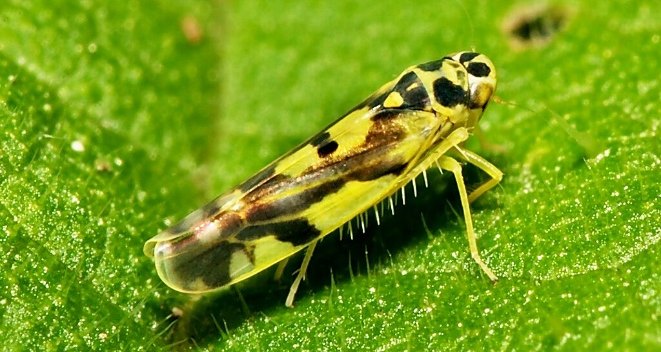
In addition to direct competition for resources, weeds can impact crops by acting as sanctuaries for pest insects including those that carry disease. The weeds provide cover for the insect populations during spraying of the fields and serve as harbors for insects from one crop cycle to the next. Many of the piercing-sucking insects, such as aphids and leafhoppers (Figure 11-3), are also vectors of disease. The presence of these insects increases the risk of introducing a virus. We will look at this in more detail later in this chapter.