

5.7: Pregnancy
- Page ID
- 187721

\( \newcommand{\vecs}[1]{\overset { \scriptstyle \rightharpoonup} {\mathbf{#1}} } \)
\( \newcommand{\vecd}[1]{\overset{-\!-\!\rightharpoonup}{\vphantom{a}\smash {#1}}} \)
\( \newcommand{\dsum}{\displaystyle\sum\limits} \)
\( \newcommand{\dint}{\displaystyle\int\limits} \)
\( \newcommand{\dlim}{\displaystyle\lim\limits} \)
\( \newcommand{\id}{\mathrm{id}}\) \( \newcommand{\Span}{\mathrm{span}}\)
( \newcommand{\kernel}{\mathrm{null}\,}\) \( \newcommand{\range}{\mathrm{range}\,}\)
\( \newcommand{\RealPart}{\mathrm{Re}}\) \( \newcommand{\ImaginaryPart}{\mathrm{Im}}\)
\( \newcommand{\Argument}{\mathrm{Arg}}\) \( \newcommand{\norm}[1]{\| #1 \|}\)
\( \newcommand{\inner}[2]{\langle #1, #2 \rangle}\)
\( \newcommand{\Span}{\mathrm{span}}\)
\( \newcommand{\id}{\mathrm{id}}\)
\( \newcommand{\Span}{\mathrm{span}}\)
\( \newcommand{\kernel}{\mathrm{null}\,}\)
\( \newcommand{\range}{\mathrm{range}\,}\)
\( \newcommand{\RealPart}{\mathrm{Re}}\)
\( \newcommand{\ImaginaryPart}{\mathrm{Im}}\)
\( \newcommand{\Argument}{\mathrm{Arg}}\)
\( \newcommand{\norm}[1]{\| #1 \|}\)
\( \newcommand{\inner}[2]{\langle #1, #2 \rangle}\)
\( \newcommand{\Span}{\mathrm{span}}\) \( \newcommand{\AA}{\unicode[.8,0]{x212B}}\)
\( \newcommand{\vectorA}[1]{\vec{#1}} % arrow\)
\( \newcommand{\vectorAt}[1]{\vec{\text{#1}}} % arrow\)
\( \newcommand{\vectorB}[1]{\overset { \scriptstyle \rightharpoonup} {\mathbf{#1}} } \)
\( \newcommand{\vectorC}[1]{\textbf{#1}} \)
\( \newcommand{\vectorD}[1]{\overrightarrow{#1}} \)
\( \newcommand{\vectorDt}[1]{\overrightarrow{\text{#1}}} \)
\( \newcommand{\vectE}[1]{\overset{-\!-\!\rightharpoonup}{\vphantom{a}\smash{\mathbf {#1}}}} \)
\( \newcommand{\vecs}[1]{\overset { \scriptstyle \rightharpoonup} {\mathbf{#1}} } \)
\(\newcommand{\longvect}{\overrightarrow}\)
\( \newcommand{\vecd}[1]{\overset{-\!-\!\rightharpoonup}{\vphantom{a}\smash {#1}}} \)
\(\newcommand{\avec}{\mathbf a}\) \(\newcommand{\bvec}{\mathbf b}\) \(\newcommand{\cvec}{\mathbf c}\) \(\newcommand{\dvec}{\mathbf d}\) \(\newcommand{\dtil}{\widetilde{\mathbf d}}\) \(\newcommand{\evec}{\mathbf e}\) \(\newcommand{\fvec}{\mathbf f}\) \(\newcommand{\nvec}{\mathbf n}\) \(\newcommand{\pvec}{\mathbf p}\) \(\newcommand{\qvec}{\mathbf q}\) \(\newcommand{\svec}{\mathbf s}\) \(\newcommand{\tvec}{\mathbf t}\) \(\newcommand{\uvec}{\mathbf u}\) \(\newcommand{\vvec}{\mathbf v}\) \(\newcommand{\wvec}{\mathbf w}\) \(\newcommand{\xvec}{\mathbf x}\) \(\newcommand{\yvec}{\mathbf y}\) \(\newcommand{\zvec}{\mathbf z}\) \(\newcommand{\rvec}{\mathbf r}\) \(\newcommand{\mvec}{\mathbf m}\) \(\newcommand{\zerovec}{\mathbf 0}\) \(\newcommand{\onevec}{\mathbf 1}\) \(\newcommand{\real}{\mathbb R}\) \(\newcommand{\twovec}[2]{\left[\begin{array}{r}#1 \\ #2 \end{array}\right]}\) \(\newcommand{\ctwovec}[2]{\left[\begin{array}{c}#1 \\ #2 \end{array}\right]}\) \(\newcommand{\threevec}[3]{\left[\begin{array}{r}#1 \\ #2 \\ #3 \end{array}\right]}\) \(\newcommand{\cthreevec}[3]{\left[\begin{array}{c}#1 \\ #2 \\ #3 \end{array}\right]}\) \(\newcommand{\fourvec}[4]{\left[\begin{array}{r}#1 \\ #2 \\ #3 \\ #4 \end{array}\right]}\) \(\newcommand{\cfourvec}[4]{\left[\begin{array}{c}#1 \\ #2 \\ #3 \\ #4 \end{array}\right]}\) \(\newcommand{\fivevec}[5]{\left[\begin{array}{r}#1 \\ #2 \\ #3 \\ #4 \\ #5 \\ \end{array}\right]}\) \(\newcommand{\cfivevec}[5]{\left[\begin{array}{c}#1 \\ #2 \\ #3 \\ #4 \\ #5 \\ \end{array}\right]}\) \(\newcommand{\mattwo}[4]{\left[\begin{array}{rr}#1 \amp #2 \\ #3 \amp #4 \\ \end{array}\right]}\) \(\newcommand{\laspan}[1]{\text{Span}\{#1\}}\) \(\newcommand{\bcal}{\cal B}\) \(\newcommand{\ccal}{\cal C}\) \(\newcommand{\scal}{\cal S}\) \(\newcommand{\wcal}{\cal W}\) \(\newcommand{\ecal}{\cal E}\) \(\newcommand{\coords}[2]{\left\{#1\right\}_{#2}}\) \(\newcommand{\gray}[1]{\color{gray}{#1}}\) \(\newcommand{\lgray}[1]{\color{lightgray}{#1}}\) \(\newcommand{\rank}{\operatorname{rank}}\) \(\newcommand{\row}{\text{Row}}\) \(\newcommand{\col}{\text{Col}}\) \(\renewcommand{\row}{\text{Row}}\) \(\newcommand{\nul}{\text{Nul}}\) \(\newcommand{\var}{\text{Var}}\) \(\newcommand{\corr}{\text{corr}}\) \(\newcommand{\len}[1]{\left|#1\right|}\) \(\newcommand{\bbar}{\overline{\bvec}}\) \(\newcommand{\bhat}{\widehat{\bvec}}\) \(\newcommand{\bperp}{\bvec^\perp}\) \(\newcommand{\xhat}{\widehat{\xvec}}\) \(\newcommand{\vhat}{\widehat{\vvec}}\) \(\newcommand{\uhat}{\widehat{\uvec}}\) \(\newcommand{\what}{\widehat{\wvec}}\) \(\newcommand{\Sighat}{\widehat{\Sigma}}\) \(\newcommand{\lt}{<}\) \(\newcommand{\gt}{>}\) \(\newcommand{\amp}{&}\) \(\definecolor{fillinmathshade}{gray}{0.9}\)A mother-to-be waits patiently for her fetus to grow as her belly swells. Reproduction ensures the survival of future generations, and the female reproductive system is specialized for this purpose. Its functions include producing gametes (eggs), secreting sex hormones (such as estrogen), providing a site for fertilization, gestating a fetus if fertilization occurs, giving birth to a baby, and breastfeeding a baby after birth. The only thing missing is sperm.
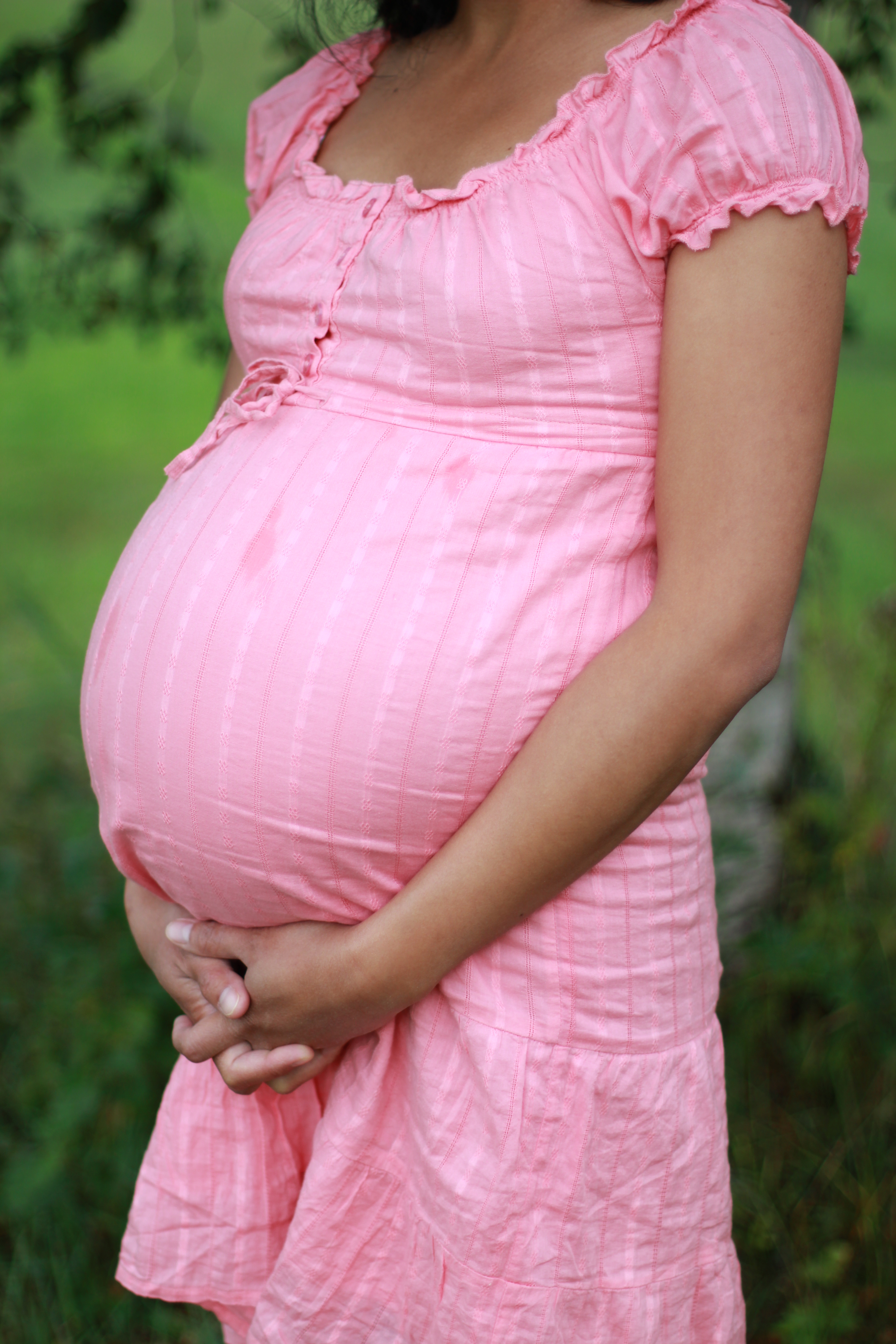
Figure \(\PageIndex{1}\): Pregnant woman. Pregnant woman (Øyvind Holmstad CC-BY-SA 4.0)
While customs and traditions surrounding pregnancy vary worldwide, the developmental process is essentially universal from conception through the three trimesters to labor and delivery.
A note: pregnancy and childbirth are important, but not the only defining aspects of being a woman. Many women have children in other ways (adoption or surrogacy), and others are child-free, whether by necessity, due to infertility or complications, or by choice.
There are many myths associated with pregnancy. Most are harmless, but some may put the pregnant woman or fetus at risk. As always, knowledge is power.
Myth: You should avoid petting your cat during pregnancy.
Reality: Cat feces may contain microscopic parasites that can cause toxoplasmosis. Pregnant people who contract this disease are at risk of stillbirth, miscarriage, or giving birth to an infant with serious health problems. Pregnant people should not have contact with a cat’s litter box or feces, but petting a cat poses no real risk of infection.
Myth: You should not dye your hair during pregnancy, because the chemicals can harm the fetus.
Reality: Whereas some chemicals (such as certain pesticides) have been shown to be associated with birth defects, there is no evidence that using hair dye during pregnancy increases this risk.
Myth: A pregnant woman needs to eat for two, so she should double her pre-pregnancy caloric intake.
Reality: Throughout a typical pregnancy, a person needs only about 300 extra calories per day, on average, to support their growing fetus. Most of the extra calories are needed during the last trimester when the fetus is growing most rapidly. Doubling her caloric intake during pregnancy is likely to lead to excessive weight gain, which can be detrimental to her baby. Babies that weigh much more than the average 7.5 pounds at birth are more likely to develop diabetes and obesity in later life.
Myth: People who are pregnant have strange food cravings, such as ice cream with pickles.
Reality: Some do have food cravings during pregnancy, but they are not necessarily cravings for strange foods or unusual food combinations. For example, a pregnant woman might crave starchy foods for a few weeks, or she may be put off by certain foods that she loved before pregnancy.
Myth: A pregnant person's skin "glows".
Reality: Pregnancy can actually be hard on the skin and its appearance. Besides stretch marks on the abdomen and breasts, pregnancy may lead to spider veins, varicose veins, new freckles, darkening of moles, and acne flare-ups. In addition, as many as 75 percent of pregnant women experience chloasma, which is the emergence of blotchy brown patches of skin on the face due to high estrogen levels. Chloasma is often called the “mask of pregnancy.”
Myth: Men cannot carry a baby.
Reality: Transgender men and others AFAB can get pregnant, as can some individuals who are intersex.
Pregnancy
Pregnancy is the carrying of one or more offspring from fertilization until birth. This is one of the major functions of the female reproductive system. Pregnancy involves virtually every other body system. The pregnant person plays a critical role in offspring development, providing all nutrients and other substances needed for the offspring's normal growth and development, and removal of the offspring's wastes.
Most nutrients are needed in greater amounts by a pregnant individual to meet fetal needs, but some are especially important, including folic acid, calcium, iron, and omega-3 fatty acids. A healthy diet, along with prenatal vitamin supplements, is recommended for the best pregnancy outcome. A pregnant person should also avoid ingesting any foods or substances that can damage the developing offspring, especially early in the pregnancy when major organs and organ systems are forming.
Counted from the first day of the last menstrual period, the average pregnancy is about 40 weeks (38 weeks from the time of fertilization). A pregnancy lasting 37-42 weeks is still considered within the normal range.
For the pregnant person, pregnancy typically spans three 3-month periods called trimesters. Trimesters are useful for summarizing the typical changes during pregnancy. The offspring's developmental divisions differ (Section 4.8).
Physical Changes During Pregnancy
A pregnancy begins when the developing embryo implants in the endometrial lining of a woman’s uterus. Most pregnant women do not have any specific signs or symptoms after implantation, so they generally do not know they are pregnant. It is not uncommon to experience minimal bleeding at implantation.
The risk of miscarriage is high in the first 8 weeks, often due to the genetic makeup of the embryo and regardless of any other factors. Many women may miscarry during this period without knowing they were pregnant.
After implantation, the uterine endometrium is called the decidua. The placenta, a combination of the decidua and outer layers of the embryo, connects the developing embryo to the uterine wall. The umbilical cord connects the embryo or fetus to the placenta for nutrient uptake, waste elimination, and gas exchange via the mother’s blood supply.
A number of physiological signs are associated with early pregnancy. These signs typically appear, if at all, within the first few weeks after conception. Not all of these signs are universally present, nor does the presence of one indicate a pregnancy; taken together, however, they may make a presumptive diagnosis of pregnancy:
- The presence of human chorionic gonadotropin (hCG) in the blood and urine.
- Missed menstrual period.
- Implantation bleeding (occurs at implantation of the embryo in the uterus during the third or fourth week after the last menstrual period).
- Increased basal body temperature sustained for over 2 weeks after ovulation.
- Chadwick’s sign (darkening of the cervix, vagina, and vulva).
- Goodell’s sign (softening of the vaginal portion of the cervix).
- Hegar’s sign (softening of the uterus isthmus).
- Pigmentation of the linea alba (called linea nigra), which is the darkening of the skin in the midline of the abdomen. This darkening is caused by hyperpigmentation resulting from hormonal changes, usually appearing around the middle of pregnancy.
- Nipples and areolas begin to darken due to a temporary increase in hormones
Despite all the signs, some women may not realize they are pregnant until they are far along in pregnancy. In some cases, a few have not been aware of their pregnancy until they begin labor. This can be caused by many factors, including irregular periods (quite common in teenagers), certain medications (not related to conceiving children), and women who disregard the pregnancy-related weight gain. Others may be in denial of their situation.
The Three Trimesters of Pregnancy
| Trimester | Physical Changes |
| First (Fertilization to 12 weeks) |
|
| Second (13-28 weeks) |
|
| Third (29-40 weeks) |
|
Time-lapse of Nasheka's pregnancy from 11- 41 weeks.
Metabolic Changes
During pregnancy, both protein metabolism and carbohydrate metabolism are affected. An increase in nutrients is required for fetal growth and fat deposition.
- Changes are caused by steroid hormones, lactogen, and cortisol.
- Increased liver metabolism is also observed, with increased gluconeogenesis, leading to elevated maternal glucose levels. Maternal insulin resistance can lead to gestational diabetes.
- One kilogram of extra protein is deposited, with half going to the fetus and placenta, and the other half going to uterine contractile proteins, breast glandular tissue, plasma protein, and hemoglobin.
Physiological Changes
Pregnancy-related physiological and homeostatic changes, such as cardiovascular, hematologic, metabolic, renal, and respiratory, are normal adaptations to better accommodate the embryo or fetus.
Hormonal Changes
Pregnant women experience adjustments in their endocrine system. Levels of progesterone and estrogens rise continuously throughout pregnancy to suppress the menstrual cycle.
- Placental hormones are important:
- Placental estrogen is associated with fetal well-being.
- Human chorionic gonadotropin (β-hCG), produced by the placenta, maintains corpus luteum progesterone production, primarily relaxing smooth muscles.
- Human placental lactogen (HPL) stimulates lipolysis and fatty acid metabolism in the mother while conserving blood glucose for the fetus, thereby decreasing the pregnant person's insulin sensitivity. This can result in gestational diabetes.
- Prolactin levels increase, leading to a shift in the mammary glands from ductal to lobular-alveolar tissue for milk production.
- Parathyroid hormone increases calcium uptake in the gut and reabsorption by the kidney.
- Adrenal hormones, such as cortisol and aldosterone, also increase.
Gestational diabetes (or gestational diabetes mellitus, GDM) is a condition in which people without previously diagnosed diabetes exhibit high blood glucose levels during pregnancy (especially during the third trimester). Research is being conducted on whether the condition may be natural during pregnancy.
Maternal insulin resistance can lead to gestational diabetes. This is related to Type II diabetes but occurs during pregnancy, likely due to factors such as the presence of human placental lactogen (see above). This, in turn, causes inappropriately elevated blood sugar levels.
With few symptoms, gestational diabetes is most commonly diagnosed by screening for inappropriately high glucose levels in the blood samples. Gestational diabetes affects 3–10% of pregnancies, depending on the population, so it may be a natural phenomenon.
Babies born to mothers with untreated gestational diabetes are typically at risk of increased size (which may lead to delivery complications), low blood sugar, and jaundice. If untreated, it can also cause seizures or stillbirth.
Gestational diabetes is treatable, and women who have adequate control of glucose levels can effectively decrease these risks.
Weight Changes
The enlarging uterus, the growing fetus, the placenta and liquor amni, and the acquisition of fat and water retention all contribute to weight gain.
- Weight gain varies widely, from 5 pounds (2.3 kg) to over 100 pounds (45 kg).
- In the U.S., the recommended weight gain range is 25 pounds (11 kg) to 35 pounds (16 kg).
- Less is recommended if the woman is overweight; more if she is underweight (up to 40 pounds or 18 kg).
Breast Changes
Breasts grow during pregnancy, usually one to two cup sizes, but possibly larger.
- Those who wore a C-cup bra before a pregnancy may need to buy an F-cup or larger bra while nursing.
- The torso also grows, and a bra band may need to be adjusted by one or two sizes.
Once the baby is born (about 50 to 73 hours after birth), the breasts fill with milk, and changes occur very quickly.
- Once lactation begins, the breasts swell significantly, can feel achy, lumpy, and heavy (engorgement), and may increase in size again.
- Individual breast size can vary daily or for longer periods, depending on how much the infant nurses from each breast.
Circulatory Changes
To accommodate all of the physical and metabolic changes, and due to increased aldosterone, plasma and blood volume slowly increase by 40–50% over the course of the pregnancy, leading to increased:
- heart rate (15 beats/min above usual)
- stroke volume
- cardiac output (increases ~50%, primarily during the first trimester).
Other common cardiovascular changes include:
- Decreased blood pressure during pregnancy, returning to baseline by the end of the pregnancy.
- Edema (swelling) of the feet, partly because the enlarging uterus compresses the veins and lymphatic drainage from the legs.
- Increased risk for blood clots and embolisms due to increased liver production of coagulation factors.
- Women are at the highest risk for developing clots (thrombi) during the weeks following labor.
- The risk of thrombosis (clotting) is exacerbated by a lack of walking following delivery.
- Both underlying thrombophilia and a caesarean section can further increase these risks.
Discover how pregnancy changes every organ in the body— from the heart, to the brain and kidneys— and what we still don’t know about it.
Exercising and Pregnancy
In the absence of complications, doctors advise 30 minutes of exercise per day on most, if not all, days of the week: “all women without contraindications should be encouraged to participate in aerobic and strength-conditioning exercises as part of a healthy lifestyle during their pregnancy” (The Clinical Practice Obstetrics Committee of Canada).
In the past, the main concerns of exercise in pregnancy were focused on the fetus, and any potential maternal benefit was thought to be offset by potential risks to the fetus. However, more recent information suggests that in the uncomplicated pregnancy, fetal injuries are highly unlikely.
Although an upper limit of safe exercise intensity has not been established, women who were regular exercisers before pregnancy and who have uncomplicated, healthy pregnancies should be able to engage in high-intensity exercise programs (e.g., jogging and aerobics) for less than 45 minutes without adverse effects.
- Regular aerobic exercise during pregnancy appears to improve (or maintain) physical fitness. However, increased energy intake and mindfulness about overheating are important.
- Many recreational activities appear to be safe, but pregnant people should avoid those with a high risk of falling, such as horseback riding or skiing, or those that carry a risk of abdominal trauma, such as soccer or hockey.
Contraindications for exercise include vaginal bleeding, shortness of breath before exertion, dizziness, headache, chest pain, muscle weakness, preterm labor, decreased fetal movement, amniotic fluid leakage, and calf pain or swelling.
Miscarriages
Spontaneous abortion is experienced in an estimated 20-40 percent of undiagnosed pregnancies and in another 10 percent of diagnosed pregnancies. Usually, the body aborts an embryo or fetus due to chromosomal abnormalities, typically before the 12th week of pregnancy. Cramping and bleeding result, and normal periods return after several months. Some women are more likely to have repeated miscarriages for chromosomal, amniotic, or hormonal reasons, but it is important to note that miscarriages can also result from compromised sperm.
Globally, around 23 million pregnancies end in miscarriage each year. Despite how common it is, miscarriage can still feel isolating, and for some, emotionally traumatizing. And myths about miscarriage add to the stigma, leading many to blame themselves for the loss. So what happens in the body during miscarriage? Nassim Assefi & Emily M. Godfrey take a closer look at pregnancy loss and treatment.
Labor and Delivery
High-risk obstetricians, Drs. Laura Riley and Dena Goffman, debunk 16 postpartum myths.
Complications and Maternal Mortality
The following are some serious complications of pregnancy that can pose health risks to mother and child and that often require special care.
- Hyperemesis gravidarum is the presence of severe and persistent vomiting, causing dehydration and weight loss. It is more severe than the more common form of morning sickness.
- Preeclampsia is gestational hypertension (high blood pressure during pregnancy). Severe preeclampsia involves blood pressure over 160/110 with additional signs. Eclampsia is a seizure in a pre-eclamptic patient.
- Deep vein thrombosis is the formation of a blood clot in a deep vein, most commonly in the legs.
- A pregnant woman is more susceptible to infections. This increased risk is due to increased immune tolerance during pregnancy, which prevents the immune system from responding to the fetus.
- Peripartum cardiomyopathy is a decrease in heart function that occurs in the last month of pregnancy, or up to six months post-pregnancy.
Maternal Mortality
Maternal mortality is unacceptably high. The Centers for Disease Control and Prevention (CDC) defines a pregnancy-related death as the death of a woman while pregnant or within 1 year of the end of a pregnancy–regardless of the outcome, duration, or site of the pregnancy–from any cause related to or aggravated by the pregnancy or its management, but not from accidental or incidental causes.
About 830 women die from pregnancy or childbirth-related complications around the world every day. It was estimated that in 2015, roughly 303,000 women died during and following pregnancy and childbirth. Almost all of these deaths occurred in low-resource settings, and most could have been prevented. The high number of maternal deaths in some areas of the world reflects inequities in access to health services and highlights the gap between the rich and the poor. Almost all maternal deaths (99%) occur in developing countries. More than half of these deaths occur in sub-Saharan Africa, and almost one-third occur in South Asia.
Almost all maternal deaths can be prevented, as evidenced by the huge disparities found between the richest and poorest countries. The lifetime risk of maternal death in high-income countries is 1 in 3,300, compared to 1 in 41 in low-income countries.
Even though maternal mortality in the United States is relatively rare today because of advances in medical care, it is still an issue that needs to be addressed, especially in light of the disparity between rates of maternal deaths between white and non-white pregnant people.
The number of reported pregnancy-related deaths in the United States steadily increased from 7.2 deaths per 100,000 live births in 1987 to 32.9 deaths per 100,000 live births in 2021. In fact, the United States has one of the worst maternal mortality rates among developed countries. The reasons for the overall increase in pregnancy-related mortality during this time are unclear.
In 2021, the most recent year for which data is available, the United States’ maternal mortality rate was 32.9 deaths per 100,000 live births — a stark increase from preceding years. For Black women, the statistics are even more dire.
Attributions:
- Hoose, N. A.-V. (2021, June 1). Complications of pregnancy and delivery. Child Psychology. https://childpsychology.pressbooks.s...nd-delivery-2/