

1.2: How Science Works
- Page ID
- 183497

\( \newcommand{\vecs}[1]{\overset { \scriptstyle \rightharpoonup} {\mathbf{#1}} } \)
\( \newcommand{\vecd}[1]{\overset{-\!-\!\rightharpoonup}{\vphantom{a}\smash {#1}}} \)
\( \newcommand{\dsum}{\displaystyle\sum\limits} \)
\( \newcommand{\dint}{\displaystyle\int\limits} \)
\( \newcommand{\dlim}{\displaystyle\lim\limits} \)
\( \newcommand{\id}{\mathrm{id}}\) \( \newcommand{\Span}{\mathrm{span}}\)
( \newcommand{\kernel}{\mathrm{null}\,}\) \( \newcommand{\range}{\mathrm{range}\,}\)
\( \newcommand{\RealPart}{\mathrm{Re}}\) \( \newcommand{\ImaginaryPart}{\mathrm{Im}}\)
\( \newcommand{\Argument}{\mathrm{Arg}}\) \( \newcommand{\norm}[1]{\| #1 \|}\)
\( \newcommand{\inner}[2]{\langle #1, #2 \rangle}\)
\( \newcommand{\Span}{\mathrm{span}}\)
\( \newcommand{\id}{\mathrm{id}}\)
\( \newcommand{\Span}{\mathrm{span}}\)
\( \newcommand{\kernel}{\mathrm{null}\,}\)
\( \newcommand{\range}{\mathrm{range}\,}\)
\( \newcommand{\RealPart}{\mathrm{Re}}\)
\( \newcommand{\ImaginaryPart}{\mathrm{Im}}\)
\( \newcommand{\Argument}{\mathrm{Arg}}\)
\( \newcommand{\norm}[1]{\| #1 \|}\)
\( \newcommand{\inner}[2]{\langle #1, #2 \rangle}\)
\( \newcommand{\Span}{\mathrm{span}}\) \( \newcommand{\AA}{\unicode[.8,0]{x212B}}\)
\( \newcommand{\vectorA}[1]{\vec{#1}} % arrow\)
\( \newcommand{\vectorAt}[1]{\vec{\text{#1}}} % arrow\)
\( \newcommand{\vectorB}[1]{\overset { \scriptstyle \rightharpoonup} {\mathbf{#1}} } \)
\( \newcommand{\vectorC}[1]{\textbf{#1}} \)
\( \newcommand{\vectorD}[1]{\overrightarrow{#1}} \)
\( \newcommand{\vectorDt}[1]{\overrightarrow{\text{#1}}} \)
\( \newcommand{\vectE}[1]{\overset{-\!-\!\rightharpoonup}{\vphantom{a}\smash{\mathbf {#1}}}} \)
\( \newcommand{\vecs}[1]{\overset { \scriptstyle \rightharpoonup} {\mathbf{#1}} } \)
\(\newcommand{\longvect}{\overrightarrow}\)
\( \newcommand{\vecd}[1]{\overset{-\!-\!\rightharpoonup}{\vphantom{a}\smash {#1}}} \)
\(\newcommand{\avec}{\mathbf a}\) \(\newcommand{\bvec}{\mathbf b}\) \(\newcommand{\cvec}{\mathbf c}\) \(\newcommand{\dvec}{\mathbf d}\) \(\newcommand{\dtil}{\widetilde{\mathbf d}}\) \(\newcommand{\evec}{\mathbf e}\) \(\newcommand{\fvec}{\mathbf f}\) \(\newcommand{\nvec}{\mathbf n}\) \(\newcommand{\pvec}{\mathbf p}\) \(\newcommand{\qvec}{\mathbf q}\) \(\newcommand{\svec}{\mathbf s}\) \(\newcommand{\tvec}{\mathbf t}\) \(\newcommand{\uvec}{\mathbf u}\) \(\newcommand{\vvec}{\mathbf v}\) \(\newcommand{\wvec}{\mathbf w}\) \(\newcommand{\xvec}{\mathbf x}\) \(\newcommand{\yvec}{\mathbf y}\) \(\newcommand{\zvec}{\mathbf z}\) \(\newcommand{\rvec}{\mathbf r}\) \(\newcommand{\mvec}{\mathbf m}\) \(\newcommand{\zerovec}{\mathbf 0}\) \(\newcommand{\onevec}{\mathbf 1}\) \(\newcommand{\real}{\mathbb R}\) \(\newcommand{\twovec}[2]{\left[\begin{array}{r}#1 \\ #2 \end{array}\right]}\) \(\newcommand{\ctwovec}[2]{\left[\begin{array}{c}#1 \\ #2 \end{array}\right]}\) \(\newcommand{\threevec}[3]{\left[\begin{array}{r}#1 \\ #2 \\ #3 \end{array}\right]}\) \(\newcommand{\cthreevec}[3]{\left[\begin{array}{c}#1 \\ #2 \\ #3 \end{array}\right]}\) \(\newcommand{\fourvec}[4]{\left[\begin{array}{r}#1 \\ #2 \\ #3 \\ #4 \end{array}\right]}\) \(\newcommand{\cfourvec}[4]{\left[\begin{array}{c}#1 \\ #2 \\ #3 \\ #4 \end{array}\right]}\) \(\newcommand{\fivevec}[5]{\left[\begin{array}{r}#1 \\ #2 \\ #3 \\ #4 \\ #5 \\ \end{array}\right]}\) \(\newcommand{\cfivevec}[5]{\left[\begin{array}{c}#1 \\ #2 \\ #3 \\ #4 \\ #5 \\ \end{array}\right]}\) \(\newcommand{\mattwo}[4]{\left[\begin{array}{rr}#1 \amp #2 \\ #3 \amp #4 \\ \end{array}\right]}\) \(\newcommand{\laspan}[1]{\text{Span}\{#1\}}\) \(\newcommand{\bcal}{\cal B}\) \(\newcommand{\ccal}{\cal C}\) \(\newcommand{\scal}{\cal S}\) \(\newcommand{\wcal}{\cal W}\) \(\newcommand{\ecal}{\cal E}\) \(\newcommand{\coords}[2]{\left\{#1\right\}_{#2}}\) \(\newcommand{\gray}[1]{\color{gray}{#1}}\) \(\newcommand{\lgray}[1]{\color{lightgray}{#1}}\) \(\newcommand{\rank}{\operatorname{rank}}\) \(\newcommand{\row}{\text{Row}}\) \(\newcommand{\col}{\text{Col}}\) \(\renewcommand{\row}{\text{Row}}\) \(\newcommand{\nul}{\text{Nul}}\) \(\newcommand{\var}{\text{Var}}\) \(\newcommand{\corr}{\text{corr}}\) \(\newcommand{\len}[1]{\left|#1\right|}\) \(\newcommand{\bbar}{\overline{\bvec}}\) \(\newcommand{\bhat}{\widehat{\bvec}}\) \(\newcommand{\bperp}{\bvec^\perp}\) \(\newcommand{\xhat}{\widehat{\xvec}}\) \(\newcommand{\vhat}{\widehat{\vvec}}\) \(\newcommand{\uhat}{\widehat{\uvec}}\) \(\newcommand{\what}{\widehat{\wvec}}\) \(\newcommand{\Sighat}{\widehat{\Sigma}}\) \(\newcommand{\lt}{<}\) \(\newcommand{\gt}{>}\) \(\newcommand{\amp}{&}\) \(\definecolor{fillinmathshade}{gray}{0.9}\)The Process of Science
- Please read and watch the following.
- Reading the material to gain understanding and taking notes during the videos will take approximately 2 hours.
- Optional Activities and Resources are embedded.
- To navigate to the next section, use the Contents menu at the top of the page OR the right arrow on the side of the page.
- If you are using a mobile device, use the Contents menu at the top of the page or the links at the bottom of the page.
- demonstrate understanding of scientific theories.
- communicate their experimental findings, analyses and interpretations both orally and in writing.
- evaluate societal issues from a natural science perspective, ask questions about the evidence presented, and make informed judgments about science-related topics and policies.
- read case studies and/or journal articles relating to women’s health and issues in women’s health.
- demonstrate an understanding of terminology relating to issues in women’s health such as cancer, infertility, birth control, menopause, dieting disorders, reproductive tract infections, sexuality, pregnancy, and complications during pregnancy.
The Process of Science
Biology is a science, but what exactly is science? What does the study of biology share with other scientific disciplines? Science (from the Latin scientia, meaning “knowledge”) can be defined as a process that uses evidence, logic, and creativity to discover and explain natural and physical phenomena while avoiding bias. The scientific method is a systematic approach to research, consisting of defined steps that include conducting experiments and making careful observations.
The steps of the scientific method will be examined in detail later, but one of the most important aspects of this method is the testing of hypotheses through repeatable experiments. A hypothesis is a proposed explanation for an event that can be tested. Although using the scientific method is inherent to science, it is inadequate in determining what science is. A hypothesis can evolve into a theory over time and with the accumulation of evidence. A theory is a well-tested and confirmed explanation for observations or phenomena. Science may be better defined as composed of fields of study that attempt to comprehend the physical and natural underpinnings of the universe.
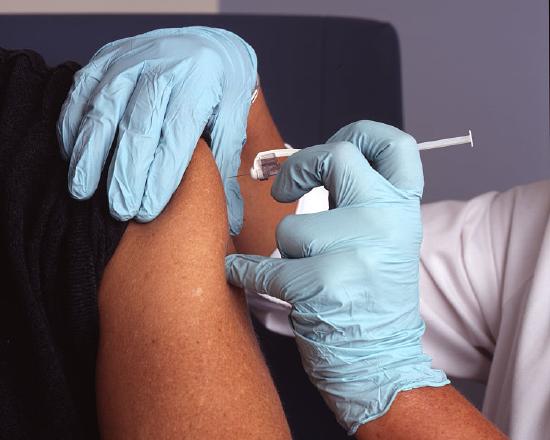
This individual in Figure \(\PageIndex{1}\) is getting a flu vaccine. You probably know that getting a vaccine can hurt, but it's usually worth it. A vaccine contains dead or altered forms of "germs" that normally cause a disease, such as flu or measles. The germs in vaccines have been inactivated or weakened so they can no longer cause illness, but they are still "noticed" by the immune system. They stimulate the immune system to produce chemicals that can kill the actual germs if they enter the body, thus preventing future disease. How was such an ingenious way to prevent disease discovered? The short answer is more than two centuries of science.
History of Biological Science
Although modern biology is a relatively recent development, sciences related to and included within it have been studied since ancient times. Natural philosophy was studied as early as the ancient civilizations of Mesopotamia, Egypt, the Indian subcontinent, and China. However, the origins of modern biology and its approach to studying nature are most often traced back to ancient Greece. In fact, "biology" is derived from the Greek word "bio" meaning "life" and the suffix "ology" meaning "study of.")
The scientific method was used in ancient times, but it was first formally documented by England’s Sir Francis Bacon (1561–1626), who established the first systematic methodology for scientific inquiry. The scientific method is not exclusively used by biologists but can be applied to almost all fields of study as a logical, rational problem-solving method. Observations in natural history and advances in microscopy have also had a profound impact on biological thinking.
In the early 19th century, several biologists emphasized the central importance of the cell, and in 1838, Schleiden and Schwann began promoting the now-universal concept of cell theory. Jean-Baptiste Lamarck was the first to present a coherent theory of evolution, although it was the British naturalist Charles Darwin who spread the theory of natural selection throughout the scientific community. In 1953, the discovery of the double-helical structure of DNA marked the transition to the era of molecular genetics.
Natural Sciences
What would you expect to see in a museum of natural sciences? Frogs? Plants? Dinosaur skeletons? Exhibits about how the brain functions? A planetarium? Gems and minerals? Or, maybe all of the above? Science includes such diverse fields as astronomy, biology, computer sciences, geology, logic, physics, chemistry, and mathematics (Figure \(\PageIndex{1}\)). However, those fields of science related to the physical world and its phenomena and processes are considered natural sciences. Thus, a museum of natural sciences might contain any of the items listed above.
There is no complete agreement on what constitutes the natural sciences, however. For some experts, the natural sciences are astronomy, biology, chemistry, earth science, and physics. Other scholars choose to divide natural sciences into life sciences, which study living things and include biology, and physical sciences, which study nonliving matter and include astronomy, geology, physics, and chemistry. Some disciplines, such as biophysics and biochemistry, draw on both life and physical sciences, making them interdisciplinary. The natural sciences often rely on the use of quantitative, or numerical, data, although some may also use qualitative, or non-numerical, data to support their findings.
Not surprisingly, the natural science of biology has many branches or subdisciplines. Cell biologists study the structure and function of cells, while biologists who study anatomy investigate the structure of an entire organism. Those biologists studying physiology, however, focus on the internal functioning of an organism. Some areas of biology focus on only particular types of living things. For example, botanists explore plants, while zoologists specialize in animals.
An example of the complexity of the science involved in human discovery science.
Question after watching: How might a team of researchers take advantage of the particular strengths of each of these techniques while overcoming their weaknesses?
Scientific Reasoning
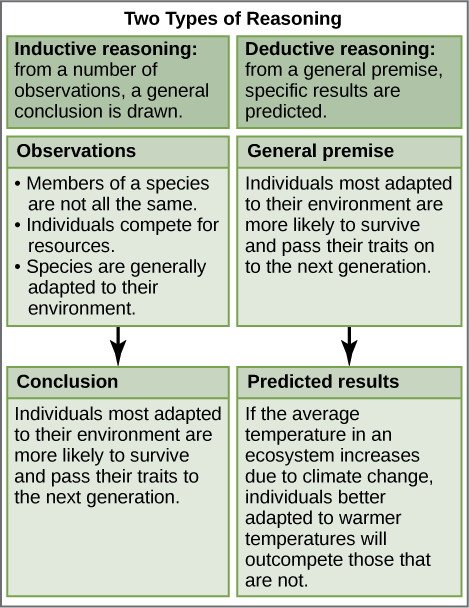
One thing is common to all forms of science: an ultimate goal “to know.” Curiosity and inquiry are the driving forces for the development of science. Scientists strive to comprehend the world and its workings. To do this, they use two methods of logical thinking: inductive reasoning and deductive reasoning (Figure \(\PageIndex{2}\)).
- Inductive reasoning is a form of logical thinking that uses related observations to arrive at a general conclusion. This type of reasoning is common in descriptive science. A life scientist, such as a biologist, makes observations and records them. These data can be qualitative or quantitative, and the raw data can be supplemented with drawings, pictures, photos, or videos. From numerous observations, scientists can infer conclusions (inductions) based on the evidence. Inductive reasoning involves formulating generalizations inferred from careful observation and the analysis of a large amount of data. Brain studies provide an example. In this type of research, many live brains are observed while people are doing a specific activity, such as viewing images of food. The part of the brain that “lights up” during this activity is then predicted to be the part controlling the response to the selected stimulus, in this case, images of food. Then, researchers can stimulate that part of the brain to see if similar responses result.
- Deductive reasoning or deduction is the type of logic used in hypothesis-based science. In deductive reasoning, the pattern of thinking moves in the opposite direction compared to inductive reasoning. Deductive reasoning is a form of logical thinking that uses a general principle or law to forecast specific results. From these general principles, a scientist can extrapolate and predict specific results that would be valid as long as the general principles remain valid. Studies in climate change can illustrate this type of reasoning. For example, scientists may predict that if the climate in a particular region becomes warmer, then the distribution of plants and animals should change. These predictions have been made and tested, and numerous such changes have been identified, including the modification of arable areas for agricultural purposes, with adjustments based on temperature averages.
Inductive and deductive reasoning are often used in tandem to advance scientific knowledge.
Many students confuse deductive reasoning with inductive reasoning, and vice versa. Learn the difference in this 3-minute video.
Question after watching: Reflect on incidents/events in your life where you applied deductive and inductive reasoning. Describe them and why they are instances of inductive and deductive reasoning.
Decide if each of the following is an example of inductive or deductive reasoning.
- All flying birds and insects have wings. Birds and insects flap their wings as they move through the air. Therefore, wings enable flight.
- Insects generally survive mild winters better than harsh ones. Therefore, insect pests will become increasingly problematic if global temperatures continue to rise.
- Chromosomes, the carriers of DNA, separate into daughter cells during cell division. Therefore, DNA is the genetic material.
- Animals as diverse as humans, insects, and wolves all exhibit social behavior. Therefore, social behavior must have an evolutionary advantage.
- Answer
-
1: inductive; 2: deductive; 3: deductive; 4: inductive.
Both types of logical thinking are related to the two main pathways of scientific study: descriptive science and hypothesis-based science.
- Descriptive (or discovery) science, which is usually inductive, aims to observe, explore, and discover.
- Hypothesis-based science, which is usually deductive, begins with a specific question or problem and a potential answer or solution that can be tested. In hypothesis-based science, specific results are predicted from a general premise.
The boundary between descriptive science and hypothesis-based science is often blurred, and most science incorporates elements of both. The fuzzy boundary becomes apparent when thinking about how easily observation can lead to specific questions. For example, a gentleman in the 1940s observed that burrs stuck to his clothes and his dog’s fur had a tiny hook structure. On observing them, he discovered that the burrs’ gripping device was more reliable than a zipper. He invented the hook-and-loop fastener popularly known today as Velcro and started a company. Descriptive science and hypothesis-based science work together to make discoveries and answer questions.
In this 5-minute video, explore how medical scientists work to answer scientific questions and the complications in building studies that involve humans.
Questions after watching: What are the important things to consider for these scientists?
The Scientific Method
Biologists study the living world by posing questions about it and seeking science-based responses. This approach is also common in other sciences and is often referred to as the scientific method. The scientific process typically starts with an observation (often a problem to be solved) that leads to a question. Think about a simple problem that starts with an observation and apply the scientific method to solve the problem. One Monday morning, a student arrives at class and quickly discovers that the classroom is too warm. That is an observation that also describes a problem: the classroom is too warm. The student then asks, “Why is the classroom so warm?” This is a testable question.
Learn about the 5 criteria that a testable question should meet in this 7.5-minute video.
Read the following questions (Q) and their associated hypothesis (H). Does the statement lend itself to investigation using the scientific method? In other words, is the hypothesis falsifiable (can be proven false)?
- (Q) Is macaroni and cheese tastier than broccoli soup? (H) Macaroni and cheese is not tastier than broccoli soup.
- (Q) Are hummingbirds attracted to the color red? (H) Hummingbirds are not attracted to the color red.
- (Q) Is the moon made out of green cheese? (H) The moon is made of green cheese.
- (Q) Is plagiarism dishonest? (H) Plagiarism is not dishonest.
- Hypotheses 1 and 2 are subjective and cannot be tested using the scientific method. Hypotheses 3 and 4 can be tested using the scientific method.
- Hypotheses 3 and 4 are subjective and cannot be tested using the scientific method. Hypotheses 1 and 2 can be tested using the scientific method.
- Hypotheses 1 and 3 are subjective and cannot be tested using the scientific method. Hypotheses 2 and 4 can be tested using the scientific method.
- Hypotheses 1 and 4 are subjective and cannot be tested using the scientific method. Hypotheses 2 and 3 can be tested using the scientific method.
- Answer
-
d. Hypotheses 1 and 4 are subjective and cannot be tested using the scientific method. Hypotheses 2 and 3 can be tested using the scientific method.
Proposing a Hypothesis
Recall that a hypothesis is a suggested explanation that can be tested. To solve a problem, several hypotheses may be proposed. For example, one hypothesis might be, “The classroom is warm because no one turned on the air conditioning.” But there could be other responses to the question, and therefore other hypotheses may be proposed. A second hypothesis might be, “The classroom is warm because there is a power failure, and so the air conditioning doesn’t work.”
Once a hypothesis has been selected, the student can make a prediction. A prediction is similar to a hypothesis, but it typically has the format “If . . . then . . . .” For example, the prediction for the first hypothesis might be, “If the student turns on the air conditioning, then the classroom will no longer be too warm.”
In this 7-minute video, learn the difference between a fact, a theory, a hypothesis, and a scientific law.
Question BEFORE and AFTER watching: How would you define hypothesis and theory?
Testing a Hypothesis
A valid hypothesis must be testable. It should also be falsifiable, meaning that it can be disproven by experimental results. Importantly, science does not claim to “prove” anything because scientific understandings are always subject to modification with further information. This step—openness to disproving ideas—is what distinguishes sciences from non-sciences. The presence of the supernatural, for instance, is neither testable nor falsifiable. To test a hypothesis, a researcher will conduct one or more experiments designed to eliminate one or more of the hypotheses.
Each experiment will have one or more variables and one or more controls.
- A variable is any part of the experiment that can vary or change during the experiment.
- The control group contains all the same conditions as the experimental group, EXCEPT for the variable being tested.
- If the results of the experimental group differ from those of the control group, the difference must be due to the manipulation, rather than to some outside factor.
- Identify the variables and controls in the examples from the section above.
Revisit the hypotheses from the section above:
- The classroom is warm because no one turned on the air conditioning.
- The classroom is warm because there is a power failure, and so the air conditioning doesn’t work.
To test the first hypothesis, the student would determine whether the air conditioning is on. If the air conditioning is turned on but does not work, there should be another reason, and this hypothesis should be rejected. To test the second hypothesis, they could check if the classroom lights are functional. If so, there is no power failure, and this hypothesis should be rejected. Each hypothesis should be tested by carrying out appropriate experiments. Be aware that rejecting one hypothesis does not determine whether or not the other hypotheses can be accepted; it simply eliminates one hypothesis that is not valid (Figure \(\PageIndex{3}\)). Using the scientific method, hypotheses inconsistent with experimental data are rejected.
While this “warm classroom” example is based on observational results, other hypotheses and experiments might have clearer controls. For instance, a student might attend class on Monday and realize they had difficulty concentrating on the lecture. One observation that might explain this occurrence is, “When I eat breakfast before class, I am better able to pay attention.” The student could then design an experiment with a control to test this hypothesis, including keeping all details of their morning the same but eating breakfast one day versus another to see how their attention holds in class.
Drawing Conclusions
If the evidence of an experiment indicates that the hypothesis is supported, does this mean that the hypothesis is true? No, not necessarily. That's because a hypothesis can never be proven conclusively to be true. Scientists can never examine all possible evidence, and someday evidence may be found that disproves the hypothesis. In addition, other hypotheses, as yet unformed, may be supported by the same evidence. For example, something else, introduced unknowingly to the experiment, might be responsible for the outcome. Although a hypothesis cannot be proven true without a shadow of a doubt, the more evidence that supports a hypothesis, the more likely the hypothesis is to be correct. Similarly, the better the match between actual observations and expected observations, the more likely it is that a hypothesis is true.
Many times, competing hypotheses are supported by evidence. When that occurs, how do scientists conclude which hypothesis is better? Several criteria can be used to evaluate competing hypotheses. For example, scientists are more likely to accept a hypothesis that:
- explains a wider variety of observations.
- explains observations that were previously unexplained.
- generates more expectations and is thus more testable.
- is more consistent with well-established theories.
- is more parsimonious, that is, it is a simpler and less convoluted explanation.
Communicating Results
The last step in a scientific investigation is communicating the results to other scientists. This is a crucial step because it enables other scientists to attempt to replicate the investigation and verify if they can obtain the same results. If other researchers get the same results, it adds support to the hypothesis. If they get different results, it may disprove the hypothesis. When scientists communicate their results, they should clearly describe their methods and highlight any potential issues or limitations with the investigation. This allows other researchers to identify any flaws in the method or consider ways to avoid potential problems in future studies.
Repeating a scientific investigation and reproducing the same results is called replication. It is a cornerstone of scientific research. Replication is not required for every investigation in science, but it is highly recommended for those that produce surprising or particularly consequential results. In some scientific fields, scientists routinely attempt to replicate their own investigations to ensure the reproducibility of their results before communicating them.
Scientists can communicate their results in various ways. The most rigorous way is to write up the investigation and results in the form of an article and submit it to a peer-reviewed scientific journal for publication. The journal's editor provides copies of the article to several other scientists working in the same field. These are the peers in the peer-review process. The reviewers study the article and inform the editor whether they believe it should be published, based on the validity of the methods and the significance of the study. The article may be rejected outright, or it may be accepted, either as is or with revisions. Only articles that meet high scientific standards are ultimately published.
In the example above, the scientific method is employed to solve a common everyday problem. Order the scientific method steps (numbered items) with the process of solving the everyday problem (lettered items). Based on the experiment's results, is the hypothesis correct? If it is incorrect, propose some alternative hypotheses.
- Observation
- Question
- Hypothesis (answer)
- Prediction
- Experiment
- Result
- There is something wrong with the electrical outlet.
- If something is wrong with the outlet, my coffeemaker also won’t work when plugged into it.
- My toaster doesn’t toast my bread.
- I plug my coffee maker into the outlet.
- My coffeemaker works.
- Why doesn’t my toaster work?
- Answer
-
1: C; 2: F; 3: A; 4: B; 5: D; 6: E. The original hypothesis is incorrect, as the coffeemaker works when plugged into the outlet. Alternative hypotheses include that the toaster might be broken or that the toaster wasn't turned on.