

19.2: Introduction to the Endocrine System
- Page ID
- 92665

\( \newcommand{\vecs}[1]{\overset { \scriptstyle \rightharpoonup} {\mathbf{#1}} } \)
\( \newcommand{\vecd}[1]{\overset{-\!-\!\rightharpoonup}{\vphantom{a}\smash {#1}}} \)
\( \newcommand{\dsum}{\displaystyle\sum\limits} \)
\( \newcommand{\dint}{\displaystyle\int\limits} \)
\( \newcommand{\dlim}{\displaystyle\lim\limits} \)
\( \newcommand{\id}{\mathrm{id}}\) \( \newcommand{\Span}{\mathrm{span}}\)
( \newcommand{\kernel}{\mathrm{null}\,}\) \( \newcommand{\range}{\mathrm{range}\,}\)
\( \newcommand{\RealPart}{\mathrm{Re}}\) \( \newcommand{\ImaginaryPart}{\mathrm{Im}}\)
\( \newcommand{\Argument}{\mathrm{Arg}}\) \( \newcommand{\norm}[1]{\| #1 \|}\)
\( \newcommand{\inner}[2]{\langle #1, #2 \rangle}\)
\( \newcommand{\Span}{\mathrm{span}}\)
\( \newcommand{\id}{\mathrm{id}}\)
\( \newcommand{\Span}{\mathrm{span}}\)
\( \newcommand{\kernel}{\mathrm{null}\,}\)
\( \newcommand{\range}{\mathrm{range}\,}\)
\( \newcommand{\RealPart}{\mathrm{Re}}\)
\( \newcommand{\ImaginaryPart}{\mathrm{Im}}\)
\( \newcommand{\Argument}{\mathrm{Arg}}\)
\( \newcommand{\norm}[1]{\| #1 \|}\)
\( \newcommand{\inner}[2]{\langle #1, #2 \rangle}\)
\( \newcommand{\Span}{\mathrm{span}}\) \( \newcommand{\AA}{\unicode[.8,0]{x212B}}\)
\( \newcommand{\vectorA}[1]{\vec{#1}} % arrow\)
\( \newcommand{\vectorAt}[1]{\vec{\text{#1}}} % arrow\)
\( \newcommand{\vectorB}[1]{\overset { \scriptstyle \rightharpoonup} {\mathbf{#1}} } \)
\( \newcommand{\vectorC}[1]{\textbf{#1}} \)
\( \newcommand{\vectorD}[1]{\overrightarrow{#1}} \)
\( \newcommand{\vectorDt}[1]{\overrightarrow{\text{#1}}} \)
\( \newcommand{\vectE}[1]{\overset{-\!-\!\rightharpoonup}{\vphantom{a}\smash{\mathbf {#1}}}} \)
\( \newcommand{\vecs}[1]{\overset { \scriptstyle \rightharpoonup} {\mathbf{#1}} } \)
\(\newcommand{\longvect}{\overrightarrow}\)
\( \newcommand{\vecd}[1]{\overset{-\!-\!\rightharpoonup}{\vphantom{a}\smash {#1}}} \)
\(\newcommand{\avec}{\mathbf a}\) \(\newcommand{\bvec}{\mathbf b}\) \(\newcommand{\cvec}{\mathbf c}\) \(\newcommand{\dvec}{\mathbf d}\) \(\newcommand{\dtil}{\widetilde{\mathbf d}}\) \(\newcommand{\evec}{\mathbf e}\) \(\newcommand{\fvec}{\mathbf f}\) \(\newcommand{\nvec}{\mathbf n}\) \(\newcommand{\pvec}{\mathbf p}\) \(\newcommand{\qvec}{\mathbf q}\) \(\newcommand{\svec}{\mathbf s}\) \(\newcommand{\tvec}{\mathbf t}\) \(\newcommand{\uvec}{\mathbf u}\) \(\newcommand{\vvec}{\mathbf v}\) \(\newcommand{\wvec}{\mathbf w}\) \(\newcommand{\xvec}{\mathbf x}\) \(\newcommand{\yvec}{\mathbf y}\) \(\newcommand{\zvec}{\mathbf z}\) \(\newcommand{\rvec}{\mathbf r}\) \(\newcommand{\mvec}{\mathbf m}\) \(\newcommand{\zerovec}{\mathbf 0}\) \(\newcommand{\onevec}{\mathbf 1}\) \(\newcommand{\real}{\mathbb R}\) \(\newcommand{\twovec}[2]{\left[\begin{array}{r}#1 \\ #2 \end{array}\right]}\) \(\newcommand{\ctwovec}[2]{\left[\begin{array}{c}#1 \\ #2 \end{array}\right]}\) \(\newcommand{\threevec}[3]{\left[\begin{array}{r}#1 \\ #2 \\ #3 \end{array}\right]}\) \(\newcommand{\cthreevec}[3]{\left[\begin{array}{c}#1 \\ #2 \\ #3 \end{array}\right]}\) \(\newcommand{\fourvec}[4]{\left[\begin{array}{r}#1 \\ #2 \\ #3 \\ #4 \end{array}\right]}\) \(\newcommand{\cfourvec}[4]{\left[\begin{array}{c}#1 \\ #2 \\ #3 \\ #4 \end{array}\right]}\) \(\newcommand{\fivevec}[5]{\left[\begin{array}{r}#1 \\ #2 \\ #3 \\ #4 \\ #5 \\ \end{array}\right]}\) \(\newcommand{\cfivevec}[5]{\left[\begin{array}{c}#1 \\ #2 \\ #3 \\ #4 \\ #5 \\ \end{array}\right]}\) \(\newcommand{\mattwo}[4]{\left[\begin{array}{rr}#1 \amp #2 \\ #3 \amp #4 \\ \end{array}\right]}\) \(\newcommand{\laspan}[1]{\text{Span}\{#1\}}\) \(\newcommand{\bcal}{\cal B}\) \(\newcommand{\ccal}{\cal C}\) \(\newcommand{\scal}{\cal S}\) \(\newcommand{\wcal}{\cal W}\) \(\newcommand{\ecal}{\cal E}\) \(\newcommand{\coords}[2]{\left\{#1\right\}_{#2}}\) \(\newcommand{\gray}[1]{\color{gray}{#1}}\) \(\newcommand{\lgray}[1]{\color{lightgray}{#1}}\) \(\newcommand{\rank}{\operatorname{rank}}\) \(\newcommand{\row}{\text{Row}}\) \(\newcommand{\col}{\text{Col}}\) \(\renewcommand{\row}{\text{Row}}\) \(\newcommand{\nul}{\text{Nul}}\) \(\newcommand{\var}{\text{Var}}\) \(\newcommand{\corr}{\text{corr}}\) \(\newcommand{\len}[1]{\left|#1\right|}\) \(\newcommand{\bbar}{\overline{\bvec}}\) \(\newcommand{\bhat}{\widehat{\bvec}}\) \(\newcommand{\bperp}{\bvec^\perp}\) \(\newcommand{\xhat}{\widehat{\xvec}}\) \(\newcommand{\vhat}{\widehat{\vvec}}\) \(\newcommand{\uhat}{\widehat{\uvec}}\) \(\newcommand{\what}{\widehat{\wvec}}\) \(\newcommand{\Sighat}{\widehat{\Sigma}}\) \(\newcommand{\lt}{<}\) \(\newcommand{\gt}{>}\) \(\newcommand{\amp}{&}\) \(\definecolor{fillinmathshade}{gray}{0.9}\)The image below identifies some of the symptoms that might be seen in someone with Cushing’s Syndrome (Figure \(\PageIndex{1}\)).
What causes so many different symptoms in one patient? The answer is overproduction of cortisol, a hormone produced by the endocrine system.
.svg.png?revision=1)
Overview of the Endocrine System
The endocrine system is a network of glands that release chemical messenger molecules called hormones into the bloodstream. Other glands of the body, including sweat glands and salivary glands, also secrete substances, but not into the bloodstream. Instead, they secrete them through ducts that carry them to nearby body surfaces. These other glands are called exocrine glands.
Endocrine hormones must travel through the bloodstream to the cells they affect, and this takes time. Because endocrine hormones are released into the bloodstream, they travel throughout the body wherever blood flows. As a result, endocrine hormones may affect many cells and have body-wide effects. Endocrine hormones may cause effects that last for days, weeks, or even months.
Over our lifetimes, our bodies undergo a series of extraordinary metamorphoses: we grow, experience puberty, and many of us reproduce. Behind the scenes, the endocrine system constantly orchestrates these changes. Emma Bryce explains how this system regulates everything from your sleep to the rhythm of your beating heart, exerting its influence over each and every one of your cells.
Major Glands of the Endocrine System
The major glands of the endocrine system are described briefly in the rest of this section (Figure \(\PageIndex{2}\)).

Pituitary Gland
The pituitary gland is located at the base of the brain. It is connected to and controlled by the nervous system via the hypothalamus.
The pituitary gland consists of two lobes, called the anterior (front) lobe and posterior (back) lobe.
- The posterior lobe stores and secretes hormones synthesized by the hypothalamus.
- The anterior lobe synthesizes and secretes its own endocrine hormones under the influence of the hypothalamus.
One endocrine hormone secreted by the pituitary gland is growth hormone, which stimulates cells throughout the body to synthesize proteins and divide.
Most of the other endocrine hormones secreted by the pituitary gland control other endocrine glands. Generally, these hormones direct the other glands to secrete either more or less of their hormones. This is why the pituitary gland is often referred to as the “master gland” of the endocrine system.
Remaining Glands of the Endocrine System
Each of the other endocrine glands is summarized below, and some are discussed in greater detail in the following sections of this text.
- The thyroid gland is a large gland in the neck.
- Thyroid hormones, such as thyroxine, increase cellular metabolism throughout the body.
- They control how quickly cells use energy and make proteins.
- The four parathyroid glands are located in the neck behind the thyroid gland.
- Parathyroid hormone (PTH) helps maintain blood calcium levels within a narrow range.
- It may stimulate bone cells to dissolve calcium and release it into the blood.
- The pineal gland is a tiny gland located near the center of the brain.
- It secretes the hormone melatonin, which controls the sleep-wake cycle and several other processes. Melatonin production is stimulated by darkness and inhibited by light.
- Cells in the retina of the eye detect light and send signals to a structure in the brain named the suprachiasmatic nucleus (SCN). Nerve fibers carry the signals from the SCN to the pineal gland via the autonomic nervous system.
- The pancreas is located near the stomach.
- Endocrine hormones of the pancreas include insulin and glucagon, which work together to regulate blood glucose levels.
- The pancreas also secretes digestive enzymes into the small intestine.
- One adrenal gland is located above each kidney.
- The adrenal glands secrete several hormones, including adrenaline, which is involved in the fight-or-flight response.
- Other endocrine hormones secreted by the adrenal glands have a variety of functions.
- For example, the hormone aldosterone helps regulate the body's mineral balance.
- Cortisol, which causes Cushing's syndrome when produced in excess, is also an adrenal gland hormone.
- The gonads include the ovaries in females and the testes in males.
- These secrete sex hormones, such as testosterone (in males) and estrogen (in females).
- Sex hormones control sexual maturation during puberty and the production of gametes (sperm or egg cells) by the gonads after sexual maturation.
- The thymus gland is located in front of the heart.
- It is large relative to the body in newborns and becomes relatively smaller with development
- Immune system cells called T cells mature in the thymus.
- T cells are critical to the adaptive immune system, which enables the body to adapt to specific pathogens.
Endocrine System Disorders (Generalized)
Disorders of the endocrine system are relatively common.
An endocrine system disorder usually involves the secretion of either too much or too little of a hormone.
- When too much hormone is secreted, the condition is called hypersecretion.
- When not enough hormone is secreted, the condition is called hyposecretion.
Other disorders can occur when the body's cells are unresponsive to a hormone secreted by an endocrine gland, known as hormone insensitivity.
Hypersecretion
Hypersecretion by an endocrine gland is often caused by a tumor. For example, a pituitary tumor can cause hypersecretion of growth hormone. If this occurs in childhood and goes untreated, it results in very long arms and legs and an abnormally tall stature by adulthood. This condition is commonly known as gigantism.
Anna Haining Swan (1846-1888) was born in Nova Scotia to an average-sized family of 13 brothers and sisters. She was normal in size at birth but began to grow very rapidly. By the age of 5, she was nearly 5 feet tall, presumably due to hypersecretion of growth hormone. At 16, PT Barnum had recruited her and her mother to move to New York as a 'living exhibit' for $1000 per month and continued education, especially in her passions of literature, theater, and music.
By age 18, Anna reached 7 feet 11 inches tall. Her highest weight was 450 pounds. At the age of 25, on a tour of Europe, she met Martin Van Buren Bates, a former Confederate soldier in the US Civil War known as the “Kentucky giant” (Bates was 7 feet 9 inches tall).
They married in 1871 and had two children. Both newborns were very large: their firstborn, a daughter, weighed 18 pounds and died at birth; their second, a son, weighed over 23 pounds and was 28 inches long at birth. He died shortly after.
Having retired and built a life with Bates in Ohio, Anna spent her time on their farm. She died in her sleep of heart failure, a few days before her 42nd birthday, without knowing the cause of her gigantism.
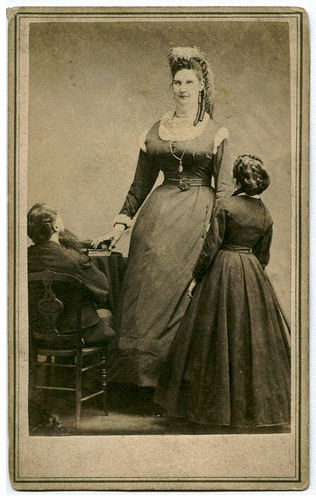
Figure \(\PageIndex{3}\): Anna Swan by Unknown CC0
Hyposecretion
Hyposecretion by an endocrine gland is often caused by the destruction of the hormone-secreting cells of the gland. As a result, not enough of the hormone is secreted. An example of this is Type 1 diabetes, in which the body’s own immune system attacks and destroys cells of the pancreas that secrete insulin. This type of diabetes is generally treated with frequent injections of insulin.
Hormone Insensitivity
In some cases, an endocrine gland secretes a normal amount of hormone, but target cells do not respond normally to it. This may occur because target cells have become resistant to the hormone. An example of this type of endocrine disorder is Androgen Insensitivity Disorder.
Individuals with this disorder are born with an X and Y chromosome but develop and are raised as females. This is due to a mutation in the Androgen Receptor (AR) gene on the X chromosome. Testosterone is an androgen hormone that causes testes to descend and typical male characteristics to develop.
People with this form of the condition have the external female secondary sexual characteristics but do not have a uterus or ovaries. Therefore, they do not menstruate and are unable to conceive a child (infertile). They typically have male internal sex organs (testes) located in the pelvis or abdomen (undescended).
Families often raise children with Androgen Insensitivity Disorder as girls. As individuals develop their sense of self, they may identify as women or men, as others in the population.
Emily Quinn is an artist and activist. In this video, she talks about the hardship that she experienced while growing up as an individual with Androgen Insensitivity Syndrome.