

1.4: Scientific Investigations
- Page ID
- 92562

\( \newcommand{\vecs}[1]{\overset { \scriptstyle \rightharpoonup} {\mathbf{#1}} } \)
\( \newcommand{\vecd}[1]{\overset{-\!-\!\rightharpoonup}{\vphantom{a}\smash {#1}}} \)
\( \newcommand{\dsum}{\displaystyle\sum\limits} \)
\( \newcommand{\dint}{\displaystyle\int\limits} \)
\( \newcommand{\dlim}{\displaystyle\lim\limits} \)
\( \newcommand{\id}{\mathrm{id}}\) \( \newcommand{\Span}{\mathrm{span}}\)
( \newcommand{\kernel}{\mathrm{null}\,}\) \( \newcommand{\range}{\mathrm{range}\,}\)
\( \newcommand{\RealPart}{\mathrm{Re}}\) \( \newcommand{\ImaginaryPart}{\mathrm{Im}}\)
\( \newcommand{\Argument}{\mathrm{Arg}}\) \( \newcommand{\norm}[1]{\| #1 \|}\)
\( \newcommand{\inner}[2]{\langle #1, #2 \rangle}\)
\( \newcommand{\Span}{\mathrm{span}}\)
\( \newcommand{\id}{\mathrm{id}}\)
\( \newcommand{\Span}{\mathrm{span}}\)
\( \newcommand{\kernel}{\mathrm{null}\,}\)
\( \newcommand{\range}{\mathrm{range}\,}\)
\( \newcommand{\RealPart}{\mathrm{Re}}\)
\( \newcommand{\ImaginaryPart}{\mathrm{Im}}\)
\( \newcommand{\Argument}{\mathrm{Arg}}\)
\( \newcommand{\norm}[1]{\| #1 \|}\)
\( \newcommand{\inner}[2]{\langle #1, #2 \rangle}\)
\( \newcommand{\Span}{\mathrm{span}}\) \( \newcommand{\AA}{\unicode[.8,0]{x212B}}\)
\( \newcommand{\vectorA}[1]{\vec{#1}} % arrow\)
\( \newcommand{\vectorAt}[1]{\vec{\text{#1}}} % arrow\)
\( \newcommand{\vectorB}[1]{\overset { \scriptstyle \rightharpoonup} {\mathbf{#1}} } \)
\( \newcommand{\vectorC}[1]{\textbf{#1}} \)
\( \newcommand{\vectorD}[1]{\overrightarrow{#1}} \)
\( \newcommand{\vectorDt}[1]{\overrightarrow{\text{#1}}} \)
\( \newcommand{\vectE}[1]{\overset{-\!-\!\rightharpoonup}{\vphantom{a}\smash{\mathbf {#1}}}} \)
\( \newcommand{\vecs}[1]{\overset { \scriptstyle \rightharpoonup} {\mathbf{#1}} } \)
\(\newcommand{\longvect}{\overrightarrow}\)
\( \newcommand{\vecd}[1]{\overset{-\!-\!\rightharpoonup}{\vphantom{a}\smash {#1}}} \)
\(\newcommand{\avec}{\mathbf a}\) \(\newcommand{\bvec}{\mathbf b}\) \(\newcommand{\cvec}{\mathbf c}\) \(\newcommand{\dvec}{\mathbf d}\) \(\newcommand{\dtil}{\widetilde{\mathbf d}}\) \(\newcommand{\evec}{\mathbf e}\) \(\newcommand{\fvec}{\mathbf f}\) \(\newcommand{\nvec}{\mathbf n}\) \(\newcommand{\pvec}{\mathbf p}\) \(\newcommand{\qvec}{\mathbf q}\) \(\newcommand{\svec}{\mathbf s}\) \(\newcommand{\tvec}{\mathbf t}\) \(\newcommand{\uvec}{\mathbf u}\) \(\newcommand{\vvec}{\mathbf v}\) \(\newcommand{\wvec}{\mathbf w}\) \(\newcommand{\xvec}{\mathbf x}\) \(\newcommand{\yvec}{\mathbf y}\) \(\newcommand{\zvec}{\mathbf z}\) \(\newcommand{\rvec}{\mathbf r}\) \(\newcommand{\mvec}{\mathbf m}\) \(\newcommand{\zerovec}{\mathbf 0}\) \(\newcommand{\onevec}{\mathbf 1}\) \(\newcommand{\real}{\mathbb R}\) \(\newcommand{\twovec}[2]{\left[\begin{array}{r}#1 \\ #2 \end{array}\right]}\) \(\newcommand{\ctwovec}[2]{\left[\begin{array}{c}#1 \\ #2 \end{array}\right]}\) \(\newcommand{\threevec}[3]{\left[\begin{array}{r}#1 \\ #2 \\ #3 \end{array}\right]}\) \(\newcommand{\cthreevec}[3]{\left[\begin{array}{c}#1 \\ #2 \\ #3 \end{array}\right]}\) \(\newcommand{\fourvec}[4]{\left[\begin{array}{r}#1 \\ #2 \\ #3 \\ #4 \end{array}\right]}\) \(\newcommand{\cfourvec}[4]{\left[\begin{array}{c}#1 \\ #2 \\ #3 \\ #4 \end{array}\right]}\) \(\newcommand{\fivevec}[5]{\left[\begin{array}{r}#1 \\ #2 \\ #3 \\ #4 \\ #5 \\ \end{array}\right]}\) \(\newcommand{\cfivevec}[5]{\left[\begin{array}{c}#1 \\ #2 \\ #3 \\ #4 \\ #5 \\ \end{array}\right]}\) \(\newcommand{\mattwo}[4]{\left[\begin{array}{rr}#1 \amp #2 \\ #3 \amp #4 \\ \end{array}\right]}\) \(\newcommand{\laspan}[1]{\text{Span}\{#1\}}\) \(\newcommand{\bcal}{\cal B}\) \(\newcommand{\ccal}{\cal C}\) \(\newcommand{\scal}{\cal S}\) \(\newcommand{\wcal}{\cal W}\) \(\newcommand{\ecal}{\cal E}\) \(\newcommand{\coords}[2]{\left\{#1\right\}_{#2}}\) \(\newcommand{\gray}[1]{\color{gray}{#1}}\) \(\newcommand{\lgray}[1]{\color{lightgray}{#1}}\) \(\newcommand{\rank}{\operatorname{rank}}\) \(\newcommand{\row}{\text{Row}}\) \(\newcommand{\col}{\text{Col}}\) \(\renewcommand{\row}{\text{Row}}\) \(\newcommand{\nul}{\text{Nul}}\) \(\newcommand{\var}{\text{Var}}\) \(\newcommand{\corr}{\text{corr}}\) \(\newcommand{\len}[1]{\left|#1\right|}\) \(\newcommand{\bbar}{\overline{\bvec}}\) \(\newcommand{\bhat}{\widehat{\bvec}}\) \(\newcommand{\bperp}{\bvec^\perp}\) \(\newcommand{\xhat}{\widehat{\xvec}}\) \(\newcommand{\vhat}{\widehat{\vvec}}\) \(\newcommand{\uhat}{\widehat{\uvec}}\) \(\newcommand{\what}{\widehat{\wvec}}\) \(\newcommand{\Sighat}{\widehat{\Sigma}}\) \(\newcommand{\lt}{<}\) \(\newcommand{\gt}{>}\) \(\newcommand{\amp}{&}\) \(\definecolor{fillinmathshade}{gray}{0.9}\)"Doing" Science
Science is more about doing than knowing. Scientists are always trying to learn more and gain a better understanding of the natural world. There are basic methods of gaining knowledge that are common to all of science. At the heart of science is the scientific investigation. A scientific investigation is a plan for asking questions and testing possible answers in order to advance scientific knowledge.
Figure \(\PageIndex{2}\) outlines the steps of the scientific method. Science textbooks often present this simple, linear "recipe" for a scientific investigation. This is an oversimplification of how science is actually done, but it does highlight the basic plan and purpose of any scientific investigation: testing ideas with evidence. We will use this flowchart to help explain the overall format for scientific inquiry.

The scientific method may seem too rigid and structured (Figure \(\PageIndex{1}\)). It is essential to note that, although scientists often follow this sequence, there is some flexibility in the approach. In fact, the scientific process is much more complex in practice. Sometimes an experiment leads to conclusions that favor a change in approach; often, it raises entirely new scientific questions.
Often, science does not operate in a linear fashion; instead, scientists continually draw inferences and make generalizations, identifying patterns as their research progresses. Scientific reasoning is more complex than the scientific method alone suggests (Figure \(\PageIndex{2}\)). Notice, too, that the scientific method can be applied to solving problems that are not necessarily scientific in nature.
In fact, knowing how scientists really conduct science can help you in your everyday life, even if you are not a scientist. Some steps of the scientific process — such as asking questions and evaluating evidence — can be applied to answering real-life questions and solving practical problems.

Figure \(\PageIndex{2}\): A realistic view of the scientific method. CC-BY-ND-SA 4.0 © University of California Museum of Paleontology, Understanding Science, www.understandingscience.org CC-BY-ND-SA 4.0
Dr. Sammy reviews the scientific process.
Questions after watching:
After reading the previous chapters in the Unit and the section above, what had you not considered before?
Making Observations
A scientific investigation typically begins with observations. An observation is anything detected through the human senses or with instruments and measuring devices that enhance them. We usually think of observations as things we see with our eyes, but we can also make observations with our sense of touch, smell, taste, or hearing. In addition, we can extend and improve our own senses with instruments such as thermometers and microscopes. Other instruments can detect phenomena the human senses cannot, such as ultraviolet light or radio waves.
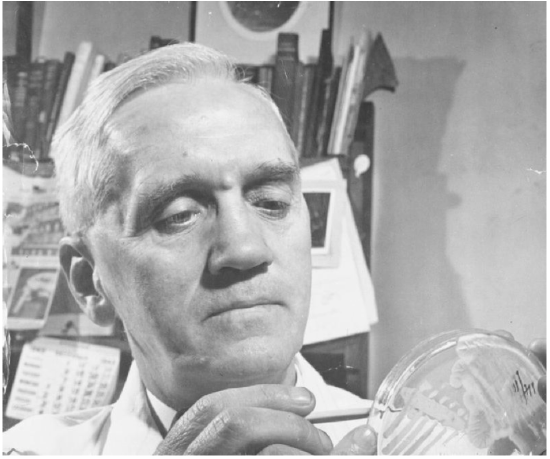
Sometimes chance observations lead to important scientific discoveries. One such observation was made by the Scottish biologist Alexander Fleming (Figure \(\PageIndex{3}\)) in the 1920s. Fleming's name may sound familiar to you because he is famous for the discovery in question. Fleming had been growing a certain type of bacteria on glass plates in his lab when he noticed that one plate had been contaminated with mold. On closer examination, Fleming observed that the area around the mold was free of bacteria.
Asking Questions
Observations often lead to interesting questions, and having scientific training and knowledge is also useful.
Relevant background knowledge and logical thinking help make sense of observations, enabling the observer to formulate particularly relevant questions. Fleming, for example, wondered whether the mold — or some substance it produced — had killed bacteria on the plate. Fortunately for us, Fleming did not just throw the mold-contaminated plate away. Instead, he investigated his question and, in so doing, discovered the antibiotic penicillin.
Hypothesis Formation
To find the answer to a question, the next step is to generate a hypothesis, or a possible answer to a scientific question. A hypothesis must be:
- based on scientific knowledge
- be logical
- relatively simple
- designed to be testable and falsifiable
- it must be possible to test the hypothesis and produce evidence for or against it (testable)
- it must be possible to make observations that would disprove the hypothesis if it really is false (falsifiable)
Fleming's hypothesis might have been: "Mold negatively affects bacteria." Based on the criteria above, is this a good and useful hypothesis?
The hypothesis is logical and based directly on observations. The hypothesis is also simple, involving just one type of mold and bacteria growing on a glass plate. This makes it easy to test. In addition, the hypothesis is falsifiable. If bacteria were to grow in the presence of the mold, it would disprove the hypothesis if it were really false.
A hypothesis is different than a prediction. A prediction is in the form of an if-then statement: if the hypothesis is true, then B will happen to the dependent variable.
Fleming's prediction might have been: "If a certain type of mold is introduced to a particular kind of bacteria growing on a plate, the bacteria will die." Predictions can help guide the development of a hypothesis test.
Hypothesis Testing - Experimentation
How would Fleming test his hypothesis? He would gather relevant data as evidence.
- Evidence is any data gathered that supports or refutes a hypothesis during testing.
- Data (singular, datum) are essentially just observations.
- The observations may be measurements from an experiment or simply things the researcher notices.
- Data that can be expressed numerically are called quantitative data.
- Data expressed in words, such as present or absent, are called qualitative data.
Testing a hypothesis involves using the data to answer two basic questions:
- If my hypothesis is true, what would I expect to observe?
- Does what I actually observe match what was predicted?
A hypothesis is supported if the actual observations (data) match the expected observations.
A hypothesis is refuted if the actual observations differ from the expected observations.
To test his hypothesis that mold kills bacteria, Fleming grew bacterial colonies on several glass plates and introduced mold to only some of them. He subjected all of the plates to the same conditions except for the introduction of mold. Any differences in the growth of bacteria on the two groups of plates could then be reasonably attributed to the presence/absence of mold. Fleming's data might have included actual measurements of bacterial colony size, as shown in the data table below, or they might have been just an indication of the presence or absence of bacteria growing near the mold.
| Bacterial Plate Identification Number | Introduction of Mold to Plate? | Total Area of Bacterial Growth on Plate after 1 Week (mm2) |
|---|---|---|
| 1 | yes | 48 |
| 2 | yes | 57 |
| 3 | yes | 54 |
| 4 | yes | 59 |
| 5 | yes | 62 |
| 6 | no | 66 |
| 7 | no | 75 |
| 8 | no | 71 |
| 9 | no | 69 |
| 10 | no | 68 |
Analyzing and Interpreting Data
The data scientists gather in their investigations are raw data. These are the actual measurements or other observations made during an investigation, such as the bacterial growth measurements shown in the data table above. Raw data usually must be analyzed and interpreted before they become evidence to test a hypothesis. To make sense of raw data and determine whether it supports a hypothesis, scientists generally use statistics.
There are two basic types of statistics: descriptive and inferential. Both types are important in scientific investigations.
- Descriptive statistics describe and summarize the data. They include values such as the mean (average) of the data. Descriptive statistics make it easier to use and discuss the data, as well as to spot trends or patterns.
- Inferential statistics help interpret data to test hypotheses. They determine how likely it is that the actual results obtained in an investigation occurred just by chance rather than for the reason posited by the hypothesis. For example, if inferential statistics show that the results of an investigation would happen by chance only 5 percent of the time, then the hypothesis has a 95 percent chance of being correctly supported by the results.
Assume that Fleming obtained the raw data shown in the data table above. We could use a descriptive statistic, such as the mean bacterial growth area, to summarize the raw data. Based on these data, the mean bacterial growth area for plates with mold is 56 mm2, and for plates without mold, it is 69 mm2.
Is this difference in bacterial growth significant?
In other words, does it provide convincing evidence that bacteria are killed by the mold or something produced by the mold? Or could the difference in mean values between the two groups of plates be due to chance alone?
What is the likelihood that this outcome could have occurred even if mold or one of its products does not kill bacteria?
One of the inferential tests that could be done to answer these questions is a t-test. The p-value for the t-test analysis of the data above is less than 0.05. This means that one can say with 95% confidence that the means of the above data are statistically different.
Drawing Conclusions
A statistical analysis of Fleming's evidence showed that it did indeed support his hypothesis. Does this mean that the hypothesis is true? No, not necessarily. That's because a hypothesis can never be conclusively proven true. Scientists can never examine all of the possible evidence, and someday evidence might be found that disproves the hypothesis. In addition, other hypotheses, as yet unformed, may be supported by the same evidence.
For example, in Fleming's investigation, something else introduced onto the plates along with the mold might have been responsible for killing the bacteria. Although a hypothesis cannot be proven true without a shadow of a doubt, the more evidence that supports a hypothesis, the more likely the hypothesis is to be correct. Similarly, the better the match between actual observations and expected observations, the more likely a hypothesis is to be true.
Many times, competing hypotheses are supported by evidence. When that occurs, how do scientists conclude which hypothesis is better? There are several criteria that may be used to judge competing hypotheses. For example, scientists are more likely to accept a hypothesis that:
- explains a wider variety of observations.
- explains observations that were previously unexplained.
- generates more expectations and is thus more testable.
- is more consistent with well-established theories.
- is more parsimonious (a simpler, less convoluted explanation).
Reporting Scientific Work
Whether scientific research is basic or applied, scientists must share their findings so that other researchers can build on and expand their discoveries. Collaboration with other scientists—when planning, conducting, and analyzing results—is all-important for scientific research. For this reason, important aspects of a scientist’s work are communicating with peers and disseminating results to peers. Scientists can share results by presenting them at a scientific meeting or conference, but this approach can reach only the select few who are present. Instead, most scientists present their results in peer-reviewed manuscripts that are published in scientific journals. Peer-reviewed manuscripts are scientific papers that are reviewed by a scientist’s colleagues, or peers. These colleagues are qualified individuals, often experts in the same research area, who assess whether the scientist’s work is suitable for publication. The peer review process helps ensure that the research described in a scientific paper or grant proposal is original, significant, logical, and thorough. Grant proposals, which are requests for research funding, are also subject to peer review. Scientists publish their work so other scientists can reproduce their experiments under similar or different conditions to expand on the findings. The experimental results must be consistent with the findings of other scientists.
A scientific paper is very different from creative writing. Although creativity is required to design experiments, there are fixed guidelines for presenting scientific results. First, scientific writing should be concise and accurate. A scientific paper needs to be concise yet detailed enough to enable peers to reproduce the experiments.
The scientific paper consists of several specific sections: introduction, materials and methods, results, and discussion. This structure is sometimes referred to as the “IMRaD” format. There are usually an acknowledgment and a reference section, as well as an abstract (a concise summary), at the beginning of the paper. Papers include a statement of ethics and any conflicts of interest. There may be additional sections depending on the type of paper and the journal where it will be published; for example, some review papers require an outline and supplementary material such as the raw data.
- Introduction: begins with brief yet comprehensive background information on what is currently known in the field. A good introduction also provides the rationale for the work, justifies the methods employed, and presents the hypothesis or research question that drives the research. The introduction may also briefly mention the paper's results. The introduction cites published scientific work and therefore requires citations in the journal's style. Using the work or ideas of others without proper citation is considered plagiarism.
- Materials and Methods: provides a comprehensive and accurate description of the substances used and the methods and techniques employed by the researchers to collect data. The description should be thorough enough to allow another researcher to repeat the experiment and obtain similar results, but it does not have to be verbose. This section will also include information on how measurements were made and the types of calculations and statistical analyses used to examine the raw data. Although the Materials and Methods section provides an accurate description of the experiments, it does not discuss the experiments themselves.
- Results and Discussion (sometimes combined): results simply narrate the findings without further interpretation, presented in tables or graphs, but without duplicate information. Discussions include interpretations of the results, descriptions of how variables may be related, and explanations of the observations. Also included are any potential complications that may have occurred. Citations of the extensive literature of previously published, relevant, scientific research are included in this section as well.
- Conclusions: used to summarize the importance of the experimental findings. These are often included in the Discussion. The paper almost certainly answered one or more of the stated scientific questions, but any good research should lead to more questions. These questions are included in the Conclusions.
Review articles do not follow the IMRaD format because they do not present original scientific findings or primary literature; instead, they summarize and comment on published primary literature, typically with extensive reference sections. They follow specific methods of searching and summarizing the scientific literature to ensure that their findings are reproducible.
This 4-minute video provides an overview of primary versus secondary sources in biology
Question after watching: Have you read a primary source before? Where might you find primary sources in biology?
Science and Culture
From the United Nations Educational, Scientific and Cultural Organization (UNESCO):
"Science is the greatest collective endeavor. It contributes to ensuring a longer and healthier life, monitors our health, provides medicine to cure our diseases, alleviates aches and pains, helps us to provide water for our basic needs – including our food, provides energy and makes life more fun, including sports, music, entertainment and the latest communication technology. Last but not least, it nourishes our spirit.
Science generates solutions for everyday life and helps us to answer the great mysteries of the universe. In other words, science is one of the most important channels of knowledge. It has a specific role, as well as a variety of functions for the benefit of our society: creating new knowledge, improving education, and increasing the quality of our lives.
Science must respond to societal needs and global challenges. Public understanding and engagement with science, and citizen participation including through the popularization of science are essential to equip citizens to make informed personal and professional choices. Governments need to make decisions based on quality scientific information on issues such as health and agriculture, and parliaments need to legislate on societal issues which necessitate the latest scientific knowledge. National governments need to understand the science behind major global challenges such as climate change, ocean health, biodiversity loss and freshwater security.
To face sustainable development challenges, governments and citizens alike must understand the language of science and must become scientifically literate. On the other hand, scientists must understand the problems policy-makers face and endeavor to make the results of their research relevant and comprehensible to society.
Challenges today cut across the traditional boundaries of disciplines and stretch across the lifecycle of innovation -- from research to knowledge development and its application. Science, technology and innovation must drive our pursuit of more equitable and sustainable development" (2021).
Watch this TED talk for a lively discussion of why the standard scientific method is an inadequate model of how science is really done.
Attributions
- Rio Tinto River by Carol Stoker, NASA, public domain via Wikimedia Commons
- Scientific Method by OpenStax, licensed CC BY 4.0
- Alexander Flemming by Ministry of Information Photo Division Photographer, public domain via Wikimedia Commons
- Text adapted from Human Biology by CK-12 licensed CC BY-NC 3.0