

12.2: Seedless Plants
- Page ID
- 159139

\( \newcommand{\vecs}[1]{\overset { \scriptstyle \rightharpoonup} {\mathbf{#1}} } \)
\( \newcommand{\vecd}[1]{\overset{-\!-\!\rightharpoonup}{\vphantom{a}\smash {#1}}} \)
\( \newcommand{\dsum}{\displaystyle\sum\limits} \)
\( \newcommand{\dint}{\displaystyle\int\limits} \)
\( \newcommand{\dlim}{\displaystyle\lim\limits} \)
\( \newcommand{\id}{\mathrm{id}}\) \( \newcommand{\Span}{\mathrm{span}}\)
( \newcommand{\kernel}{\mathrm{null}\,}\) \( \newcommand{\range}{\mathrm{range}\,}\)
\( \newcommand{\RealPart}{\mathrm{Re}}\) \( \newcommand{\ImaginaryPart}{\mathrm{Im}}\)
\( \newcommand{\Argument}{\mathrm{Arg}}\) \( \newcommand{\norm}[1]{\| #1 \|}\)
\( \newcommand{\inner}[2]{\langle #1, #2 \rangle}\)
\( \newcommand{\Span}{\mathrm{span}}\)
\( \newcommand{\id}{\mathrm{id}}\)
\( \newcommand{\Span}{\mathrm{span}}\)
\( \newcommand{\kernel}{\mathrm{null}\,}\)
\( \newcommand{\range}{\mathrm{range}\,}\)
\( \newcommand{\RealPart}{\mathrm{Re}}\)
\( \newcommand{\ImaginaryPart}{\mathrm{Im}}\)
\( \newcommand{\Argument}{\mathrm{Arg}}\)
\( \newcommand{\norm}[1]{\| #1 \|}\)
\( \newcommand{\inner}[2]{\langle #1, #2 \rangle}\)
\( \newcommand{\Span}{\mathrm{span}}\) \( \newcommand{\AA}{\unicode[.8,0]{x212B}}\)
\( \newcommand{\vectorA}[1]{\vec{#1}} % arrow\)
\( \newcommand{\vectorAt}[1]{\vec{\text{#1}}} % arrow\)
\( \newcommand{\vectorB}[1]{\overset { \scriptstyle \rightharpoonup} {\mathbf{#1}} } \)
\( \newcommand{\vectorC}[1]{\textbf{#1}} \)
\( \newcommand{\vectorD}[1]{\overrightarrow{#1}} \)
\( \newcommand{\vectorDt}[1]{\overrightarrow{\text{#1}}} \)
\( \newcommand{\vectE}[1]{\overset{-\!-\!\rightharpoonup}{\vphantom{a}\smash{\mathbf {#1}}}} \)
\( \newcommand{\vecs}[1]{\overset { \scriptstyle \rightharpoonup} {\mathbf{#1}} } \)
\(\newcommand{\longvect}{\overrightarrow}\)
\( \newcommand{\vecd}[1]{\overset{-\!-\!\rightharpoonup}{\vphantom{a}\smash {#1}}} \)
\(\newcommand{\avec}{\mathbf a}\) \(\newcommand{\bvec}{\mathbf b}\) \(\newcommand{\cvec}{\mathbf c}\) \(\newcommand{\dvec}{\mathbf d}\) \(\newcommand{\dtil}{\widetilde{\mathbf d}}\) \(\newcommand{\evec}{\mathbf e}\) \(\newcommand{\fvec}{\mathbf f}\) \(\newcommand{\nvec}{\mathbf n}\) \(\newcommand{\pvec}{\mathbf p}\) \(\newcommand{\qvec}{\mathbf q}\) \(\newcommand{\svec}{\mathbf s}\) \(\newcommand{\tvec}{\mathbf t}\) \(\newcommand{\uvec}{\mathbf u}\) \(\newcommand{\vvec}{\mathbf v}\) \(\newcommand{\wvec}{\mathbf w}\) \(\newcommand{\xvec}{\mathbf x}\) \(\newcommand{\yvec}{\mathbf y}\) \(\newcommand{\zvec}{\mathbf z}\) \(\newcommand{\rvec}{\mathbf r}\) \(\newcommand{\mvec}{\mathbf m}\) \(\newcommand{\zerovec}{\mathbf 0}\) \(\newcommand{\onevec}{\mathbf 1}\) \(\newcommand{\real}{\mathbb R}\) \(\newcommand{\twovec}[2]{\left[\begin{array}{r}#1 \\ #2 \end{array}\right]}\) \(\newcommand{\ctwovec}[2]{\left[\begin{array}{c}#1 \\ #2 \end{array}\right]}\) \(\newcommand{\threevec}[3]{\left[\begin{array}{r}#1 \\ #2 \\ #3 \end{array}\right]}\) \(\newcommand{\cthreevec}[3]{\left[\begin{array}{c}#1 \\ #2 \\ #3 \end{array}\right]}\) \(\newcommand{\fourvec}[4]{\left[\begin{array}{r}#1 \\ #2 \\ #3 \\ #4 \end{array}\right]}\) \(\newcommand{\cfourvec}[4]{\left[\begin{array}{c}#1 \\ #2 \\ #3 \\ #4 \end{array}\right]}\) \(\newcommand{\fivevec}[5]{\left[\begin{array}{r}#1 \\ #2 \\ #3 \\ #4 \\ #5 \\ \end{array}\right]}\) \(\newcommand{\cfivevec}[5]{\left[\begin{array}{c}#1 \\ #2 \\ #3 \\ #4 \\ #5 \\ \end{array}\right]}\) \(\newcommand{\mattwo}[4]{\left[\begin{array}{rr}#1 \amp #2 \\ #3 \amp #4 \\ \end{array}\right]}\) \(\newcommand{\laspan}[1]{\text{Span}\{#1\}}\) \(\newcommand{\bcal}{\cal B}\) \(\newcommand{\ccal}{\cal C}\) \(\newcommand{\scal}{\cal S}\) \(\newcommand{\wcal}{\cal W}\) \(\newcommand{\ecal}{\cal E}\) \(\newcommand{\coords}[2]{\left\{#1\right\}_{#2}}\) \(\newcommand{\gray}[1]{\color{gray}{#1}}\) \(\newcommand{\lgray}[1]{\color{lightgray}{#1}}\) \(\newcommand{\rank}{\operatorname{rank}}\) \(\newcommand{\row}{\text{Row}}\) \(\newcommand{\col}{\text{Col}}\) \(\renewcommand{\row}{\text{Row}}\) \(\newcommand{\nul}{\text{Nul}}\) \(\newcommand{\var}{\text{Var}}\) \(\newcommand{\corr}{\text{corr}}\) \(\newcommand{\len}[1]{\left|#1\right|}\) \(\newcommand{\bbar}{\overline{\bvec}}\) \(\newcommand{\bhat}{\widehat{\bvec}}\) \(\newcommand{\bperp}{\bvec^\perp}\) \(\newcommand{\xhat}{\widehat{\xvec}}\) \(\newcommand{\vhat}{\widehat{\vvec}}\) \(\newcommand{\uhat}{\widehat{\uvec}}\) \(\newcommand{\what}{\widehat{\wvec}}\) \(\newcommand{\Sighat}{\widehat{\Sigma}}\) \(\newcommand{\lt}{<}\) \(\newcommand{\gt}{>}\) \(\newcommand{\amp}{&}\) \(\definecolor{fillinmathshade}{gray}{0.9}\)Seedless Plant Lab
Introduction
Three major groups of land plants, Bryophytes, Lycophytes, and Ferns, are called seedless plants because they do not produce seeds (an adaptation that developed in later groups). A commonality of seedless plants is that they produce flagellated sperm, which require the presence of water to successfully fertilize an egg. For this reason, seedless plants are not as well-adapted to terrestrial life as more recently evolved groups.
Bryophytes, a gametophyte-dominant group of plants, includes the mosses, liverworts, and hornworts. These plants are seedless and lack vascular tissue as well as true leaves, stems, and roots.
Lycophytes, which includes club mosses, spike mosses, and horsetails, are a sporophyte-dominant group. Lycophytes are the first group of land plants to possess vascular tissue and true plant organs (roots, stems, and small leaves called microphylls).
Ferns are the third major group of land plants to evolve. They are sporophyte-dominant and possess vascular tissue. A notable trait that evolved in the ferns is megaphylls, large leaves that enhance the plant's ability to absorb solar energy.
In this portion of the lab, you will be observing examples of the three groups of seedless plants (bryophytes, lycophytes, and ferns). As you observe the specimens provided and describe the life cycles for each, think about the similarities and differences you see in the three groups.
At the conclusion of the lab, the student should be able to:
- Explain what is meant by “alteration of generations”
- Explain the difference between the sporophyte and gametophyte generation in plants. State which generation is haploid and which is diploid
- Name the process that makes spores and state if spores are haploid or diploid
- Name the process that creates sperm and egg from spores and state if sperm and egg are haploid or diploid
- Name the phyla discussed in the lab and give an example of a plant from each
- Identify and know the function of the archegonium and the antheridum
- Identify the fern structures discussed
- Understand the seedless plant life cycle
Bryophytes
Phylum: Bryophyta (Mosses)
- Observe different kinds of moss on display and note the body form of the gametophyte.
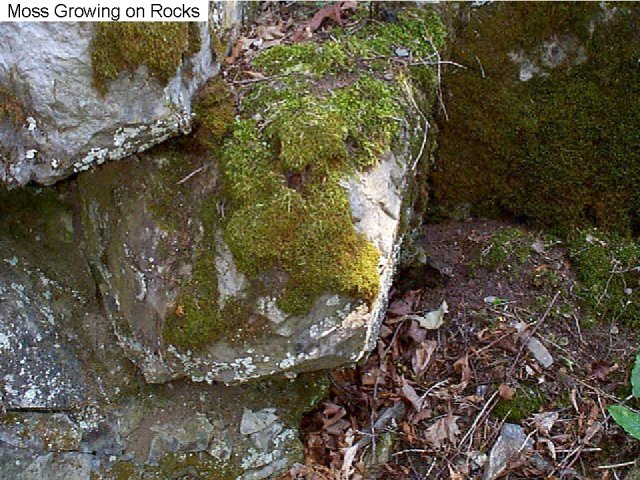
Figure \(\PageIndex{3}\): Moss growing on a rock. - Obtain live sporulating moss (if available) and identify the sporophyte and gametophyte generations.
- Is the green “leaf-like” tissue the gametophyte or sporophyte?
- Is the stalk that emerges from the green “leaf-like” tissue the gametophyte or sporophyte?
-
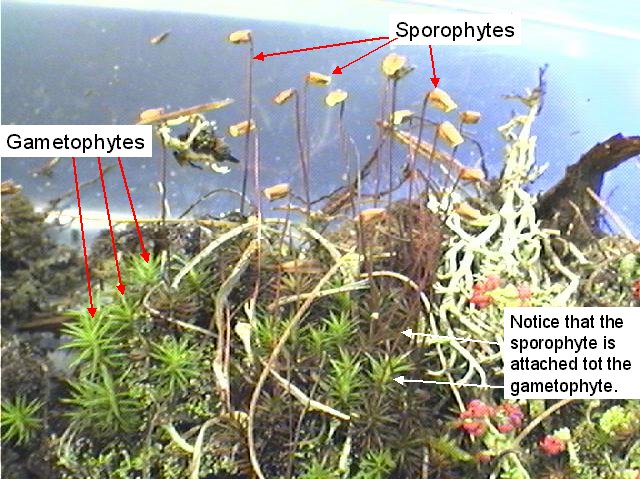 Figure \(\PageIndex{4}\): Moss gametophytes and sporophytes
 - Draw the life cycle of a typical bryophyte such as moss. Your drawing should contain the following terms:
- 2N (Diploid)
- N (Haploid)
- Sporophyte
- Sporangium
- Meiosis
- Spores
- Gametophyte
- Antheridium
- Sperm
- Archegonium
- Egg
- Fertilization
4. Is the archegonium male or female?
5. What cell is produced in the archegonium?
6. Is this cell haploid or diploid?
7. Is the antheridium male or female?
8. What cell is produced in the antheridium?
9. Is this cell haploid or diploid?
10. Observe a slide showing the antheridial head of a moss. Begin using the scanning (4X) objective and then switch to the low-power objective (10X).
11. What is produced in this structure (the antheridium)?
12. Show where the antheridium occurs on the live moss plant. Indicate where this structure occurs in the life cycle diagram that you prepared (above).
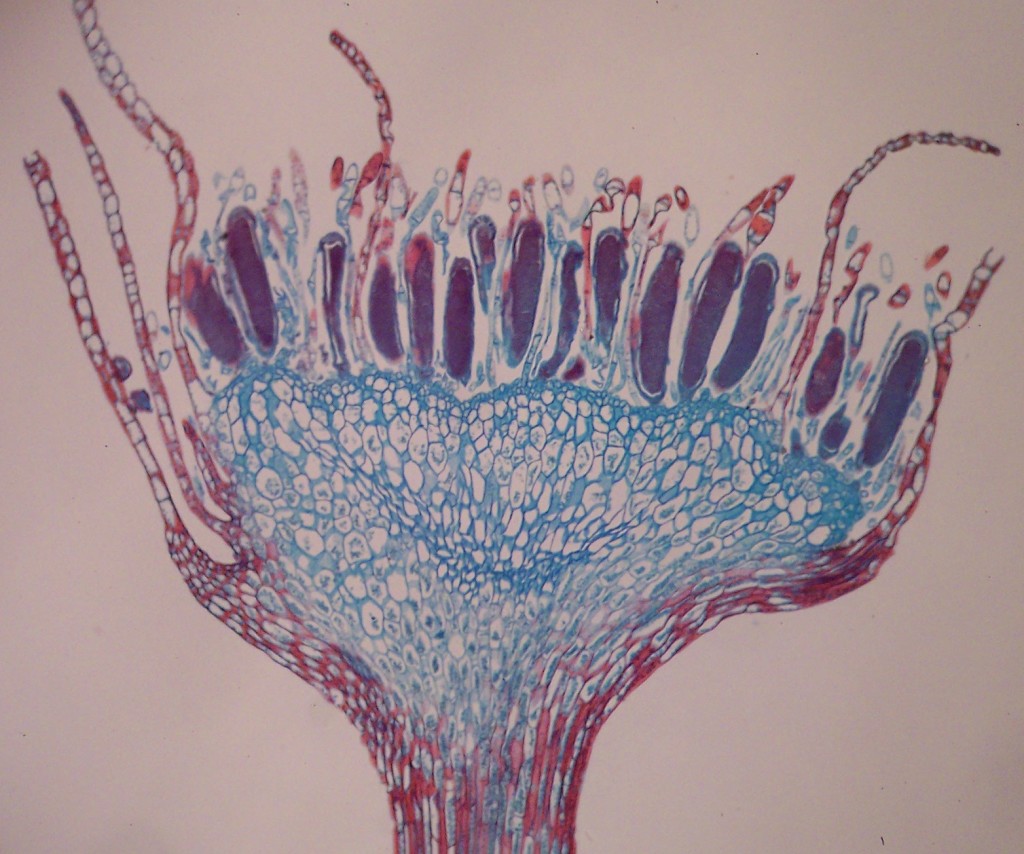
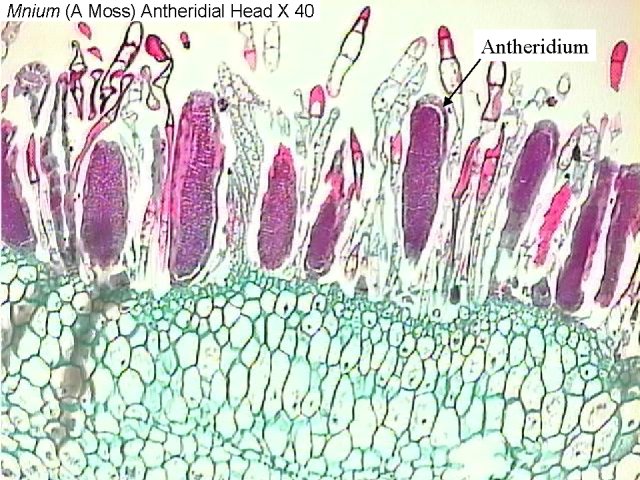
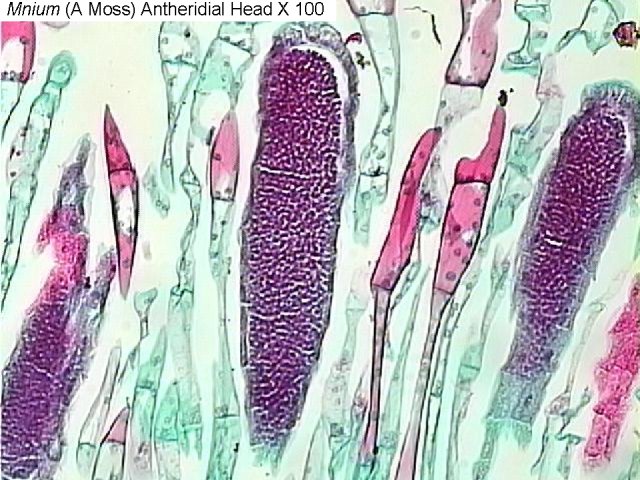
13. Observe a slide showing the archegonial head of a moss. Begin using the scanning (4X) objective and then switch to the low-power objective (10X).
14. What is produced in the archegonium?
15. Show where the archegonium occurs on the live moss plant. Indicate where this structure occurs in the life cycle diagram that you prepared (above).
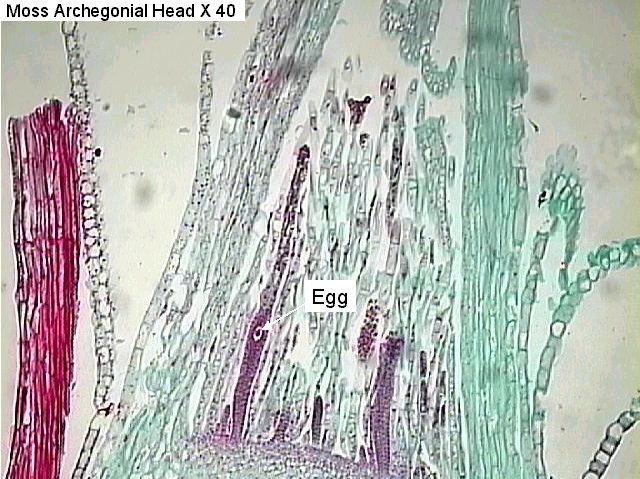
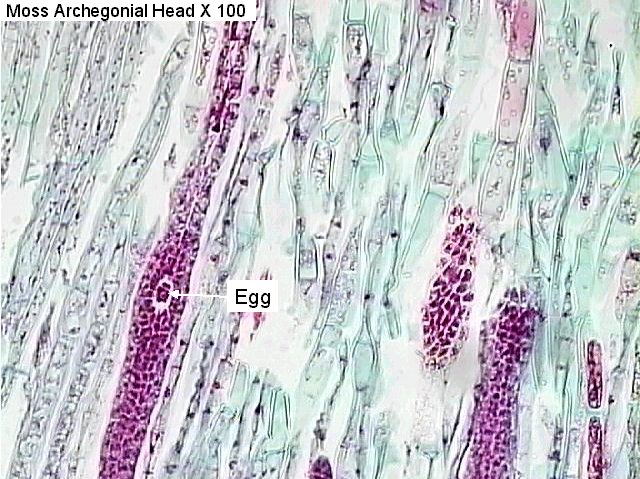
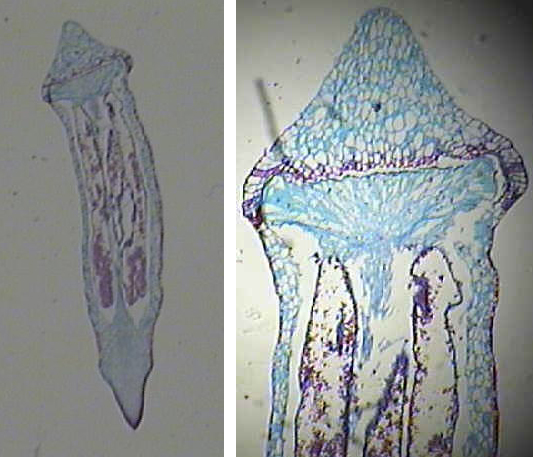
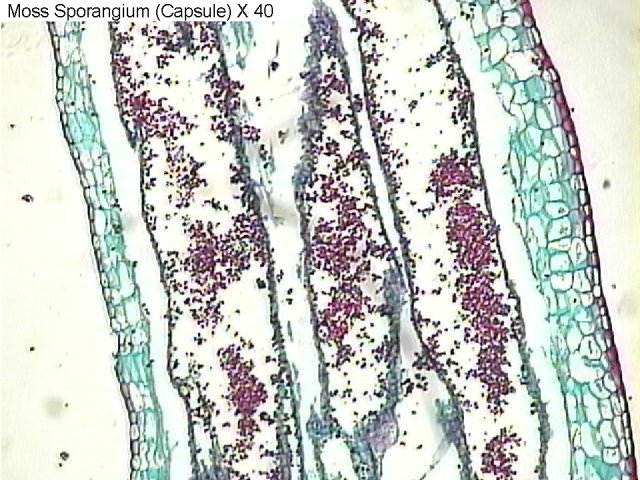
16. After the egg is fertilized, it grows and produces a sporophyte. A capsule containing a sporangium is found at the tip of the mature sporophyte. Refer back to Figure 2 on the previous page to view a sporophyte.
17. What is produced within the sporangium?
18. Be sure that you can identify the sporophyte and the sporangium on the live moss plant. Indicate where these structures occur in the life cycle diagram that you prepared (above).
19. How are moss spores dispersed to new locations?
Phylum: Lycophyta
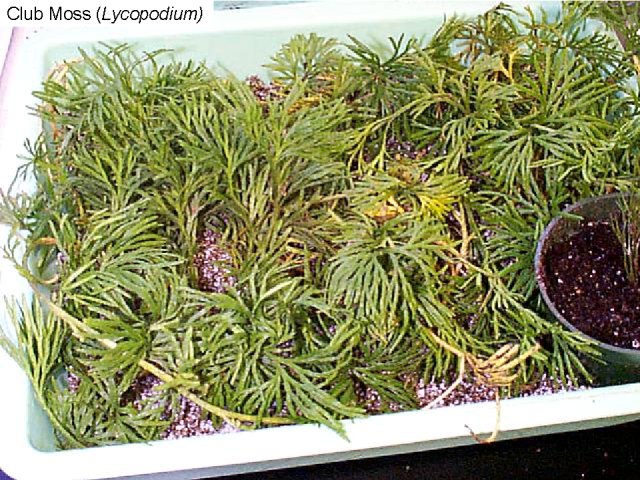
Members of this phylum have horizontal stems, upright stems, and small, spike-shaped leaves called microphylls.
Club Mosses
Observe a specimen of live club mosses such as Lycopodium. Find rhizomes. Identify microphylls. Do the specimens have any strobili? (Be sure to look up these words if you do not understand them.)
Spike Mosses
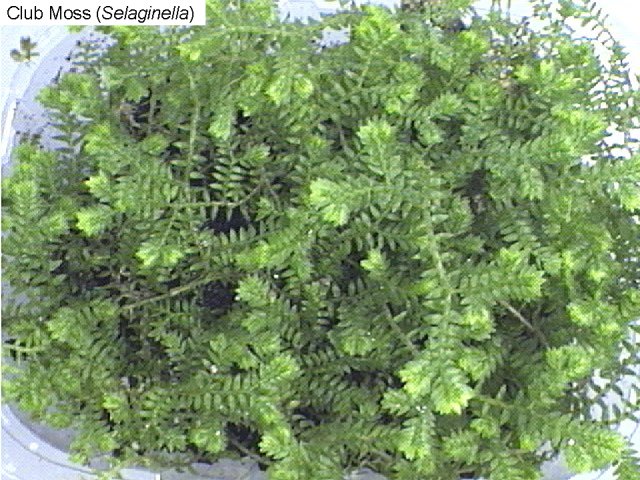
Observe a specimen of a spike moss such as Selaginella. Note the structure of the microphylls.
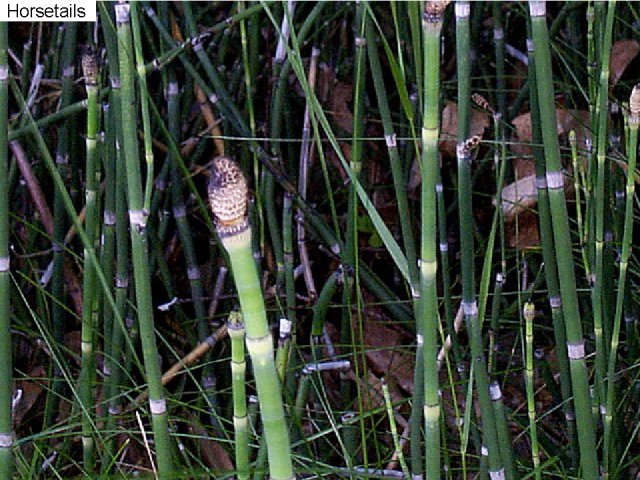
Horsetails
Observe a live horsetail if available. Find the a strobilus. What reproductive structures are contained within the strobilus?
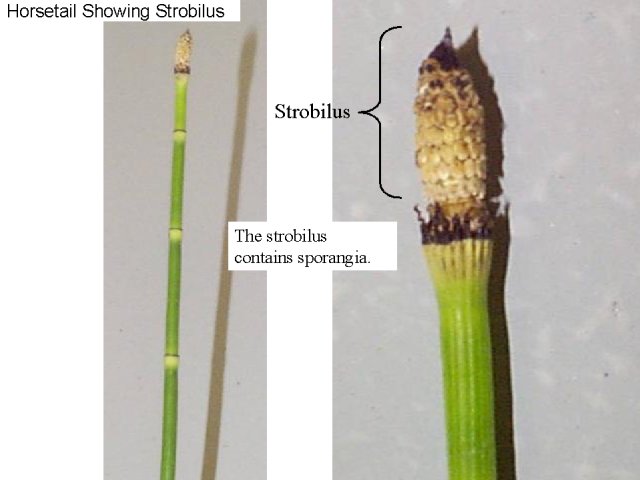
1. Observe the lycophyte slides provided to you. Begin using the scanning (4X) objective and then switch to the low-power objective (10X).
The life cycles of lycophytes are very similar to that of bryophytes.
Phylum: Pterophyta (Ferns)
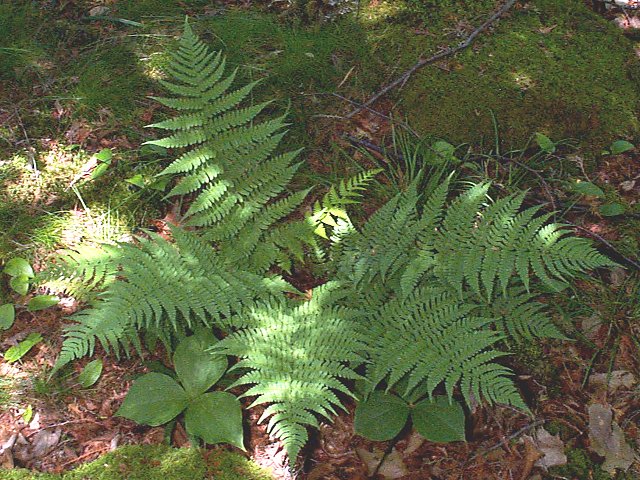
- Draw the life cycle of a fern. Your drawing should contain the following terms:
- 2N (Diploid)
- N (Haploid)
- Sporophyte
- Sorus
- Sporangium
- Meiosis
- Spores
- Gametophyte
- Antheridium
- Sperm
- Archegonium
- Egg
- Fertilization
2. Observe sori on the underside of a fern leaf. Are sporangia visible? Indicate where this structure occurs in the life cycle diagram that you prepared (above).
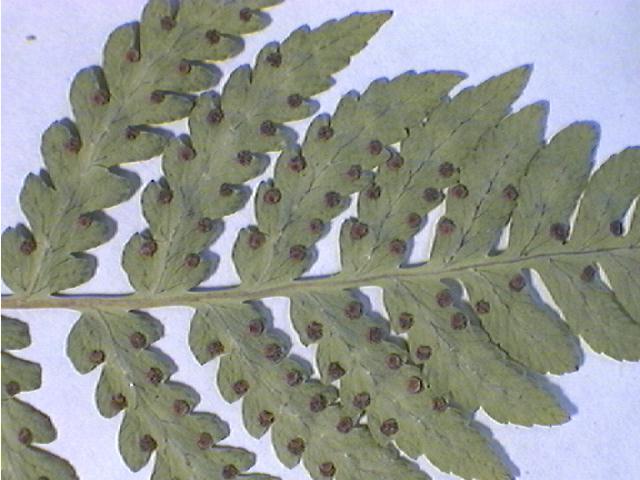
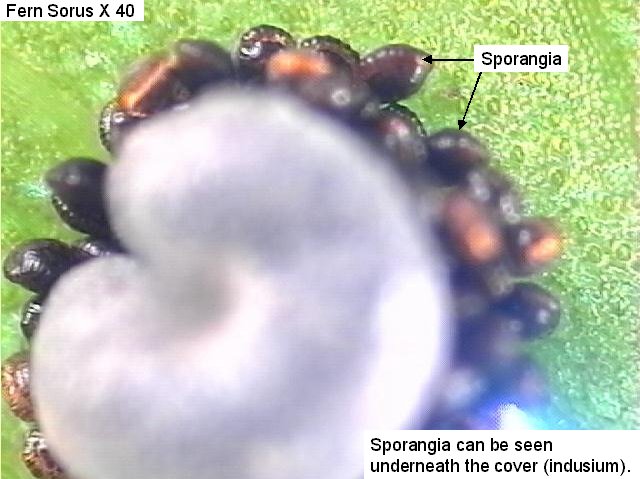
3. Is the frond sporophyte or gametophyte?
4. What cell is produced in the sori?
5. Is this cell diploid or haploid?
6. View a slide of a fern gametophyte showing antheridia. What reproductive cells are produced by gametophytes? Indicate where the gametophyte occurs in the life cycle diagram that you prepared.
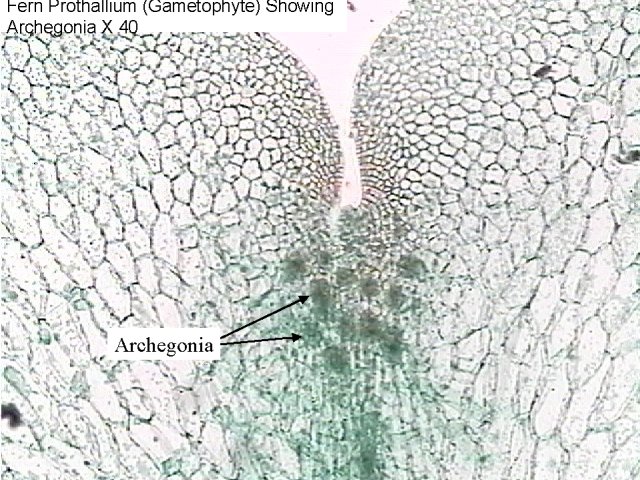
7. View the display that includes the fern prothallus.
8. What shape is the prothallus?
9. Is the prothallus part of the sporophyte or gametophyte generation?
10. What reproductive structures are present on the prothallus?
11. What cells are made in the archegonium?
12. What cells are made in the antheridium?
- Is gametophyte tissue haploid or diploid?
- Is sporophyte tissue haploid or diploid?
- Is the moss life cycle gametophyte or sporophyte dominant?
- Is the lycophyte life cycle gametophyte or sporophyte dominant?
- Is the fern life cycle gametophyte or sporophyte dominant?
- In the life cycle of plants, the process of meiosis produces what type of cell?
- Does the gametophyte or sporophyte generation produce spores?
- Which type of cell division is used to produce gametes in plants? How is this different than animals/humans?
- State one reason why bryophytes, lycophytes, and ferns are considered primitive plants.
- What is meant by the idea of “alteration of generations?”
Contributors and Attributions
- Seedless Plants (Kingdom: Plantae), Biology 102. Authored by: Michael J. Gregory, Ph.D.. Provided by: LibreTexts. Located at: bio.libretexts.org/Under_Construction/BioStuff/BIO_102/Laboratory_Exercises/Seedless_Plants. Project: The Biology Web. License: CC BY-NC-SA: Attribution-NonCommercial-ShareAlike