

1.2: The Process of Science
- Page ID
- 81302

\( \newcommand{\vecs}[1]{\overset { \scriptstyle \rightharpoonup} {\mathbf{#1}} } \)
\( \newcommand{\vecd}[1]{\overset{-\!-\!\rightharpoonup}{\vphantom{a}\smash {#1}}} \)
\( \newcommand{\dsum}{\displaystyle\sum\limits} \)
\( \newcommand{\dint}{\displaystyle\int\limits} \)
\( \newcommand{\dlim}{\displaystyle\lim\limits} \)
\( \newcommand{\id}{\mathrm{id}}\) \( \newcommand{\Span}{\mathrm{span}}\)
( \newcommand{\kernel}{\mathrm{null}\,}\) \( \newcommand{\range}{\mathrm{range}\,}\)
\( \newcommand{\RealPart}{\mathrm{Re}}\) \( \newcommand{\ImaginaryPart}{\mathrm{Im}}\)
\( \newcommand{\Argument}{\mathrm{Arg}}\) \( \newcommand{\norm}[1]{\| #1 \|}\)
\( \newcommand{\inner}[2]{\langle #1, #2 \rangle}\)
\( \newcommand{\Span}{\mathrm{span}}\)
\( \newcommand{\id}{\mathrm{id}}\)
\( \newcommand{\Span}{\mathrm{span}}\)
\( \newcommand{\kernel}{\mathrm{null}\,}\)
\( \newcommand{\range}{\mathrm{range}\,}\)
\( \newcommand{\RealPart}{\mathrm{Re}}\)
\( \newcommand{\ImaginaryPart}{\mathrm{Im}}\)
\( \newcommand{\Argument}{\mathrm{Arg}}\)
\( \newcommand{\norm}[1]{\| #1 \|}\)
\( \newcommand{\inner}[2]{\langle #1, #2 \rangle}\)
\( \newcommand{\Span}{\mathrm{span}}\) \( \newcommand{\AA}{\unicode[.8,0]{x212B}}\)
\( \newcommand{\vectorA}[1]{\vec{#1}} % arrow\)
\( \newcommand{\vectorAt}[1]{\vec{\text{#1}}} % arrow\)
\( \newcommand{\vectorB}[1]{\overset { \scriptstyle \rightharpoonup} {\mathbf{#1}} } \)
\( \newcommand{\vectorC}[1]{\textbf{#1}} \)
\( \newcommand{\vectorD}[1]{\overrightarrow{#1}} \)
\( \newcommand{\vectorDt}[1]{\overrightarrow{\text{#1}}} \)
\( \newcommand{\vectE}[1]{\overset{-\!-\!\rightharpoonup}{\vphantom{a}\smash{\mathbf {#1}}}} \)
\( \newcommand{\vecs}[1]{\overset { \scriptstyle \rightharpoonup} {\mathbf{#1}} } \)
\(\newcommand{\longvect}{\overrightarrow}\)
\( \newcommand{\vecd}[1]{\overset{-\!-\!\rightharpoonup}{\vphantom{a}\smash {#1}}} \)
\(\newcommand{\ket}[1]{\left| #1 \right>}\)
\(\newcommand{\bra}[1]{\left< #1 \right|}\)
\(\newcommand{\braket}[2]{\left< #1 \vphantom{#2} \right| \left. #2 \vphantom{#1} \right>}\)
\(\newcommand{\braopket}[3]{\left< #1 \vphantom{#2}\vphantom{#3} \right| #2 \vphantom{#1}\vphantom{#3} \left| #3 \vphantom{#1}\vphantom{#2} \right>}\)
\(\newcommand{\qmvec}[1]{\mathbf{\vec{#1}}}\)
\(\newcommand{\op}[1]{\hat{\mathbf{#1}}}\)
\(\newcommand{\expect}[1]{\langle #1 \rangle}\)
\(\newcommand{\dfn}[1]{\emph{\textbf{#1}}}\)
The Process of Science
Environmental science is a science, but what exactly is "science"? What does the study of environmental science share with other scientific disciplines?
- Science (from the Latin scientia, meaning “knowledge”) is a process that uses evidence, logic, and creativity to discover and explain natural and physical phenomena while avoiding bias.
- The process of science (otherwise known as the "scientific method") is a systematic approach to research that consists of distinct steps that include asking questions, conducting experiments, and making careful observations.
Although using the scientific method is inherent to science, it is inadequate in determining what science is. Science can be thought of as a variety of fields of study that seek to understand the physical and natural underpinnings of the universe (including the Earth).
The process of science will be explored later, but one of its most important aspects is testing ideas through repeatable experiments, which may eventually lead to a theory.
- A hypothesis is a proposed explanation for an event that can be tested. A hypothesis can evolve into a theory over time as evidence accumulates.
- A theory is a well-tested and confirmed explanation for observations or phenomena.
- A scientific law is a statement that describes what always happens under certain conditions in nature (e.g., the law of gravity).
National Resources Defense Council scientists share how their discipline works, what they love about it, and the wonder about our world it provides. (2 min)
Nature is Understandable
Scientists view nature as a unified system governed by natural laws. By discovering natural laws, scientists strive to increase their understanding of the natural world.
Scientific Ideas are Open to Change
Science is a process rather than a set body of knowledge. Scientists constantly test and revise their ideas. As new observations are made, existing ideas may be challenged. New ideas that better fit the evidence replace older ideas, but more often, existing ideas are simply revised. Through numerous new discoveries over time, scientists have gradually built an increasingly accurate and detailed understanding of the natural world.
For example, when genes were discovered, scientists did not discard older ideas of how traits were inherited. The new discoveries helped explain why inheritance laws applied to certain traits but not others. They widened the view of genetics.
Occasionally, scientific ideas change radically. Radical changes in scientific ideas are known as paradigm shifts(Kuhn, 1962). From time to time, a scientific revolution occurs in which current theories are abandoned, and completely new ideas take their place. These do not happen often, but evolutionary theory is widely accepted as a prime example in biology.
Before Charles Darwin's 1860s publication of his theory of evolution, most scientists believed a god had created life and that life on Earth had not changed since their creation. However, using substantial evidence and logical arguments, Darwin demonstrated that species can change over time and that new species can evolve from pre-existing species. This was such a radical shift in scientific thinking that Darwin was reluctant to publish his ideas, fearing a backlash from other scientists and the public. Although Darwin was initially ridiculed for his theory, it became widely accepted over time in the scientific community and among much of the public, and is now a cornerstone of the life sciences.
Scientific Knowledge May Be Long Lasting
Many scientific ideas have withstood the test of time. For example, about 200 years ago, John Dalton proposed the atomic theory: that all matter is made of tiny particles called atoms. This theory is still valid.
Over the past two centuries, much more has been learned about atoms, and the even smaller particles that comprise them, but the underlying idea that all matter consists of atoms remains.
There are numerous other examples of fundamental scientific ideas that have been repeatedly tested and found to be sound.
Natural Sciences
What would you expect to see in a museum of natural sciences? Frogs? Plants? Dinosaur skeletons? Exhibits about how the brain functions? A planetarium? Gems and minerals? Or, maybe all of the above? Science includes such diverse fields as astronomy, biology, environmental science, computer science, geology, logic, physics, chemistry, and mathematics.
However, the natural sciences are those that study the physical/living world and its phenomena and processes. Thus, a natural sciences museum might contain any of the items listed above.
For some experts, the natural sciences are astronomy, biology, chemistry, earth science, and physics. Other scholars divide the natural sciences into life sciences, which study living things and include biology, and physical sciences, which study nonliving matter and include astronomy, geology, physics, and chemistry. Some disciplines, such as environmental science, biophysics, and biochemistry, draw on both life and physical sciences, making them interdisciplinary.
Not surprisingly, the natural science of environmental science has many branches or subdisciplines. Environmental toxicologists study the impacts of various compounds on humans and the environment, while climate scientists investigate patterns in temperature and rainfall across large areas and over long periods. Even within a particular field, there is specialization; hydrologists may study surface water and/or groundwater patterns, engage in flood mitigation, or assist with water-use planning. Some areas of environmental science focus on studying non-living aspects of the environment, while others investigate the impacts of the environment on living organisms.
An example of the complexity of understanding the environmental implications of using something as simple as a plastic water bottle. (~4 min)
Question after watching: How many different areas of research can you identify in the video that could be used to find solutions to the problem of single-use plastics?
Brief History of Natural Science
Although the modern process of science is a relatively recent development, natural phenomena have been studied since ancient times. Evidence of "natural philosophy" can be found in the ancient civilizations of Mesopotamia, Egypt, the Indian subcontinent, and China. The origins of modern science and its approach to studying nature are most often traced back to ancient Greece. Although the idea of science is quite old, it was first formally documented by England’s Sir Francis Bacon (1561–1626), who developed the first systematic methodology for scientific inquiry.
The scientific process is not used exclusively by environmental scientists; it can be applied to almost all fields of study as a logical, rational problem-solving approach. Finer natural history studies and advances in satellites and other large-scale measurements have also had a profound impact on environmental scientists' thinking.
Scientific Reasoning
One thing is common to all forms of science: an ultimate goal “to know.” Curiosity and inquiry are the driving forces of science.
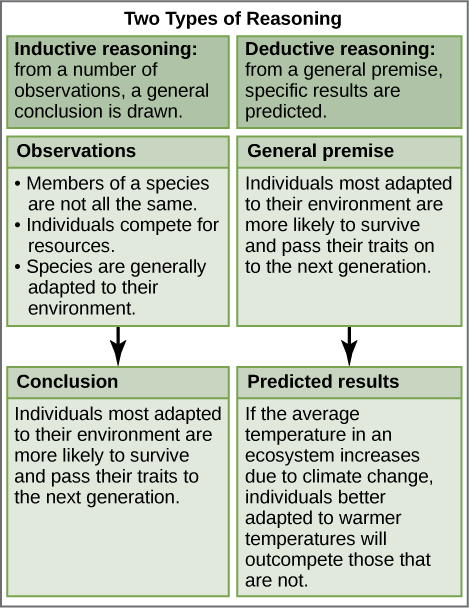
Scientists strive to comprehend the world and its workings. To do this, they use two methods of logical thinking: inductive reasoning and deductive reasoning (Figure \(\PageIndex{1}\)).
- Inductive reasoning (induction): a form of logical thinking that uses related observations to arrive at a general conclusion common in descriptive science.
- In induction, a scientist makes observations and records data. The raw data is supplemented with drawings, pictures, photos, or videos. From numerous observations, scientists can infer conclusions (inductions) based on the evidence. Inductive reasoning involves making generalizations from careful observations and analysis of large amounts of data.
- Brain studies provide an example. In this type of research, many participants' brains are observed while they perform a specific activity, such as viewing images of food. The part of the brain that “lights up” during this activity is predicted to be the part controlling the selected stimulus response (e.g., images of food). Then, researchers stimulate that part of the brain to see if similar responses result.
- Deductive reasoning (deduction): a type of logic used in hypothesis-based science where the pattern of thinking moves in the opposite direction of induction.
- In deduction, a general principle or law is used to forecast specific results using logic. From these general principles, a scientist can extrapolate and predict specific results that remain valid as long as the general principles remain valid.
- Climate change studies are an example. Climate scientists may predict that if the climate in a particular region warms, the distribution of plants and animals should change. These predictions have been made and tested, and numerous changes have been identified over the last 40 years, including modifications to agricultural areas for agriculture, in response to rising average temperatures.
Inductive and deductive reasoning are often used in tandem to advance scientific knowledge.
Many students confuse deductive reasoning with inductive reasoning, and vice versa. Learn the difference! (~3 min)
Question after watching: Identify where you applied deductive and inductive reasoning. Describe why they are instances of inductive and deductive reasoning.
Decide if each of the following is an example of inductive or deductive reasoning.
- All flying birds and insects have wings. Birds and insects flap their wings as they move through the air. Therefore, wings enable flight.
- Insects generally survive mild winters better than harsh ones. Therefore, insect pests will become increasingly problematic if global temperatures continue to rise.
- Chromosomes, the carriers of DNA, separate into daughter cells during cell division. Therefore, DNA is the genetic material.
- Animals as diverse as humans, insects, and wolves all exhibit social behavior. Therefore, social behavior must have an evolutionary advantage.
- Answer
-
1: inductive; 2: deductive; 3: deductive; 4: inductive.
Descriptive versus Hypothesis-Based Science
Both induction and deduction are related to the two main paths of scientific study: descriptive science and hypothesis-based science.
- Descriptive science (discovery science): usually inductive, aims to observe, explore, and discover.
- Hypothesis-based science: usually deductive, begins with a specific question or problem and a potential answer or solution that can be tested. Hypotheses are based on general premises.
Descriptive sciences and hypothesis-based sciences are often blurred; most science incorporates elements of both.
For example, in the 1940s, a man observed that burrs that stuck to his clothes and his dog’s fur had tiny hooked structures which gripped more reliably than a zipper. He invented the hook-and-loop fastener, now known as Velcro, and founded a company.
In this example, descriptive science and hypothesis-based science were used together to make discoveries and answer questions.
Explore how medical scientists work to answer scientific questions and the complications in building studies that involve humans. (~5 min)
Questions after watching: What are the important things to consider for these scientists?
From the United Nations Educational, Scientific and Cultural Organization (UNESCO):
"Science is the greatest collective endeavor. It contributes to ensuring a longer and healthier life, monitors our health, provides medicine to cure our diseases, alleviates aches and pains, helps us to provide water for our basic needs – including our food, provides energy and makes life more fun, including sports, music, entertainment and the latest communication technology. Last but not least, it nourishes our spirit.
Science generates solutions for everyday life and helps us to answer the great mysteries of the universe. In other words, science is one of the most important channels of knowledge. It has a specific role and a variety of functions that benefit our society: creating new knowledge, improving education, and enhancing the quality of our lives.
Science must respond to societal needs and global challenges. Public understanding and engagement with science, and citizen participation, including through the popularization of science, are essential to equip citizens to make informed personal and professional choices. Governments need to make decisions based on high-quality scientific information on issues such as health and agriculture, and parliaments need to legislate on societal issues that require the latest scientific knowledge. National governments need to understand the science behind major global challenges such as climate change, ocean health, biodiversity loss and freshwater security.
To face sustainable development challenges, governments and citizens alike must understand the language of science and must become scientifically literate. On the other hand, scientists must understand the problems policy-makers face and endeavor to make the results of their research relevant and comprehensible to society.
Challenges today cut across the traditional boundaries of disciplines and stretch across the lifecycle of innovation -- from research to knowledge development and its application. Science, technology and innovation must drive our pursuit of more equitable and sustainable development."(2021).
Conducting Science
Life and environmental scientists pose questions about nature and seek science-based responses. This process of science, common in other sciences, typically starts with an observation (often a problem to be solved) that leads to a question.
For example, a student arrives at class and quickly discovers that the classroom is too warm. That observation also describes a problem: the classroom is too warm. The student then asks, “Why is the classroom so warm?” This is a testable question.
The natural sciences often rely on quantitative (numerical) data, although some may also use qualitative (non-numerical) data to support their findings.
Learn about the 5 criteria that a testable question should meet in this 7.5-minute video.
Proposing a Hypothesis
Remember that a hypothesis is a testable explanation. Sometimes several hypotheses may be proposed for a particular question.
Using the example above, the hypotheses might be:
- “The classroom is warm because no one turned on the air conditioning.” or
- “The classroom is warm because there is a power failure, and so the air conditioning doesn’t work.”
After hypotheses have been determined, predictions can be made. Predictions are similar to hypotheses, but typically have the format “If . . . then . . . .” For example, the prediction for the first hypothesis might be, “If the student turns on the air conditioning, then the classroom will no longer be too warm.”
In this 7-minute video, learn the difference between a fact, a theory, a hypothesis, and a scientific law.
Question BEFORE and AFTER watching: How would you define hypothesis and theory?
Testing a Hypothesis
A valid hypothesis must be testable AND falsifiable, meaning that evidence can indicate it is false. Importantly, science does not claim to “prove” anything because our understanding of the natural world may be modified with further information. Openness to disproving ideas is what distinguishes sciences from non-sciences.
The presence of the supernatural, for instance, is neither testable nor falsifiable.
To test a hypothesis, a researcher will conduct one or more experiments designed to eliminate hypotheses and narrow down to the likeliest explanations. Each experiment will have one or more variables and one or more controls.
- Variable: any part of the experiment that can vary or change during the experiment.
- Control group: contains all the same conditions as the experimental group, EXCEPT for the variable being tested.
- Experimental group: the group being modified in the experiment. If the results for the experimental group differ from the control group, they must be due to the manipulation, rather than to outside factors.
Revisiting the Example Hypotheses
- The classroom is warm because no one turned on the air conditioning.
- The classroom is warm because there is a power failure, and so the air conditioning doesn’t work.
To test Hypothesis #1, the student would determine if the air conditioning is on. If the air conditioning is turned on but does not work, there should be another reason, and this hypothesis should be rejected.
To test Hypothesis #2, the student could check if the classroom lights are functional. If so, there is no power failure, and this hypothesis should be rejected.
Each hypothesis should be tested by carrying out appropriate experiments. Be aware that rejecting one hypothesis does not determine whether or not the other hypotheses can be accepted; it simply eliminates one invalid hypothesis. Hypotheses not supported by data are rejected in science.
Read the following questions (Q) and their associated hypothesis (H). Does the statement seem like it can be answered with the scientific process? In other words, is the hypothesis falsifiable (can be proven false)?
- (Q) Is macaroni and cheese tastier than broccoli soup? (H) Macaroni and cheese is not tastier than broccoli soup.
- (Q) Are hummingbirds attracted to the color red? (H) Hummingbirds are not attracted to the color red.
- (Q) Is the moon made out of green cheese? (H) The moon is made of green cheese.
- (Q) Is plagiarism dishonest? (H) Plagiarism is not dishonest.
- Hypotheses 1 and 2 are subjective and cannot be tested using the scientific method. Hypotheses 3 and 4 can be tested using the scientific method.
- Hypotheses 3 and 4 are subjective and cannot be tested using the scientific method. Hypotheses 1 and 2 can be tested using the scientific method.
- Hypotheses 1 and 3 are subjective and cannot be tested using the scientific method. Hypotheses 2 and 4 can be tested using the scientific method.
- Hypotheses 1 and 4 are subjective and cannot be tested using the scientific method. Hypotheses 2 and 3 can be tested using the scientific method.
- Answer
-
d.Hypotheses 1 and 4 are subjective and cannot be tested using the scientific method. Hypotheses 2 and 3 can be tested using the scientific method.
Drawing Conclusions
If a hypothesis appears to be supported by scientific evidence, does this mean that the hypothesis is true? No, not necessarily.
A hypothesis can never be proven conclusively true. Scientists can never examine all possible evidence, and someday evidence may be found that disproves the hypothesis. In addition, other future hypotheses may be supported by the same evidence.
Although a hypothesis cannot be proven true without a shadow of a doubt, the more evidence that supports a hypothesis, and the better the match between actual and expected observations, the more likely the hypothesis is to be correct. Scientists have statistical methods to measure these factors.
Many times, competing hypotheses are supported by evidence. How do scientists conclude which hypothesis is better? Several criteria can be used to evaluate competing hypotheses. Scientists are more likely to accept a hypothesis that:
- explains a wider variety of observations.
- explains observations that were previously unexplained.
- generates more expectations and is thus more testable.
- is more consistent with well-established theories.
- is more parsimonious, that is, it is a simpler and less convoluted explanation.
Communicating Results
The last step in a scientific investigation is communicating the results to other scientists. This is a crucial step because it enables other scientists to attempt to replicate the investigation and verify if they can obtain the same results. If other researchers get the same results, it adds support to the hypothesis. If they get different results, it may disprove the hypothesis. When scientists communicate their results, they should clearly describe their methods and highlight any potential issues or limitations with the investigation. This allows other researchers to identify any flaws in the method or consider ways to avoid potential problems in future studies.
Repeating a scientific investigation and reproducing the same results is called replication. It is a cornerstone of scientific research. Replication is not required for every scientific investigation, but it is highly recommended for those that yield surprising or particularly consequential results. In some scientific fields, scientists routinely attempt to replicate their own investigations to ensure the reproducibility of their results before communicating them.
Scientists can communicate their results in various ways. The most rigorous approach is to write up the investigation and results as an article and submit it to a peer-reviewed scientific journal for publication. The journal's editor provides copies of the article to several other scientists working in the same field. These are the peers in the peer-review process. The reviewers study the article and inform the editor whether they believe it should be published, based on the validity of the methods and the significance of the study. The article may be rejected outright or accepted, either as is or with revisions. Only articles that meet high scientific standards are ultimately published.
In the example above, the scientific method is employed to solve a common everyday problem. Order the scientific method steps (numbered items) with the process of solving the everyday problem (lettered items). Based on the experiment's results, is the hypothesis correct? If it is incorrect, propose some alternative hypotheses.
- Observation
- Question
- Hypothesis (answer)
- Prediction
- Experiment
- Result
- There is something wrong with the electrical outlet.
- If something is wrong with the outlet, my coffeemaker also won’t work when plugged into it.
- My toaster doesn’t toast my bread.
- I plug my coffee maker into the outlet.
- My coffeemaker works.
- Why doesn’t my toaster work?
- Answer
-
1: C; 2: F; 3: A; 4: B; 5: D; 6: E. The original hypothesis is incorrect, as the coffeemaker works when plugged into the outlet. Alternative hypotheses include that the toaster is broken or that it wasn't turned on.
Basic and Applied Science
Is it valuable to pursue science for the sake of simply gaining knowledge, or does scientific knowledge only have worth if we can apply it to solving a specific problem or bettering our lives? This question focuses on the differences between two types of science: basic science and applied science.
Basic science or “pure” science seeks to expand knowledge regardless of the short-term application of that knowledge. It is not focused on developing a product or a service of immediate public or commercial value. The immediate goal of basic science is knowledge for knowledge’s sake, though this does not mean that in the end it may not result in an application.
In contrast, applied science aims to use science to solve real-world problems, such as improving crop yield, finding a cure for a particular disease, or saving animals threatened by a natural disaster. In applied science, the problem is usually defined for the researcher.
Some individuals may perceive applied science as “useful” and basic science as “useless.” A question these people might pose to a scientist advocating knowledge acquisition would be, “What for?” A careful look at the history of science, however, reveals that basic knowledge has resulted in many remarkable applications of great value. Many scientists think that a basic understanding of science is necessary before an application is developed; therefore, applied science relies on the results generated through basic science. Other scientists think it is time to move on from basic science and instead focus on solving real problems. Both approaches are valid. It is true that there are problems that demand immediate attention; however, few solutions would be found without the knowledge generated by basic science.
One example of how basic and applied science can work together to solve practical problems occurred after the discovery of DNA structure led to an understanding of the molecular mechanisms governing DNA replication. Strands of DNA, unique to each person, are found in our cells, where they provide the instructions necessary for life. During DNA replication, new copies of DNA are made shortly before a cell divides to form new cells. Understanding the mechanisms of DNA replication (through basic science) enabled scientists to develop laboratory techniques that are now used to identify genetic diseases, pinpoint individuals who were at a crime scene, and determine paternity (all examples of applied science). Without basic science, it is unlikely that applied science would exist.
Another example of the link between basic and applied research is the Human Genome Project, a study in which each human chromosome was analyzed and mapped to determine the precise sequence of the DNA code and the exact location of each gene. (The gene is the basic unit of heredity; an individual’s complete collection of genes is his or her genome.) Other organisms have also been studied as part of this project to better understand human chromosomes. The Human Genome Project relied on basic research conducted with non-human organisms and, later, on research conducted on the human genome. An important end goal eventually became using the data for applied research aimed at developing cures for genetic diseases.
Scientific research is often reported in the popular media, and that is how most people learn about new scientific findings. Informing the public about scientific research is a valuable media service, but the types of scientific investigations that are reported may lead to a distorted public perception of what science is and how reliable its results are. Why? There are actually two types of science, often referred to as consensus science and frontier science. The latter type of science is usually the one that makes the news, but the media generally do not distinguish between the two. Therefore, many people may infer that what they read about frontier science is typical of all science.
- Consensus science refers to scientific ideas that have been researched for a long period of time and for which a great deal of evidence has accumulated. This type of research typically aligns well with current scientific paradigms. A notable example of consensus science is the science of global climate change. Data showing the impact of increasing levels of atmospheric carbon dioxide, due to human activities, on global warming have been accumulating for many decades. Today, virtually all climate scientists agree that global warming is occurring and that human actions are largely responsible for it. However, the few scientists — and many politicians — who disagree with the consensus view receive greater media attention because the consensus view is considered "old" news. The findings have been accumulating for years, and new research in the area continues to yield similar results.
- Frontier science, in contrast, refers to scientific ideas that are relatively new and have not yet been supported by years of scientific evidence. Frontier research occurs at the forefront of knowledge in a specific field. A good example of frontier science is research into the presumed link between dietary cholesterol and blood cholesterol levels. The consensus view for many years was that a diet high in cholesterol increases blood levels of cholesterol, which may lead, in turn, to cardiovascular disease. Recent research challenging the accepted view found that genes play a greater role than diet in determining blood cholesterol levels and the risk of cardiovascular disease.
The media tend to focus on frontier science because it is exciting, may seem controversial, and could lead to major new scientific breakthroughs. With more research, ideas in frontier science may be supported by more evidence, gain wider acceptance, and become consensus science. In some cases, frontier science that contradicts a current paradigm may even lead to a paradigm shift.
However, the opposite may happen instead. Additional research may undermine the initial findings of frontier research, leading to the rejection of new and exciting ideas. Unfortunately, when frontier science is later shown to be mistaken, people may infer that all science, including consensus science, is unreliable.
Not All Current Questions Can be Answered by Science
Science rests on evidence and logic, and evidence comes from observations. Therefore, science deals only with things that can be observed. An observation is anything detected by the human senses or with instruments and measuring devices that extend human senses. Things that cannot be observed or measured by current means or technology — such as supernatural beings or events — are the human senses or by instruments and measuring devices that extend them:
- Did life on Earth evolve over time?
- Was life on Earth created by a supernatural deity?
The first question can be answered by science, based on evidence such as fossils, molecular clocks, geological evidence, and more.
The second question could be a matter of belief, but no evidence can be gathered to support or refute it. Therefore, it is outside the realm of science.